



India needs hundreds of chip companies to build a global ecosystem, says L&T Semiconductor CEO
India has strengths in digital compute, analogue and RF technologies, but needs to deepen capabilities in system architecture, memory, optics, high-power chips and manufacturing, said Sandeep Kumar, CEO of L&T Semiconductor Technologies.

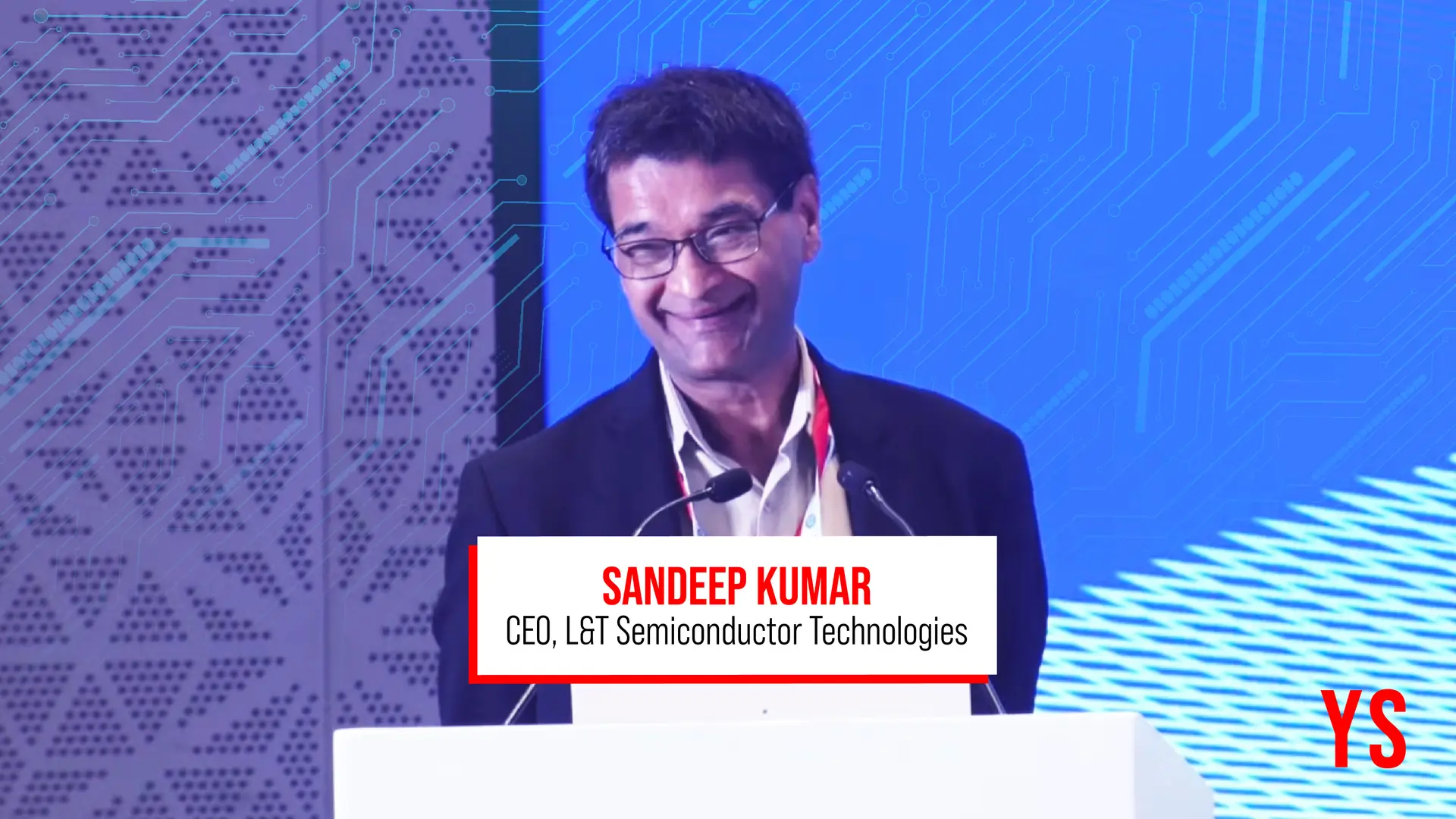

India will require hundreds of domestic semiconductor companies to build a globally competitive chip industry, according to Sandeep Kumar, CEO of L&T Semiconductor Technologies.
Speaking at Semicon 2026 India, Kumar said the breadth of the global semiconductor market makes it impossible for any single company to address all product categories.
“There are more than 20,000 semiconductor products. No single company can make that many products. No single company can even make 2,000 products,” he said. “This journey requires hundreds of companies to be created.”
Kumar said the emergence of more domestic chip companies should therefore be viewed as necessary ecosystem building rather than simply as competition.
“At the end of the day, the market is so big,” he said, adding that part of L&T Semiconductor’s effort is to help build the broader semiconductor ecosystem in India.
Where India needs to build depth
Kumar said India already has strong capabilities in digital and compute technologies as well as analogue and mixed-signal design, while its expertise in radio frequency technologies is reasonably developed.
But significant gaps remain in high-power semiconductors, memory and optics.
“High power, memory and optics, I would say, are very weak,” he said, referring to India’s design and architecture capabilities in these areas.
Kumar identified system architecture as another major gap. Unlike chip architecture, system architecture starts with understanding customer requirements, markets and the problems a product needs to solve.
“The first macro gap, in my knowledge, is system architecture, not chip architecture,” he said.
Kumar said much of this expertise comes from direct exposure to customers and markets, an area where Indian semiconductor engineers have historically had fewer opportunities because many large end customers are based outside the country.
India also needs greater experience in taking chips from design into manufacturing, running semiconductor supply chains and working directly with fabrication plants, he added.
Architecture becoming the differentiator
Kumar said competition in the semiconductor industry is increasingly being shaped by system-level architecture.
“The big difference this time around from the previous ones is now this boom on the semiconductor side is led by architecture,” he said.
As individual chips reach physical manufacturing limits, technologies such as chiplets and advanced packaging are becoming increasingly important. AI workloads are also driving demand for faster interconnects, co-packaged optics and more efficient power delivery.
“How innovative your architecture is, how creative you are, how do you put it together? That is defining the winners versus the others,” Kumar said.
High margins, but high reinvestment
Kumar also highlighted the economics of the semiconductor business, where high gross margins come with significant reinvestment requirements.
“The good thing in the chip business is, unlike other businesses, you can make 50, 60, 70% gross margin,” he said.
But a substantial portion of those earnings has to be put back into developing the next generation of products.
“There’s a lot of money you can make on the product, but then you have to pour that money back into developing the next product,” Kumar said.
Chipmakers, therefore, have to continuously innovate as existing products are replaced by newer technologies, he added.
L&T Semiconductor’s growing product portfolio
L&T Semiconductor Technologies is itself expanding across several of the areas Kumar highlighted. The fabless chip company has reportedly designed and begun shipping more than 40 products over the past 18 months to 15-20 customers, spanning power modules, communications, power conversion and compute.
The company is targeting sectors including energy, industrial applications, mobility, data centres and AI.
It has also been building capabilities through acquisitions and partnerships. L&T Semiconductor acquired power-module design assets from Fujitsu General Electronics, including intellectual property, design patents and packaging expertise. It has partnered with Hon Young Semiconductor on silicon-carbide wafer development and with Andes Technology on RISC-V processor platforms.
More recently, it signed a partnership with Taiwan-based Azuremoto Technologies covering silicon-carbide power devices for AI data centres as well as rectifiers and MOS-based power products, and entered a multiyear agreement with Synopsys to strengthen power-electronics design and simulation capabilities.
A 20-year journey
Kumar described India’s semiconductor ambitions as a long-term effort rather than something that can be built in a few years.
“It’s not something that we can do in one year, two years. It’s a 20-year journey,” he said.
While India has begun creating the ecosystem, the next stage will involve building technology depth and developing products that can compete globally.
“Differentiated doesn’t mean different,” Kumar said. “Differentiated means it’s different and better than what exists.”
For India, he said, the goal should ultimately be to create semiconductor products that are not merely designed or made locally, but are competitive with the best alternatives in global markets.