



India wants 1 lakh chip engineers: MeitY Secretary S Krishnan on what students must learn to be ready
With three plants in production and Rs 1.27 lakh crore cleared for phase two, the MeitY Secretary tells YourStory what the first phase got right

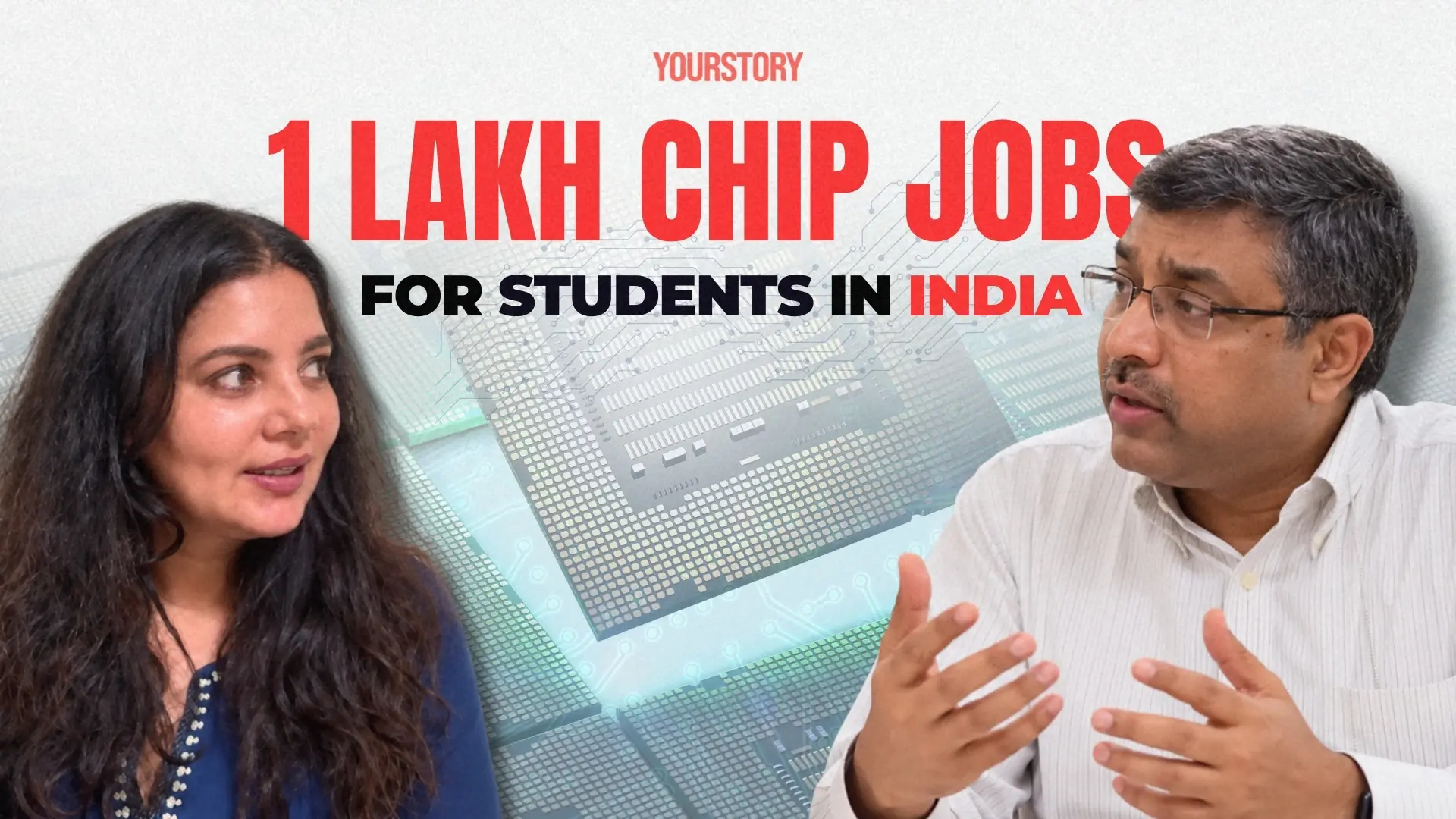

As Semicon India 2026 opens in New Delhi, Ministry of Electronics and Information Technology (MeitY) Secretary S Krishnan has set out why the India Semiconductor Mission (ISM) delivered operational factories within four years of launch, when many national programmes struggle to move past the announcement stage. Speaking to YourStory Founder and CEO Shradha Sharma on 16 September 2026, Krishnan said three plants approved under the first phase are already in commercial production, with two or three more expected to come online before the end of the year. The account matters because the second phase of the mission, cleared by the Union Cabinet in July, will now test whether the same approach can work across a far wider set of activities.
The ISM was approved in December 2021 with an outlay of Rs 76,000 crore to seed chip fabrication and packaging in a country that had no commercial semiconductor manufacturing. By the time the first phase closed, the government had approved 12 projects with a cumulative investment of over Rs 1.64 lakh crore. Micron's assembly, test and packaging unit at Sanand in Gujarat was the first to ship, inaugurated by Prime Minister Narendra Modi on 28 February 2026.
Three design choices behind the India Semiconductor Mission's pace
Krishnan attributed the speed to how the programme was designed rather than to any single decision. First, it was narrow. The mission concentrated on two things, establishing a fab and establishing outsourced assembly and test units, known as OSATs or ATMPs.
Second, it built in room to negotiate. The ministry could send proposals back, ask for changes and work with applicants until a project met the programme's objectives. The aim, he said, was to improve applications, not just filter them.
Third, every project went to the Union Cabinet for final approval. Krishnan said this signalled that each case had been examined at the highest level and that the ministry was committed to seeing it through. The combination, in his words, allowed a scheme designed to accept applications over six years to commit almost all its resources within roughly three and move on to announcing the next stage.
Krishnan said confidence in the mission now rests on physical evidence rather than projections. He recounted an equity analyst saying investors were most struck by photographs of completed plants, and a senior official whose visit to a Gujarat facility changed his view on whether the money was being spent effectively.
That evidence arrives ahead of a larger commitment. ISM 2.0, approved by the Cabinet on 15 July 2026 with an outlay that Union Minister Ashwini Vaishnaw put at Rs 1.27 lakh crore, extends support to chip design, equipment, chemicals, gases, materials, R&D and skilling, with a 12-year programme life. Krishnan described it as an ecosystem approach and said the aim is to make India a significant part of the global value chain in silicon.
Inclusion, autonomy and openness
Asked what India needs to get right on critical technologies such as AI and semiconductors, Krishnan named the objective first: technology has to work for people, and inclusion must extend beyond government to institutions and private industry. He pointed to the Anusandhan National Research Foundation and the Research, Development and Innovation fund as signals that the government is funding next-generation R&D, alongside the IndiaAI Mission and the National Quantum Mission.
He also argued that strategic autonomy and openness are not in conflict. India needs to develop and deploy its own technology so it is not dependent on others, he said, but cannot shut out inflows of technology and ideas, because that is how knowledge builds.
Why does Krishnan want graduates to be able to doubt AI
His prescription for the education system has two parts. The first is that using AI should be taught horizontally, across every discipline and at every level from schools to universities.
The second is deep domain knowledge. In a post-AI world, Krishnan said, a graduate needs to know their subject well enough to recognise when a model is producing an incorrect answer, or hallucinating, and to know the process by which a correct answer is reached even if it is the slower route. That knowledge, he argued, is what lets people question AI output and keep some degree of human control over these systems.
Semicon India 2026 opens at Yashobhoomi in New Delhi today, 17 September 2026, with Prime Minister Narendra Modi inaugurating the event, and runs until 19 September 2026. Krishnan said the government has a different story to tell this year: operational projects, a second phase already approved, and a programme scope that now runs from design to materials. The harder question for the next 12 months is whether the focus and flexibility that closed out phase one can be preserved when the mission is spread across six areas instead of two.