



Started at 12, Built a 300,000-Member Community: The Story of Children’s Art Museum of India (CAMI)
Starting with 12 children, CAMI grew into a 300,000-member community, making art more accessible and giving children a space to create and connect.

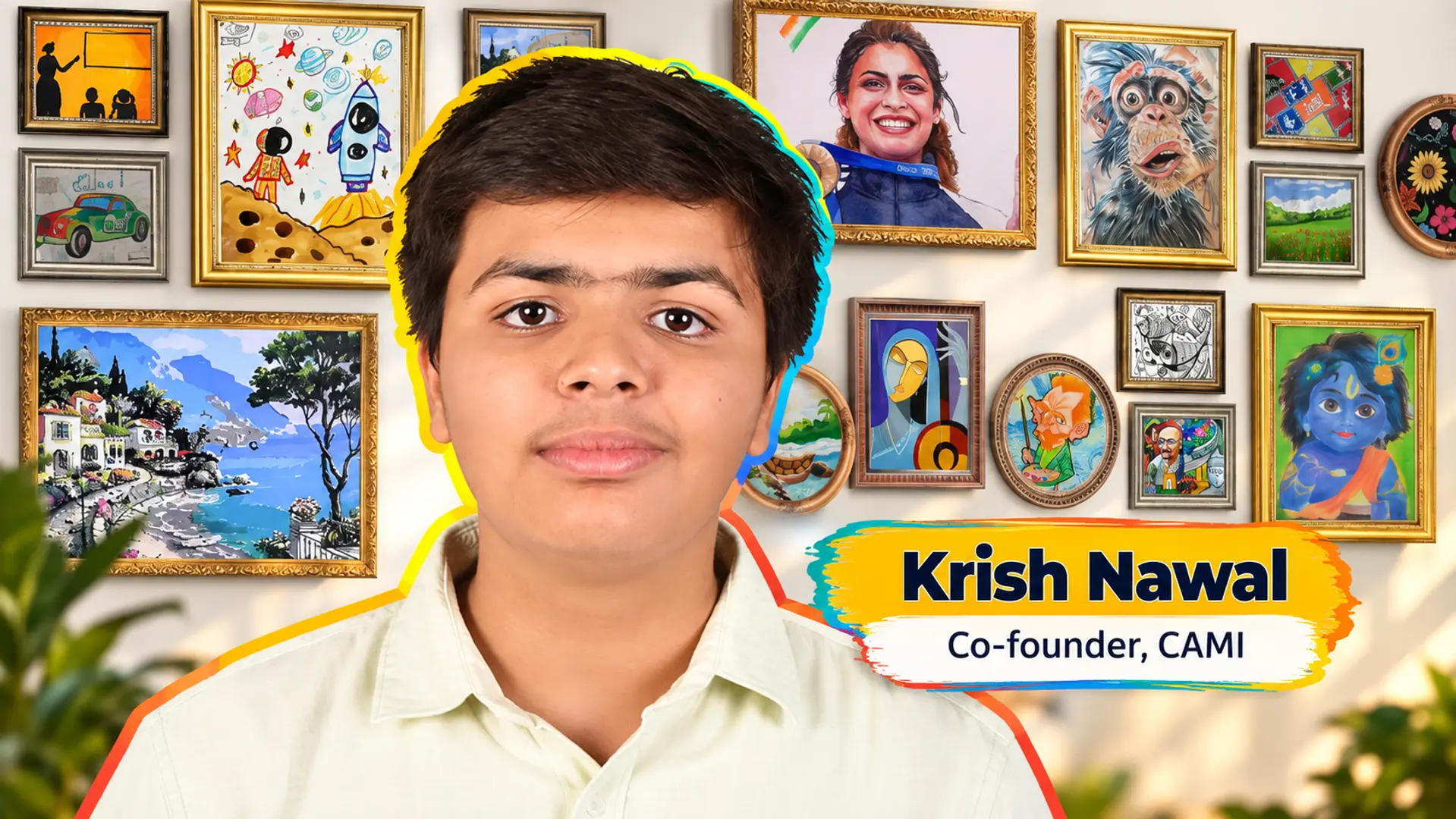

A child's painting often has a very short life. For a few days, it finds a place on the wall at home. Sometimes it is pinned to the refrigerator, sometimes carefully tucked into a school file. Parents admire it, the child receives praise, and then another drawing comes along to take its place. Over time, that painting often ends up in a drawer, cupboard or forgotten corner of a file.
But what if that same painting became part of a museum? What if it could be seen not just by parents and teachers, but by other children and people from different parts of the world?
That question led to the birth of the Children's Art Museum of India (CAMI).
What makes the story even more remarkable is that the digital museum was started by two children at an age when most kids are still carrying their drawings around in school bags.
In 2022, then 12-year-old Krish Nawal and 14-year-old Manya Roongta came together to launch CAMI. Four years later, the digital platform has grown into a community of more than 300,000 members. Over 20,000 paintings and artworks have been submitted to the platform, while its website has attracted more than one million visitors.
A love for art, but a different way of thinking
Krish Nawal is currently a Class 11 student. From an early age, he enjoyed drawing and other creative activities. But his interest was never limited to simply creating something on paper. He was equally drawn to technology. He enjoyed building new things, experimenting with ideas and exploring what could be created around creativity itself. Over time, he realised that what fascinated him most was not just making art, but thinking about what could be built around it.
He was also intrigued by the way different children could look at the same subject and imagine completely different things. For one child, a tree may simply be a tree. For another, the same tree could become a character in an elaborate story.
That idea would eventually become one of the foundations of CAMI.
Speaking to YourStory, CAMI Co-founder Krish Nawal says, “My interest in art was never limited to learning how to draw or paint. Over time, I became more interested in the question of what could be created around art. Every child sees the same subject differently, and that idea became central to CAMI. For me, CAMI became a way to bring creativity, technology and entrepreneurship together.”
One question sparked the idea for CAMI
Krish began thinking seriously about the idea during the COVID-19 pandemic. At the time, he noticed something interesting. Professional artists had museums, galleries and several digital platforms where their work could be displayed. But there were very few spaces designed specifically for children, where their artwork could be shared and experienced by others instead of simply being submitted and forgotten.
That led to a simple question: What happens to a child's painting after it is made?
There was no elaborate business plan behind CAMI. The idea began with that one question.
In most cases, a painting spends some time in a school file or on a wall at home. It may remain on the refrigerator for a while before eventually finding its way into a drawer or cupboard. Meanwhile, the work of established artists finds space in galleries and museums.
Krish felt children deserved to experience something similar. Their work, too, could be seen, appreciated and taken seriously.
Krish says, “We didn't start CAMI thinking that it would one day become a large organisation. We simply wanted a child to see their own painting in a museum and feel that this space belonged to them too.”
The beginning was simple. Krish and Manya started by asking their friends to share their paintings. But as the initiative grew, they discovered something else.
Krish says, “Children don't always need another competition. They need a space where their creativity can simply be seen.”
Today, CAMI describes itself through the idea of “By the Children, For the Children, Of the Children.” The larger goal is to build a creative community with children and for children. CAMI has now reached more than 200 cities and towns across India. Its community has grown through schools, young ambassadors, children and various creative programmes.
Is art just an extra-curricular activity?
Giving children's paintings a place in a digital gallery was not CAMI's only challenge. Krish and his team also recognised a larger problem: access to art education is far from equal across India. In many schools, art is still treated as an extra-curricular activity rather than an important part of learning. Quality art programmes, trained teachers and creative learning resources are not easily available to every child.
CAMI has tried to bridge some of that gap through digital tools. The platform has developed learning material for children, including videos focused on traditional Indian art forms. The goal is not simply to help children become better at drawing. It is also to introduce them to India's cultural heritage and encourage curiosity about the country's artistic traditions.
Krish says, “We believe creativity is not about making a perfect painting. It is about imagination, observation, experimentation and finding ways to express yourself.”
He adds, “Art education is not the same in every school in India. That's why we have worked on hundreds of videos and learning resources. Many of them focus on traditional Indian art forms so children can also learn about their cultural heritage.”
CAMI's digital platform allows children to share their artwork with a wider audience. Beyond the digital museum and galleries, the platform also hosts ArtFest, creative challenges, school galleries, blogs and newsletters. CAMI works with schools as well, helping create dedicated digital art galleries for students.
The organisation has also experimented with emerging technologies such as virtual worlds and the metaverse to create new ways for children to experience art. But while the technology continues to evolve, CAMI's core idea remains unchanged. The child and their creativity remain at the centre.
Built without investor funding
CAMI has remained bootstrapped since its inception. The initiative has not raised funding from investors. In its early days, expenses related to the digital platform, hosting, design and technology were supported through family backing and available resources.
Instead of focusing immediately on fundraising, Krish was more interested in answering other questions. Did children actually want to use such a platform? Would schools find the idea useful?
Krish says, “We wanted to keep access simple and open to as many children as possible from the beginning. Our first goal was to understand whether children and schools would adopt the idea. So we focused first on usefulness and participation.”
Even today, success for CAMI is not measured only in terms of revenue or profitability. Krish says, “For us, what matters more is how many children are able to share their creativity and their paintings.”
CAMI has received recognition at both national and international levels. The initiative has won the Global Youth Award for Creative Innovation and the Bower School of Entrepreneurship's Top 18 Under 18 Entrepreneurship Award.
Krish has also spoken at the MuseumNext Digital Museums Conference and has been recognised as a Shri Innovation Awardee.
But building an initiative at such a young age came with its own challenges.
Winning people's trust
According to Krish, earning trust was the biggest challenge in the early days. It was not easy to convince schools and institutions that an initiative started by children could sustain itself over the long term. As CAMI grew, new challenges emerged: maintaining quality, ensuring children's safety and managing a rapidly expanding community. And then there was school. Balancing classes, examinations, meetings and events was never easy.
Krish says, “When we started, we were very young, and earning trust was our biggest challenge. Later, we had to constantly focus on quality and the safety of children as well.”
Managing CAMI alongside studies also taught him an important lesson.
He says, “Handling CAMI along with school was not easy. But I learned that you don't have to do everything yourself. A strong team, volunteers and ambassadors can help you move forward.”
For a young founder, that may be one of the most important lessons of all: instead of trying to do everything yourself, learn to trust the right people with responsibility.
The road ahead
Over the next few years, Krish does not want CAMI to remain just a website where children upload their paintings. The plan is to expand its school network, strengthen its international community and build more engaging and interactive museum experiences.
He is also interested in exploring how emerging technologies such as artificial intelligence (AI) and virtual worlds could transform the way children experience art and museums.
But even as CAMI expands, one thing remains important: its original spirit should not change.
Krish says, “I want to make sure that a child's opportunities are not determined by whether they live in a large city or a small town. Digital platforms can help reduce that distance.”
According to him, not every child needs to grow up to become an artist.
Krish says, “Every child doesn't have to become an artist. “But every child should feel that their creativity has value. Art is not just a subject. It can also be a way of thinking and understanding the world.”
Not every painting needs to be preserved, but every imagination deserves space
The story of CAMI is not just about two children who started an initiative. It also raises a larger question: How seriously do we take children's creativity?
Not every painting will become a masterpiece. Not every child will grow up to become a professional artist. And perhaps that is not the point. What matters is that no child should ever feel that their imagination is unimportant.
In 2022, Krish and Manya began with a small idea: to create a space where children could do more than simply submit their paintings and forget about them. They wanted children to see their creativity displayed before the world.
Four years later, CAMI has grown into a community of more than 300,000 members. But the question that inspired it remains the same. If children are given the right space for creativity, perhaps they will learn more than just how to make better paintings. Perhaps they will learn a new way of seeing the world.