



Meet the lender taking secured small-business credit beyond India’s top 100 locations
Business Nextgen Finance has raised Rs 215 crore from Beams Fintech Fund I and its affiliates, Baring Private Equity India Fund 6, Saison Capital, and UNLEASH to scale its technology-led secured lending model for underserved MSMEs.

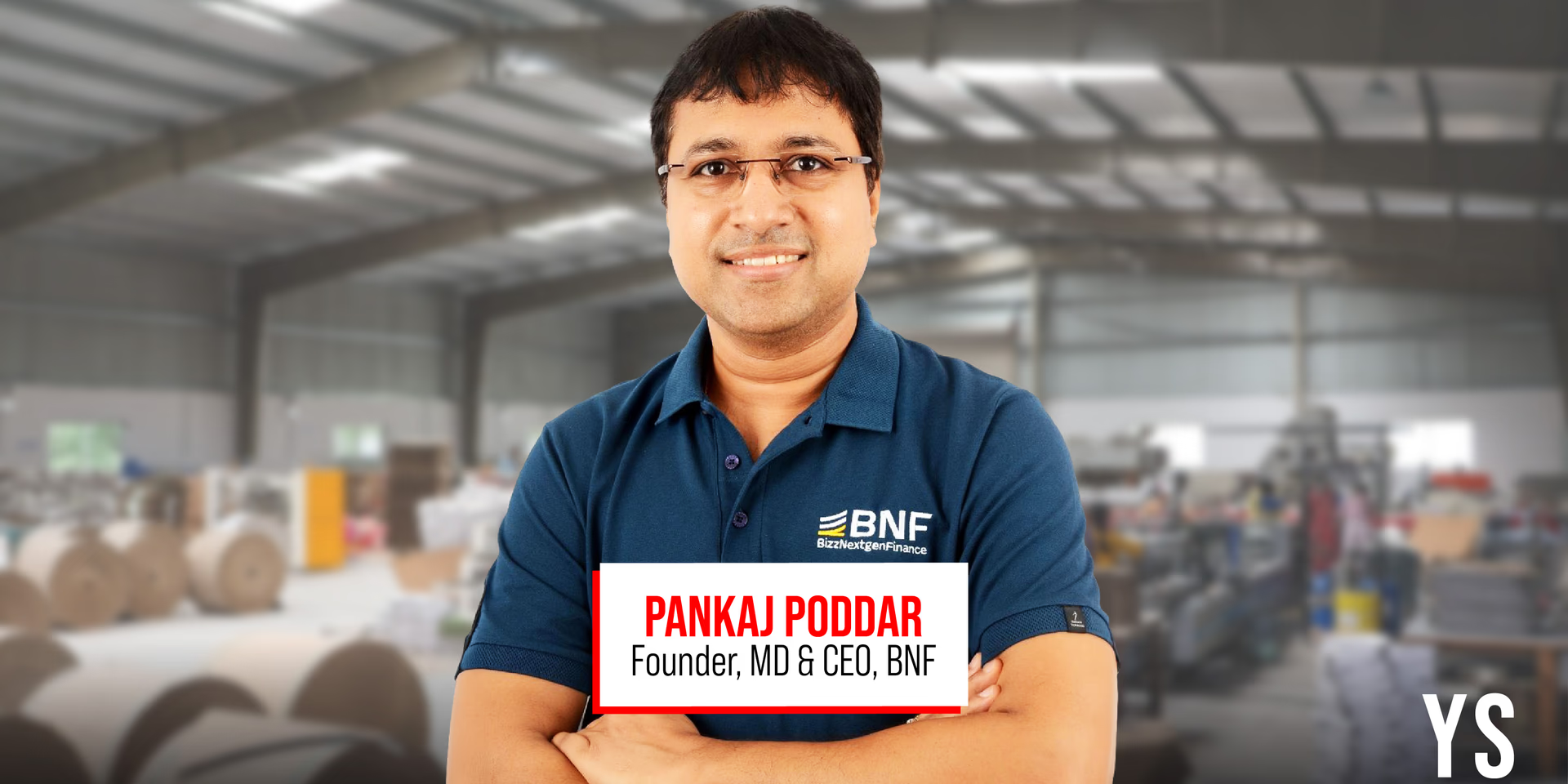

For much of his career, Pankaj Poddar’s job was to think about what could go wrong with a loan. As a credit and risk executive, he spent close to two decades across institutions including Kotak Mahindra Bank, Standard Chartered Bank, Bajaj Finance, and SBFC Finance, looking at lending through the prism of underwriting, portfolio quality, operating costs and profitability.
“The long-term purpose, however, was always to be an entrepreneur,” Poddar tells YourStory. He is now Founder, Managing Director, and CEO of Business Nextgen Finance Private Limited (BNF), a young non-banking financial company (NBFC) focused on secured lending to small entrepreneurs, particularly outside India’s biggest financial centres.
That ambition has just received a significant boost.
Rs 215 Cr raised in equity
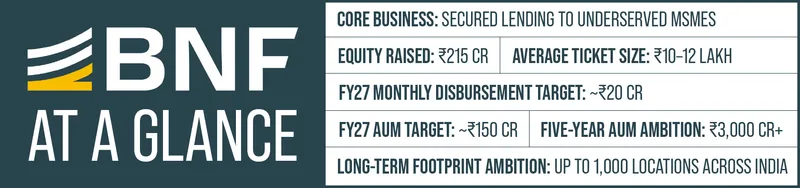
BNF has raised Rs 215 crore in equity capital from a group of institutional and strategic investors as it prepares to scale its MSME lending business. The round was led by Beams Fintech Fund I and its affiliates, Baring Private Equity India Fund 6, Saison Capital, and UNLEASH 1st Investment Partnership, along with other investors.
The transaction has received prior approval from the Reserve Bank of India. Beams and its affiliates will collectively hold more than 26% of BNF’s paid-up equity share capital on a fully diluted basis following the transaction. The capital will be used to expand BNF’s secured lending business, widen its geographic footprint and invest further in technology.
For a lender that received its RBI Certificate of Registration only in September 2025, the fundraise gives BNF the capital to test a thesis Poddar has developed over years of looking at small-business credit: a large lending opportunity remains untapped beyond India’s top 100 markets.
“The significant credit gap in India's underserved MSME segment presents a compelling opportunity for a differentiated lender with strong underwriting, technology and customer-centricity,” says Sagar Agarwal, Partner at Beams.
Looking beyond the top 100 markets
According to Poddar, roughly 70% of secured MSME and mortgage credit is concentrated in India’s top 100 geographies. BNF wants to go beyond them. Its long-term ambition is to build a presence across as many as 1,000 locations, with a particular focus on smaller cities and towns where entrepreneurs may have viable businesses and assets but do not always fit neatly into conventional underwriting frameworks.
Poddar says BNF envisaged a pan-India model from the outset, with both its North and South zones going live from day one.
Many of the small businesses BNF wants to lend to may not have conventional documentary proof of income. Property records are not uniformly digitised. Collateral can be more complicated to assess outside large cities. And determining whether a small entrepreneur can repay a loan often requires looking beyond tax returns.
BNF’s loans are largely in the Rs 5 lakh to Rs 30 lakh range, with an average ticket size of around Rs 10-12 lakh. The average interest rate is currently about 17-18%, according to Poddar.
Its underwriting is centred on the borrower’s ability to generate cash rather than merely the value of the property being pledged. Credit officers assess the underlying business, stock, banking activity, existing loan obligations and other available information. Bureau records and alternative data can supplement the assessment, while field-level checks are used to understand both the entrepreneur and the collateral.
Poddar says the objective is to estimate the cash flow available to a borrower after existing obligations and then put a buffer around how much can go towards servicing a new loan. Collateral provides protection if things go wrong. It is not intended to substitute for the borrower’s ability to repay.
That approach reflects Poddar’s background in risk. When lending to a small business, he says, understanding the entrepreneur can be as important as analysing the numbers. How long has the business been around? How much of the owner’s own capital is invested? What is the borrower’s track record? And can the business remain viable over the duration of the loan? For a lender extending credit for several years, the sustainability of that cash flow matters more than what the business looks like at a single point in time.
Can secured lending become more digital?
BNF’s second bet is on technology. Not in the sense of turning a secured MSME loan into a completely digital product. Property still has to be inspected. Original documents still matter. Credit officers still need to understand the underlying business. Instead, Poddar wants to eliminate as many manual hand-offs as possible around those physical realities.
Once a loan application enters BNF’s system, the company wants documents and information to move digitally through the lending process. KYC is digital. Banking information is integrated into the workflow. Valuation and verification partners feed information into the system. Where information cannot be obtained directly through an integration, documents can be uploaded and read using technologies such as OCR and AI-assisted processing. Original property documents remain one of the few unavoidable physical elements. The distinction is important.
BNF’s technology proposition is not that software will replace underwriting. It is that technology can reduce paperwork, improve process control and bring down the operating costs of a lending business that still requires people on the ground. Poddar says that because BNF was built in the AI era, the company has adopted what he describes as an “AI-native enterprise architecture” from the outset. That becomes particularly relevant if the company eventually wants to operate across hundreds of smaller markets.
Debanshi Basu, Partner at Baring Private Equity India, points to BNF’s approach of “leveraging technology within a conventional touch-and-feel underwriting product” to drive risk-based credit decisions while creating what she describes as a “sustainable opex advantage”. A conventional branch-heavy lending model can become expensive as it expands. BNF’s thesis is that local underwriting combined with more digital and centralised processes can allow it to grow without replicating the same layers of operating costs at every new location.
Building an NBFC from scratch
BNF has moved relatively quickly since it was set up last year. Poddar left his role as Chief Risk Officer at SBFC Finance in April 2025. The team applied to the RBI for an NBFC licence the following month. BNF received its RBI Certificate of Registration in September 2025 and made its first disbursement in October. By November, it had entered into a co-lending arrangement with Godrej Finance Limited.
The company subsequently raised an angel investment round in February 2026 and continued expanding its physical network. By March, BNF was operating 11 branches. BNF expects monthly disbursements to reach around Rs 20 crore during FY27, with assets under management of about Rs 150 crore across 20-25 branches spanning three states and Delhi-NCR, according to Poddar.
Those are still relatively small numbers in India’s lending market. But the Rs 215 crore equity infusion changes the scale at which BNF can now build.
The Rs 500 crore milestone
Poddar is particularly conscious of one trap that fresh capital can create: chasing growth before building the economics to support it.
The company’s first significant scale milestone is Rs 500 crore in AUM over the next two to three years. Poddar sees Rs 1,000 crore as a subsequent milestone and believes BNF could potentially become a roughly Rs 3,000 crore-plus AUM lender over a five-year horizon. Getting there will test more than its ability to raise capital.
Affordable MSME lending is hardly an empty market. Banks and established NBFCs have spent years building distribution networks, credit models, collections capabilities and knowledge of individual markets.
Going deeper into smaller centres adds another layer of complexity. Informal cash flows have to be assessed accurately. Property documentation varies across geographies. Collections require local knowledge. And in lending, rapid growth can hide problems that become visible only after a loan book has had time to mature. Poddar knows those risks better than most. His career has largely been spent deciding how much risk a financial institution should take. At BNF, he now has to solve the other side of that equation too: how fast a lender should grow.
“We will not do growth over risk or governance,” he says. The harder question is whether it can combine the credit discipline of an established lender with the cost structure and operating model of a technology-led startup. That will determine how far beyond India’s top 100 markets BNF can really go.