



Open-source is more than free code. It’s a way to build for the future
From sovereign AI to open-code culture, Margaret Dawson on what it really takes to build for the AI era.

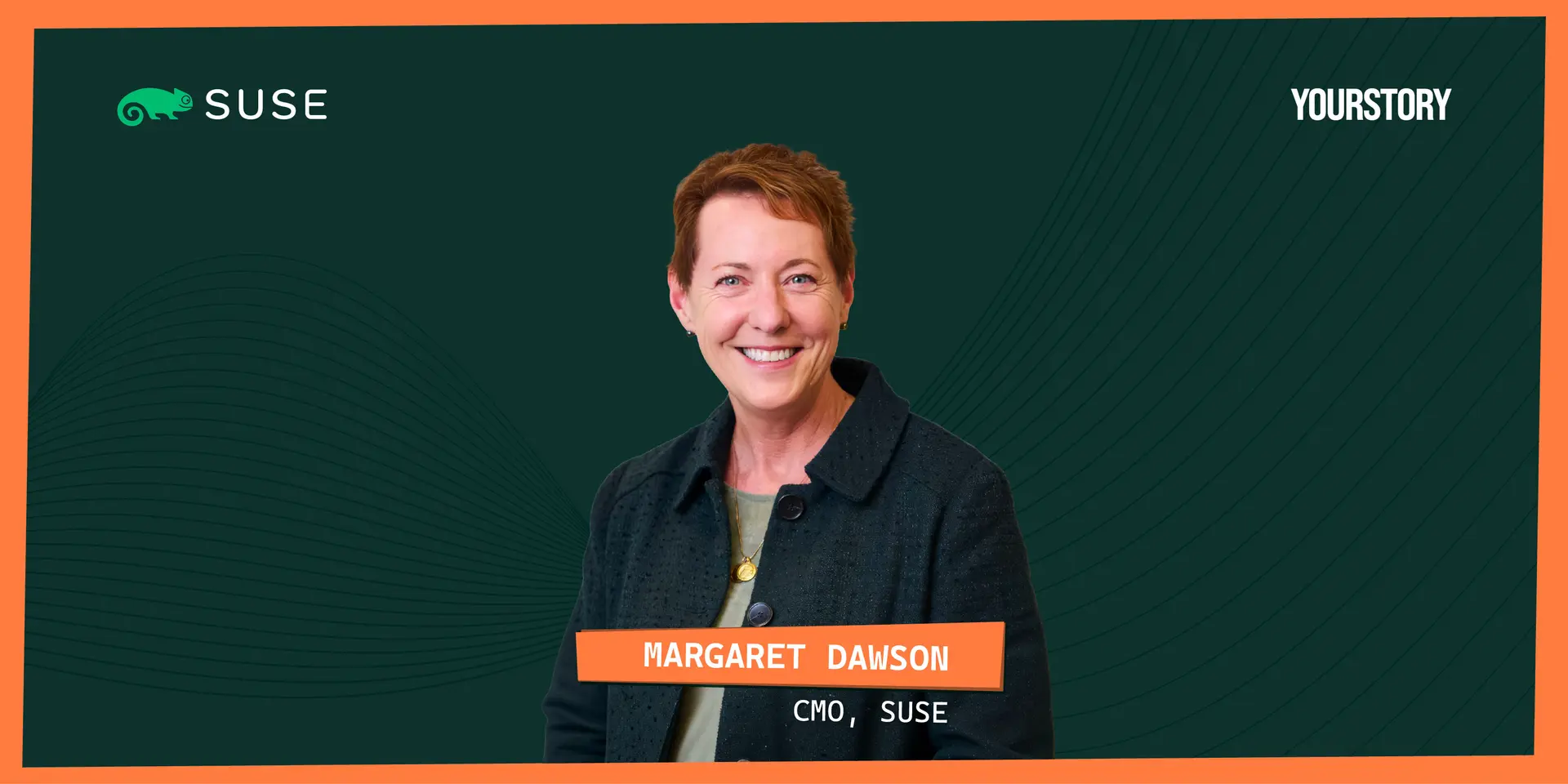

What does open-source really mean when artificial intelligence is changing how companies build, scale, and innovate? For SUSE CMO Margaret Dawson, it goes far beyond free software. In a conversation with YourStory, she explores why Indian startups need to think about open-source as a strategic advantage.
Be it building sovereign AI architectures and avoiding vendor lock-in or creating workplaces where ideas matter more than hierarchy, Dawson explores how open-source could be key to building AI-ready organisations.
Edited excerpts:
YS: When founders hear “open-source”, many immediately think of free tools or licenses. How would you reframe it for the AI era, and why should Indian startups care beyond cost savings?
MD: In the AI era, treating open-source as a discount code is a massive strategic mistake. Open-source isn't just a license; it is a development model, a technology process, and an architectural strategy based on control, choice, and speed.
For Indian startups scaling at breakneck speed, open-source is about avoiding the 10x architectural tax down the road. It gives you the composable foundation to ensure interoperability across multi-cloud and edge environments, fine-tune models on your own IP, and innovate without permission or lock-in.
When model pricing shifts, APIs get deprecated, or data governance mandates evolve, open-source keeps you in the driver’s seat of your own business. Also, it ensures your developers are working in the technologies they love or want to learn, and you have the option to purchase the supported, enterprise-ready version of that software.
YS: You’ve been driving SUSE’s Sovereign AI strategy. For a CTO in Bengaluru or Hyderabad, what does “Sovereign AI” look like in practice, and where are you seeing Indian companies start?
MD: There is a misconception that digital sovereignty is a uniquely European compliance headache. That’s simply not true — sovereignty is a global operational imperative.
For a CTO in Bengaluru or Hyderabad, it comes down to three non-negotiable capabilities:
- Control over data and model lineage: Knowing exactly where your data, prompt context, and model weights reside.
- Supply chain transparency: Complete visibility into every layer of the software stack, from the Linux kernel and container runtime up to the LLM orchestration layer.
- Operational autonomy: The freedom to run workloads air-gapped, on-premises, or across hybrid clouds without a mandatory umbilical cord to a single cloud provider.
Deloitte research indicates that 65% of organizations have abandoned AI initiatives midway, primarily due to skills gaps, data residency risks, and infrastructure lock-in. Our own research validates this. Indian tech leaders are starting where the risk is highest: regulated enterprise workloads and fine-tuning open-weight models on private data. They are abandoning the "public-cloud-first" of the past in favor of hybrid, governed architectures. You cannot build a sovereign future inside a black box; transparency and open standards are the only way to guarantee true control.
YS: The core idea here is adopting open-source ways of working internally — transparency, meritocracy of ideas, psychological safety. Can you share one example where an “InnerSourcing” or open-community practice inside a company broke silos and sped up delivery?
MD: As I shared in my SUSECON keynote on the Power of Open, true openness isn't just about software licenses, but rather it rests on three interconnected pillars: Open Standards, Open Architecture, and Open Culture. You simply cannot build an open, sovereign AI future if your leadership operates with a closed, command-and-control mindset. In an open-source culture, the best ideas win regardless of title, and contribution always trumps hierarchy.
InnerSourcing changes the entire operating model by applying open-source community principles inside the company. A clear example of this in action was how we transformed our cross-functional go-to-market campaigns and AI agent workflow architecture across marketing, sales, support, and our products.
Our agentic ecosystem, fully aligned to our brand style and voice, now guides prospects and customers through their discovery journey, appointment setting, sales and support questions, and technical implementation.
YS: A lot of older Indian tech firms talk about innovation but run on closed, hierarchy-heavy management. What are some specific management behaviors or rituals that demonstrate a team is truly embodying an open-source culture, not just using the label?
MD: If you want to know whether an organization genuinely lives an open-source culture, look at their daily operational habits:
- Working in the open: Information is treated as a collaboration opportunity, with strategy, roadmaps, decisions, and learnings openly documented across the company.
- Blameless learning: When things go wrong, leaders focus on systemic bottlenecks rather than blame, making workflows more inspectable and repeatable.
- Prototypes over titles: Ideas are judged by data, logic and working code, not seniority. A working prototype from a junior engineer beats a 50-slide deck from a Vice President every single time.
YS: In open-source communities, contribution trumps pedigree. How can Indian startups create hiring, promotion, and project governance so that self-taught engineers, women in tech, and career-switchers can thrive — not just be “included”?
MD: I care deeply about this topic because talent shortages or skill sets remain the single largest bottleneck to AI adoption. IDC projects that 90% of enterprises will face critical AI skills shortages by 2026, representing an estimated $5.5 trillion in unrealized productivity globally. You simply cannot solve a talent shortage of that scale using legacy, pedigree-heavy hiring filters.
In open-source communities, no one asks where you went to school; they look at your pull requests, your problem-solving logic, and your passion. Startups can replicate this through three deliberate shifts:
- Skills-based hiring: Replace pedigree-heavy screening with problem-solving challenges and reviews of relevant work or open-source contributions.
- Transparent growth paths: Clearly define the objective milestones required to earn leadership or maintainer roles.
- Reciprocal mentorship: Pair non-traditional talent with senior leaders, creating two-way learning—junior employees share AI-native skills while leaders offer strategic and executive guidance.
When people feel safe to bring their curiosity and "work out loud,” style, diversity stops being a corporate compliance metric and becomes your ultimate innovation engine.
YS: Skill gaps are repeatedly cited as the primary obstacle to AI adoption. Instead of “train everyone on LLMs,” what open-source-style learning models (peer review, community docs, contributor ladders) have you seen actually move the needle on upskilling teams for AI work?
MD: Pushing top-down, passive video training modules on a team rarely builds real operational capability. Organizations that establish structured, hands-on learning achieve a 3.7x to 10.3x average return on their AI investments.
The biggest need I see here is to recognize how everyone learns and retains information differently. You need to have training content that is watched, listened to, read, and experienced.
Active, community-driven models work best for upskilling: peer-review prompts and agent workflows, use sandboxes and hackathons to build real-world prototypes, and replace static training with living, community-driven documentation. Make learning collaborative, even for non-technical teams, and recognise cross-functional wins — not just individual technical expertise. Programmes such as “AI Stars of the Week” can celebrate teams that use AI together to innovate, solve problems and move the business forward.
YS: For a founder reading this who wants to start leveraging open-source culture tomorrow, what’s the smallest, high-impact change they could make in the next 30 days?
MD: Open up one key strategic discussion currently happening behind closed doors. Choose a product pivot, architectural decision, or operational bottleneck, and publish the context, constraints, and data internally.
Then host an open, cross-functional working session with developers, marketers, product managers, and customer leads. Ask: “What are we missing?” and “How do we unblock this together?” When leaders show that clarity and good ideas matter more than hierarchy, they’re building a culture of openness.