



From pits and walkie talkies to AI: Angel One Founder Dinesh Thakkar charts the 30-year-old stock broking company’s stellar growth
Retail broking firm Angel One believes AI can be a disruptive force that personalises an individual’s financial journey. However, the real test will be whether AI can deliver tangible value to users.

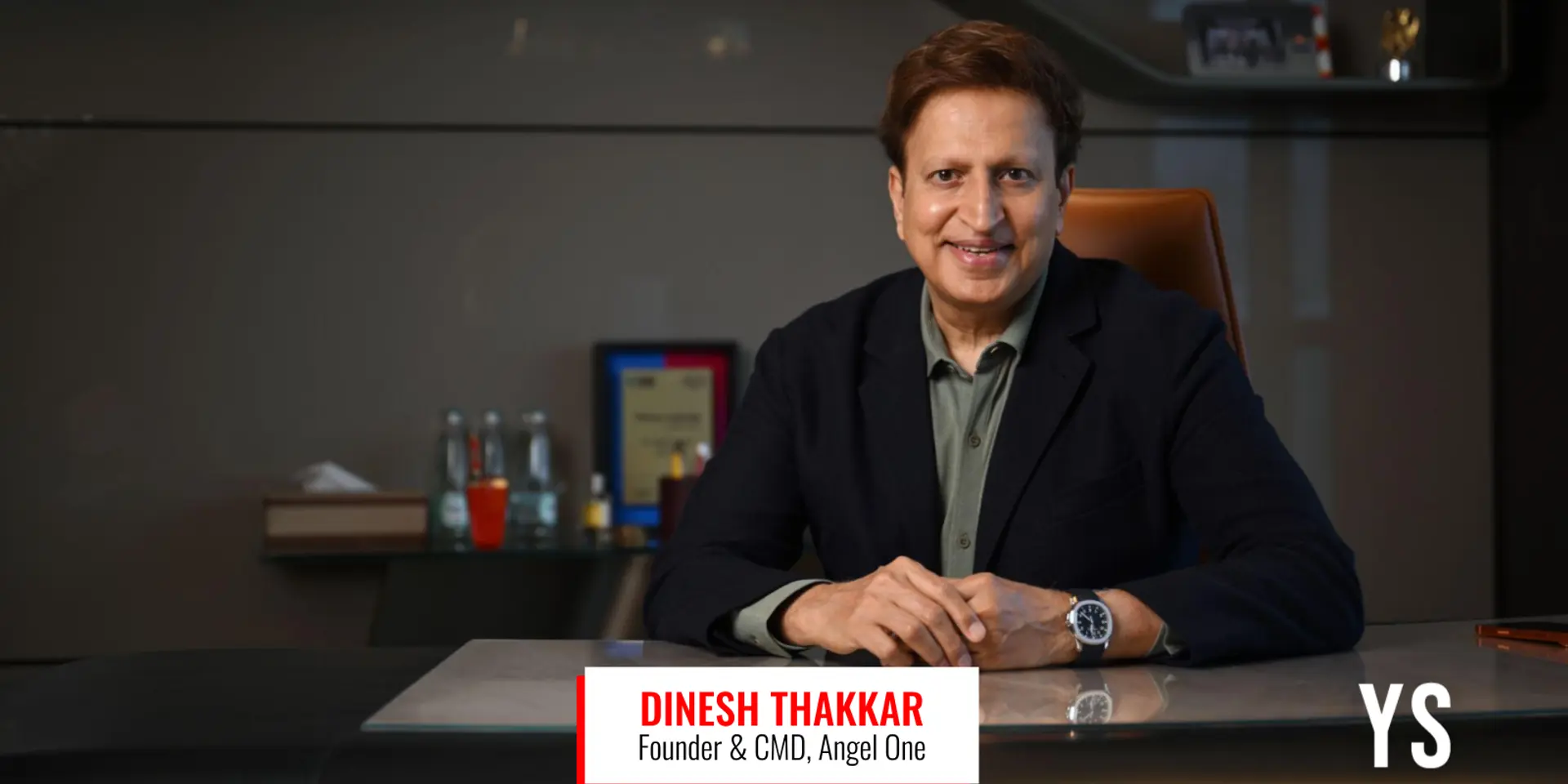

The year was 1996 when Angel One made its debut. Back then, stock broking was a high-adrenaline game that happened in a “pit” where brokers yelled and used complex hand signals to buy and sell shares. Angel One pioneered the use of walkie talkies that enabled investors to know the stock trades that were executed on their behalf.
Cut to 2026, outcry pits have given way to silent algorithms that make trades in milliseconds. Retail investors can now access real-time analytics via a smartphone screen. Despite the vast technological disruptions that have sidelined legacy companies, Angel One has managed to remain relevant.
Today, Angel One has a user base of 3.95 crore despite intense competition from new players such as Zerodha and Groww. It is now actively exploring AI to further improve user experience.
In an interview with YourStory, Founder, Chairman and Managing Director Dinesh Thakkar and Group CEO Ambarish Kenghe discuss Angel One’s journey, its plans for the future and, more pertinently, its approach to AI.
“Today, through AI, one can think about personalising every journey the way a person wants it, which I cannot imagine otherwise,” he says.
Edited excerpts:
YourStory (YS): How did it all begin for Angel One?
Dinesh Thakkar (DT): Before Angel One was really incorporated, we were reading about computers in the mid-1980s, when India was getting ready to open up the market for the use of computers. That is where a thought came to my mind that this is a powerful instrument. How can we use it in any business?
I borrowed some money from my friends and entered the stock market but got badly bruised, losing 50% of my capital. For a newcomer, there was a lag in getting information on how and when stock trades were executed. The first thing I wanted to see was how the whole process could be made transparent, where one could get confirmation of a stock purchase or sale in real time.
This was when I introduced the walkie-talkie, through which a customer’s order could be confirmed within five to 10 minutes. We also built software on our computers so that customers were given the contract note by the end of the day.
My point was to always look at what users want. My philosophy is: don’t get too fascinated by technology; use it to solve a problem.
When screen-based trading started, we started investing in routers, VSATs and modems to extend our services to other terminals. When I heard about internet trading becoming popular in the US, that is when I started working on how I could bring this experience to people here.
In 2000-01, I went very aggressive because I was very excited by this technology. This was the first time I made a mistake in terms of not realising that technology was there, but not for other users. We invested heavily in internet trading, but our vendor could not provide the software as its parent company had different priorities. We suffered huge losses, with a lot of unused hardware.
That is where I realised that I was too attracted towards technology while users did not have a personal desktop to do internet trading. We then decided to use our unused hardware to connect with other sub-brokers outside Mumbai through a leased line. By using technology, we became a kind of national player.
In 2010-11, I saw that a lot of things could be built on mobile. Having learned a big lesson from internet trading, I was very clear. There were not enough users at that time who would use mobile phones, but I thought we should have a solution on mobile.
By 2015-16, there was talk about Digital India, e-KYC, UPI and Aadhaar, so we realised that there was a good opportunity to activate the mobile phone for actual use.
In 2016-17, we were ready with a fully integrated mobile app, but we still had a profitable branch model. During this time, we saw a lot of people from Tier-3 and Tier-4 towns, where we had no branch offices, start using stock market services through a mobile app.
That is when we took a call that either we had to become a big player and capture a significant market share in a new user base, because the old user base was not large while the digital-native base was growing fast, or we would miss the opportunity.
So we decided to close all our physical offices and go completely digital. In 2018, we went fully digital and focused on acquiring and serving customers digitally. It was a bold call because if we wanted to go digital, we had to match the pricing of a digital broker. This had a 65% impact on our revenues.
At the same time, we calculated how much of a hit we would have to take to become profitable. The second question was whether we could grow at a rate higher than 65%. Our calculation showed that we could grow at a higher rate, though we would have a few quarters of losses.
We decided to go fully digital and our customer base was growing by around 100-120%. There was no quarter where we made losses.
Though for us that was not enough. We thought that if a customer was using our app, that individual would have multiple other requirements, which could include mutual funds, insurance and credit products.
That is where we decided to scrap the app and build a new one, which we called a super app in 2022, where we gave customers the experience of transitioning between stocks, mutual funds, insurance and other products on one app.
Now we are thinking about how to use AI. I don’t get attracted towards new technology, as for me it is just another tool in the arsenal. But one should know how to use it.
Today, there is a significant base of what I would call latent users who are still hesitant to invest in stocks or mutual funds for various reasons. Now, our thought is how to use AI to solve that problem.
Knowing about AI is not sufficient. Are we able to create something useful for a user where we can bring these latent users to our platform?
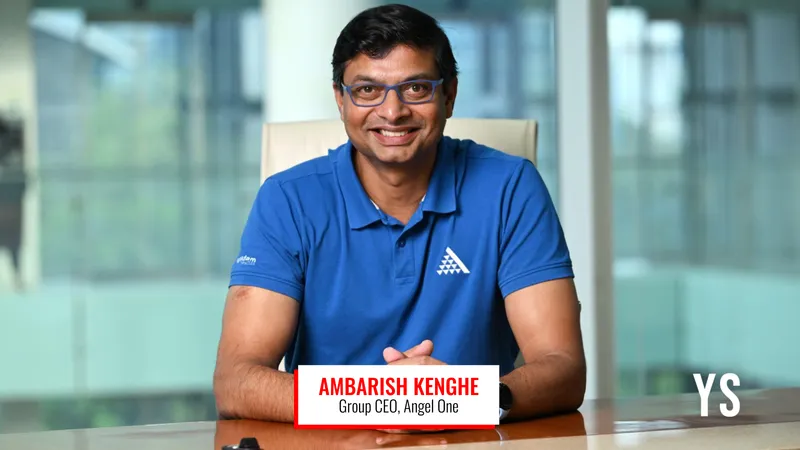
Even in our wealth management practice, which requires an omni-channel approach involving relationship managers, we are able to use technology to serve customers who do not fall under the high-net-worth category.
The day is not far when we will go for tokenisation of assets, where even a small ticket size can get an experience comparable to that of the best wealth managers. That is where AI and everything will come into the picture.
YS: How does Angel One connect with users?
DT: When I entered this business, there were only a few communities that were trading and investing in India. But when screen-based trading came, there was increased participation from different parts of the country.
Then came the era of mobile phones, where onboarding became totally digital. We saw a lot of customers coming in from Tier-3 and beyond locations. Those people whom we thought would never come to the market started coming in a big way.
The country’s demat customer base is around 20 crore and has the potential to reach 30-35 crore. Can AI be that kind of a step which creates that awareness?
Today, there is access to knowledge and information, but how does one personalise that journey? That is where AI has to come and solve that problem.
That is what we are working towards — addressing all the concerns of a user.
I believe AI will personalise our journeys so that a person does not require big-ticket investments to enter the stock market.
Ambarish Kenghe (AK): The headroom for growth is extremely high, especially in Tier-III beyond locations, where there is a lot of economic activity that is creating wealth.
Earlier, people in these locations did not have access to information or knowledge, but the internet has been a very big equaliser. AI is getting to the next level, where information and knowledge can be provided in the hands of a retail user. It will create an even more efficient market and a level playing field.
YS: How does Angel One ensure that customers remain with you for the long term?
DT: We want people to question us, definitely, and do not want them to just accept whatever we say. That is the reason on our app you will see Ask Angel on our wealth app. We have an AI agent. They can check with it.
If a relationship manager is giving some kind of advice, it can be verified because there is an LLM model. We are encouraging that.
We try to understand the objectives of our customers and then measure the outcomes of their investments. If they are deviating from their main objective, some guardrails or nudges should be there so that they are guided to take advantage of this platform rather than move away from the stock markets.
Now, with AI, one can see whether their investment approach is appropriate or whether rebalancing is required in their portfolio. Users will always appreciate it when you recommend the right things.
People will do some wrong things, but at whatever point they want to come back and check what they did and what the way to their destination is, we should be able to guide them.
YS: Do you believe AI is a game changer?
DT: Definitely. AI is something that is going to disrupt all industries in a big way. It will create an experience for a user the way it should be, although AI is still at a nascent stage as one needs to understand how we are going to use it.
Today, I can think about personalising every journey the way a person wants it, which I cannot imagine otherwise. It can tell what to buy or sell by analysing the individual’s requirements or what the right product would be.
Once that happens, we can see a lot of people entering this market.
YS: What changes has Angel One seen internally by integrating AI?
AK: At the organisational level, we have all these AI tools where we are looking at not just being efficient but also being effective.
Across the board, in anything that we are producing, AI is getting used. In customer support, we are starting to experiment with AI calling already in certain places.
We have developed a data agent that is continuously improving the way we work. Culturally also, things are changing as people are starting to think about what they can do differently.
It is changing from the inside out in how we are doing business. But the real win will be when we are able to change how customers experience our product fully.
YS: What will be the human element in this AI journey?
DT: Humans are building everything. Humans are using AI. See, you cannot create a solution without a human being there.
If I want to create a good fund for a user, then one has to incorporate a lot of human intelligence. AI will make humans more productive, where a particular task may no longer be needed, but they will have to upgrade themselves and learn something new.
AI can make it easier for people to participate in the capital markets, and this provides an avenue to entrepreneurs who want access to risk capital.
Once these entrepreneurs get easy access to this capital, they are going to create more jobs. Lots of industries can use AI to increase their productivity and create new jobs and competencies.
Some tasks may no longer be there, but jobs, I believe, are going to increase.
AK: In the short term, as it suddenly takes off, there will be some disruption. But in the longer term, I feel like we haven't solved a lot of problems.
YS: How do you see the competitive scenario?
DT: I'm not looking at competition in an industry which is highly underpenetrated.
We are an enabler. We are trying to expand the market, so we need more players who can really spend money to acquire more customers.
We should focus on how we all can get more users and expand the market. There is enough for everyone.
AK: There is a large gap between the user base and those who are active users, and if there are more players in the market, people will become more aware of these investments.
However, if you get players in the market who don't do the right thing for the customer, then the whole industry gets a bad name. We have to make sure that everybody does the right thing for the consumer.
YS: Angel One has taken numerous pivots. How do you take these risks?
DT: When I am taking a step, it is about calculated risk management. Risk is all about whether you are unable to identify what can go wrong and how much can go wrong. You may term that as a risk.
But if I am doing any experimentation where I may lose 5% but, if it works, there is a 500% upside, then it makes sense.
During the 2007-08 global financial crisis, we took the step of expanding our operations. My calculation was that if a customer comes into the market and remains active, they will be doing business for at least five years.
This was also a time when competition was not spending money and you could acquire customers at half the cost, while lifetime value was almost the same.
It was during this time that we expanded from 70 offices to around 150 and gained significant market share. All my branches were profitable.
Whatever step we take, we calculate a lot. We believe in data, analyse that data and interpret what the future looks like.
If you go wrong, what is the downside? And if it goes right, what is the upside?
Edited by Affirunisa Kankudti