



PM Modi's 76th birthday: 17 moves powering India's journey from Startup India to Build India
On his 76th birthday, YourStory looks at the decisions that are changing what Indian founders can build.

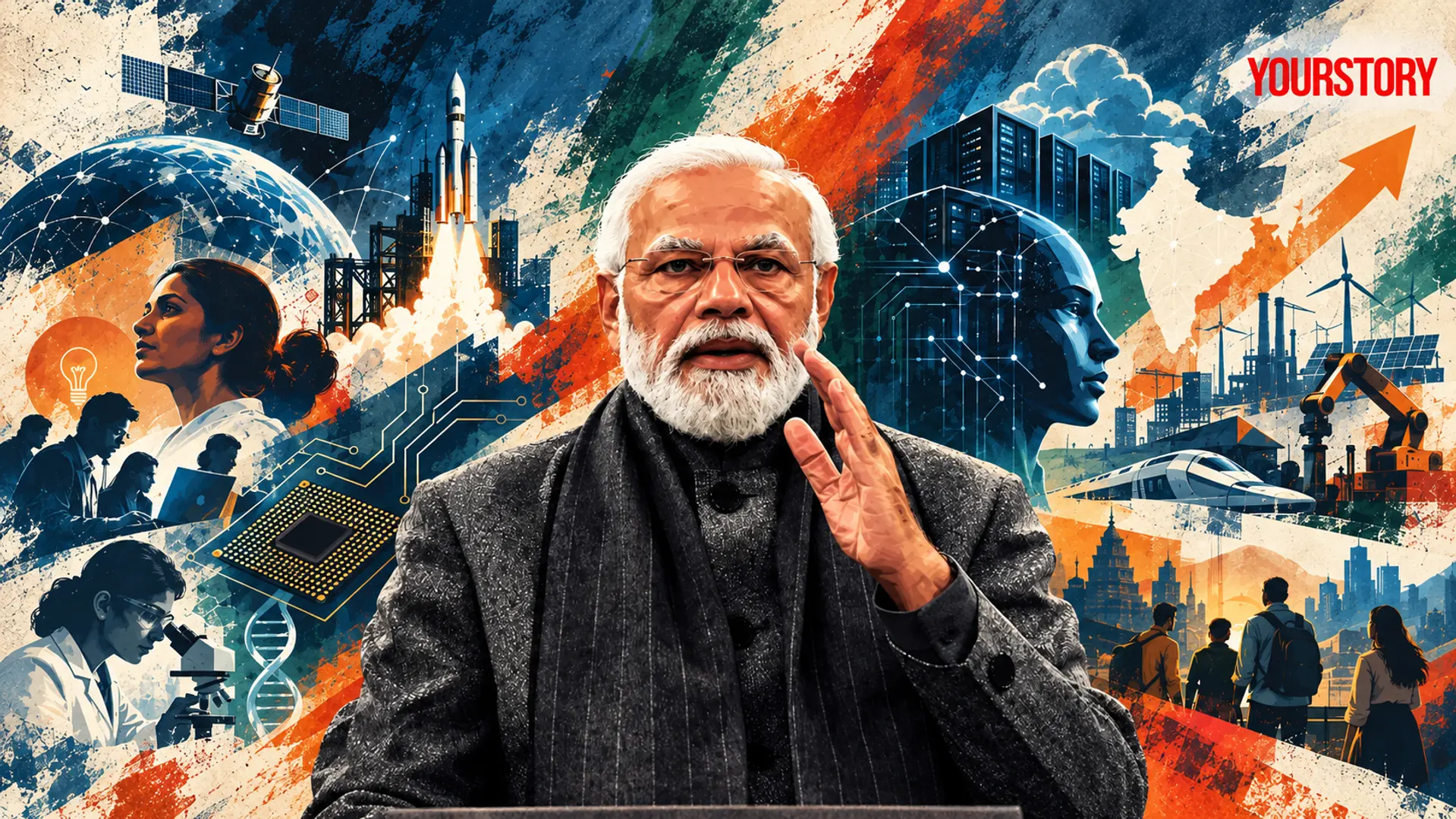

For most of the last decade, the conversation was about starting up: entrepreneurship, venture capital, unicorns, digital businesses. The conversation today runs deeper. Who will build India's AI models? Who will design its chips? Who will fund its laboratories, its rockets, its biotech platforms, its quantum computers? And can the next generation of entrepreneurs come from every district, not only Bengaluru, Delhi and Mumbai?
Over the past twelve years, and with particular intensity in the past twelve months, the government led by Prime Minister Narendra Modi has been answering those questions with capital, compute and missions. On his 76th birthday, here are 17 moves that matter to India's builders, and what they set up for the decade ahead.
Capital
1. Rs 1 lakh crore for research and innovation
The Research, Development and Innovation Fund may prove the most consequential intervention of the year. It is built to bring long-term, low-cost capital into hard areas: AI, quantum, robotics, space, biotech, energy. The Cabinet approved it on 1 July 2025 and the PM launched it on 3 November 2025 at ESTIC, with Rs 20,000 crore earmarked for FY26. Money is now moving: the Technology Development Board signed its first agreements with five deeptech companies and made the first disbursement on 13 May 2026.
Why it matters: India has never lacked entrepreneurial ambition. Deeptech needs the harder thing, patient capital.
2. Another Rs 10,000 crore for the startup capital stack
In February, the Cabinet approved Startup India Fund of Funds 2.0 with a Rs 10,000 crore corpus, prioritising deeptech, tech-driven manufacturing, early-growth founders and investment beyond the major metros. The next startup cycle is being designed to look different from the consumer-internet cycle that produced India's first unicorns.
3. Startup debt got easier
Equity cannot fund everything. The Credit Guarantee Scheme for Startups doubled its maximum cover per borrower from Rs 10 crore to Rs 20 crore in FY26, and by the end of the year more than 410 loans worth over Rs 1,250 crore had been guaranteed. For founders, this means growth capital that does not always cost ownership.
4. Public capital kept pulling private capital behind it
The original Fund of Funds shows how government can back startups without picking them. By the end of FY26, more than Rs 7,000 crore had gone to over 135 AIFs, which in turn invested more than Rs 26,900 crore in over 1,420 startups. Nearly four rupees of private money for every public rupee. FoF 2.0 aims to repeat that multiplier for deeptech.
Compute and AI
5. AI compute became national infrastructure
The biggest barrier to serious AI companies is no longer talent. It is compute. Under the IndiaAI Mission, more than 38,000 GPUs are available to startups and researchers at a subsidised rate of about Rs 65 an hour, with another 20,000 announced in February and a stated target of 100,000 by December 2026. Build the rails, let entrepreneurs build on top.
6. From using AI to building Indian AI
India is now backing indigenous foundation models rather than accepting that the base layer of AI must come from elsewhere. Twelve startups have been selected to build multimodal foundation models on India-specific data, and Sarvam launched two open-source models, a 30B and a 105B, at the AI Impact Summit in February. The shift is from AI adoption to AI ownership.
Frontier missions
7. Semiconductors became an industrial mission
This year's biggest bet. On 15 July 2026 the Cabinet approved Semicon 2.0 with an outlay of Rs 1,27,500 crore, and it is designed to fix what the first phase revealed: equipment and specialty chemicals are still overwhelmingly imported. Twelve units were approved under phase one, three are already shipping chips, and the first front-end fab at Dholera is expected to begin commercial production in 2028. The question for founders is no longer whether India can make chips. It is how much of the design, equipment and IP around them Indian companies can own.
8. Deeptech entered the mainstream
Quantum, robotics, space, biotech, advanced materials were once peripheral to Indian venture. The RDI Fund names them as strategic. That matters because India's most valuable companies of the 2030s may take ten years to build, not ten months.
9. Private space kept opening up
The deeper story of India's space reforms is not rockets. It is an ecosystem where private companies can access what used to be out of reach. The Rs 1,000 crore venture fund, the Rs 500 crore Technology Adoption Fund, and access to ISRO's infrastructure, expertise and mentorship now sit alongside in-orbit validation on ISRO's POEM platform. Space is becoming an industry, not a programme.
10. Biotech got the bridge from lab to market
India has abundant scientific talent; translating it into products has been the gap. The Rs 9,197 crore Bio-RIDE scheme, with its new biomanufacturing and biofoundry component, exists to close it, alongside the BioE3 policy's push on biomanufacturing.
11. Quantum moved from aspiration to ecosystem
The National Quantum Mission has an outlay of Rs 6,003.65 crore over eight years and runs through four thematic hubs in computing, communication, sensing and metrology, and materials and devices. The test now is whether research inside those hubs becomes companies outside them.
Founders
12. Startup India's biggest year
More than 55,200 startups were recognised in FY26, the highest ever in a single year. Total recognised startups crossed 2.23 lakh as of 31 March 2026, with over 23.36 lakh direct jobs. The number that matters next is not how many India registers, but how many scale.
13. Entrepreneurship moved beyond the metros
Over 45 percent of DPIIT-recognised startups now come from Tier-II and Tier-III cities. That may be the most important democratisation story of all. India cannot build its entrepreneurial future in five postal codes.
14. More women in the formal startup economy
Over 1.07 lakh recognised startups, nearly 48 percent, have at least one woman director or partner. The next milestone is capital: how much of it reaches women who found and run companies.
15. Innovation as infrastructure
Fibre, 5G, compute and capital markets look like separate stories. They are not. Over 2.18 lakh gram panchayats are service-ready on BharatNet, and 5G reaches 99.9 percent of districts. These are the rails the next founder builds on, wherever she lives.
The bigger question
16. India's innovation rank kept climbing
India moved from 81st on the Global Innovation Index to 38th, and it is now the world's sixth-largest patent filer with more than 63,000 filings in 2024. Rankings are not the destination, but they show the direction of travel.
17. India is asking a different question
For years the question was: can India build successful startups? Increasingly it is: can India own the technologies that will define the next 25 years? AI models. Chips. Rockets. Quantum. Biotech. Robotics. Energy. Advanced manufacturing.
That is the thread through most of these decisions. From Startup India to Build India. From adoption to invention. From entrepreneurship to technological ownership.
What comes next
A birthday is a moment to look back. For India's entrepreneurs, the more interesting question is what comes next.
The government has built the rails: capital that waits, compute that is affordable, missions that name the frontier. What founders now have to do is harder. Turn registrations into companies that last. Turn women's participation into women's capital. Turn research inside hubs into products outside them. Turn Indian chips into Indian chip IP.
Government can create the rails. Capital can provide the fuel. Institutions can open doors. But entrepreneurs have to build.
On Prime Minister Narendra Modi's 76th birthday, the most meaningful measure of the road ahead will not be how many startups India registers, but how many enduring companies, technologies and jobs India creates.
The next chapter of Startup India must be Build India.