



Samtel Avionics, BULL explore joint approach to space debris
Samtel Avionics and Japan’s BULL will explore combining passive post-mission disposal and active debris removal technologies to develop practical solutions for space sustainability.

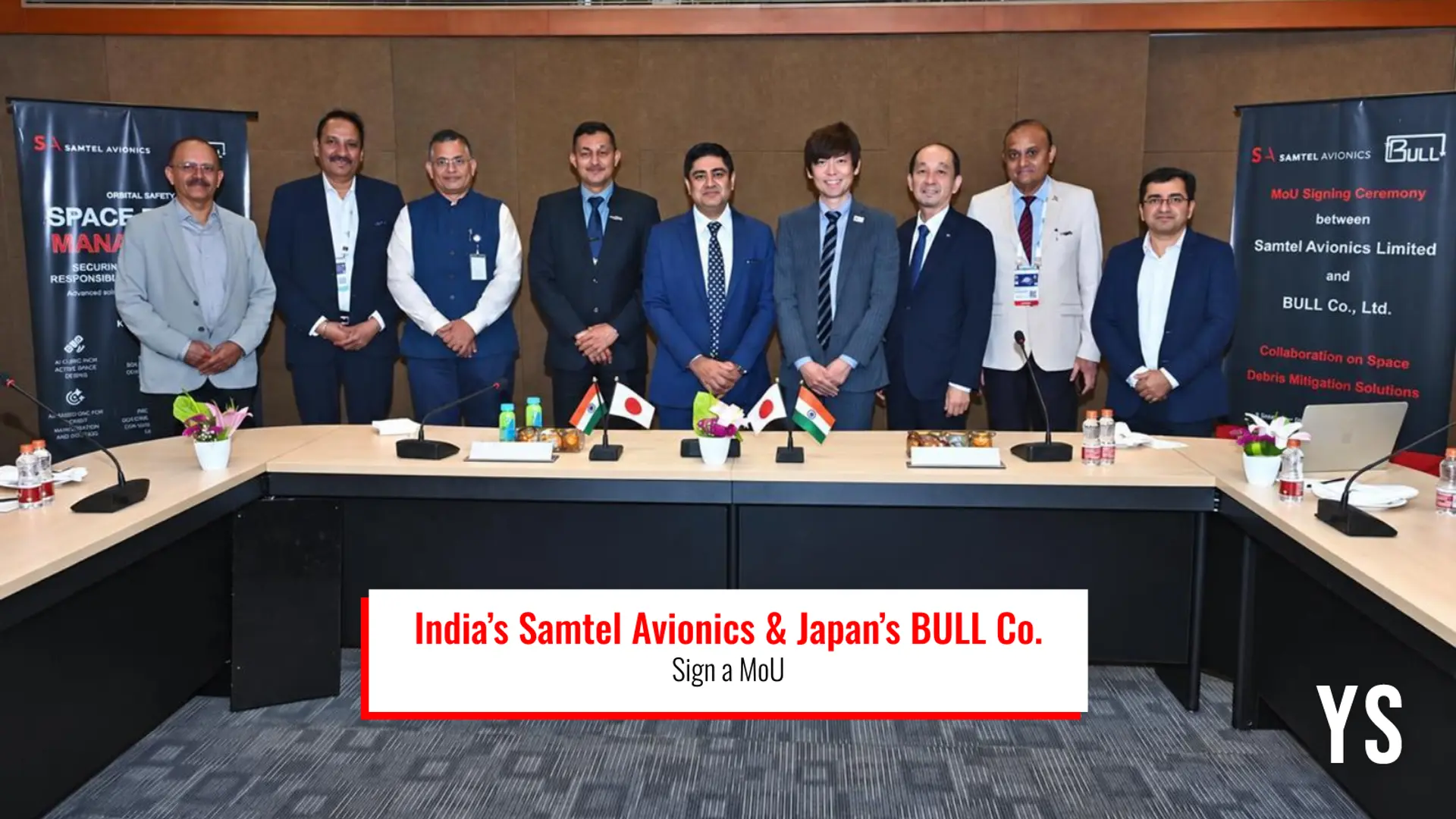

Samtel Avionics and Japan’s BULL Co., Ltd. have signed a memorandum of understanding to explore combining passive post-mission disposal technology with active debris removal systems, as the number of objects in Earth orbit continues to rise.
The agreement is exploratory rather than a commitment to a commercial product, but it points to a broader shift in the space industry towards tackling debris both before and after satellites stop operating.
The problem is becoming harder to ignore. The European Space Agency estimates that about 40,000 objects are currently tracked in Earth orbit, including roughly 11,000 active payloads. The actual population of debris larger than 1 cm is estimated at more than 1.2 million. At orbital speeds, even relatively small fragments can damage or destroy spacecraft. ESA has warned that active debris removal is needed alongside efforts to prevent new debris from being created.
The proposed Samtel-BULL combination addresses two different parts of that problem. BULL develops passive Post-Mission Disposal (PMD) systems designed to help spacecraft leave orbit after their operational lives. Essentially, PMD is about preventing a functioning satellite or rocket-related object from becoming long-lived debris. Active debris removal, by contrast, involves a separate spacecraft approaching an object that can no longer dispose of itself and helping to remove it from orbit.
Under the MoU, the companies will examine technical requirements, system interfaces, customisation and possible integration. They may also assess opportunities to attach BULL’s passive PMD device to existing debris in orbit using Samtel’s debris removal vehicles. Any such activity would remain subject to separate agreements and technical, export-control and regulatory requirements.
Puneet Kaura, Managing Director and CEO of Samtel Avionics, said, “Space debris is an increasing challenge for the sustainable development of the global space economy. Through our collaboration with BULL, we aim to explore innovative and scalable solutions that combine BULL’s passive PMD technologies with Samtel’s capabilities in satellite systems and debris removal concepts.”
The timing is significant for both countries. India declared its Debris Free Space Mission in 2024, with the objective of achieving debris-free missions by the Indian government and private space actors by 2030. ISRO has also been expanding its Network for Space Objects Tracking and Analysis, known as NETRA, to improve monitoring of satellites and debris.
Japan has been pursuing practical debris-removal demonstrations as well. JAXA’s Commercial Removal of Debris Demonstration programme uses private companies to develop technologies for removing large Japanese-origin debris. Astroscale’s ADRAS-J completed its first phase in 2025 after demonstrating close-proximity operations, including approaching a rocket body to about 15 metres. Its follow-on ADRAS-J2 mission is planned to attempt capture and removal of the same object, with launch planned for fiscal 2027.
BULL’s own development has also moved beyond the laboratory. The company, founded in 2022, was selected for Japan’s J-Startup programme in 2025 and is listed by JAXA as a partner startup focused on PMD technologies. Its first in-orbit PMD demonstration, according to a statement, began aboard Japan’s H3 Launch Vehicle No. 6 in June 2026 and was declared successful in July.
For Samtel, the agreement also fits its broader move from traditional defence avionics into space and satellite technologies. Its history includes a joint venture with Hindustan Aeronautics Limited established in 2006 for indigenous defence avionics production, while the company said it is now expanding into satellite capabilities and other advanced aerospace systems.