



No nation builds a chip alone: Vikram Misri's case for partnership at SEMICON India 2026
Vikram Misri lays out four forces pushing every chipmaking nation toward partnership, and three tests for choosing the right one

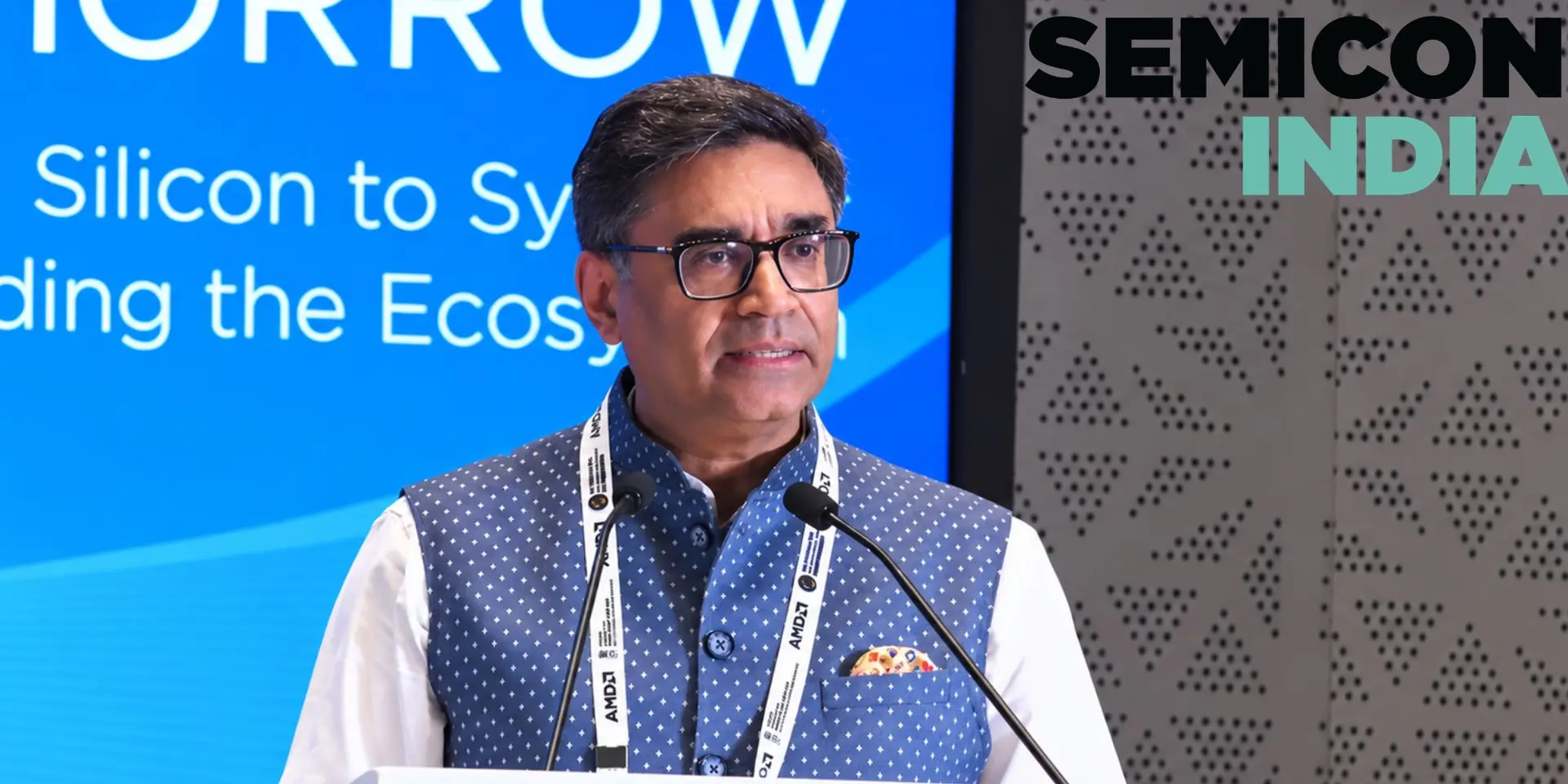

Self-reliance in semiconductors does not mean building everything within a country's own borders, Foreign Secretary Vikram Misri told delegates at SEMICON India 2026 in New Delhi. Speaking on the International Collaboration track on the conference's second day, 18 September 2026, Misri argued that the real opportunity for companies and countries lies in choosing the right partners rather than going it alone. "No nation builds a chip alone," he said, noting that even Taiwan, which produces over 90% of the world's most advanced chips, still depends on design software, tools and materials developed elsewhere.
Why SEMICON India 2026 put partnership over self-reliance in the spotlight
SEMICON India 2026, held at Yashobhoomi in New Delhi from 17 to 19 September 2026, is jointly organised by the India Semiconductor Mission and SEMI, and has grown into the country's largest platform for semiconductor policy dialogue. This year's theme, "Silicon to Systems: Building the Ecosystem," reflects a shift in India's conversation, from whether it can manufacture chips to how quickly it can build the ecosystem around them.
The four forces pulling chipmaking nations into partnership
Misri laid out four forces he said pull nations into coalitions. The value chain itself forces partnership, since design, equipment, fabrication, materials and assembly rarely sit in one country. Over concentration is worth diversifying away from as sound industrial practice, he said, pointing to how a handful of countries dominate rare earth processing and advanced node manufacturing, calling a single point of failure "an eminently avoidable situation."
The race to the technological frontier has become a shared national project backed by real money, he added, citing the United States' over $50 billion CHIPS Act commitment, China's sustained investment, Europe's ambition to capture a fifth of global manufacturing capacity, and India's own SEMICON India programme. Standard setting and interoperability, he argued, are the least visible but most durable form of influence.
India's own audit: sovereign strength here, trusted partners there
No nation on Earth builds everything within its own borders, Misri said, and attempting to would mean higher costs, slower innovation and a lonelier industrial base. Properly understood, self-reliance means knowing precisely where a country's capabilities must be sovereign, and pursuing trusted partnership everywhere else with equal discipline. For India, he pointed to a young, English fluent engineering talent base, a large domestic market, political stability and policy momentum, a Rs 76,000 crore India Semiconductor Mission 1.0, 12 approved projects, three already in production, and a now underway ISM 2.0. He was candid about the gaps too, saying trust "is built on accurate expectations, not on enthusiasm."
What does self-reliance actually mean in the semiconductor industry
Self-reliance is often read as a country manufacturing every part of a chip within its own borders. That is not how the industry works anywhere, including in established chipmaking hubs. A single advanced chip typically passes through design software from one country, materials from another, and fabrication equipment from a third before it reaches a device. What Misri described is narrower, sovereignty over a few critical capabilities rather than control over the entire chain, while relying on trusted partners for the rest.
Misri closed with three tests for choosing a partner: look for complementarity rather than duplication, value predictability as much as price, and invest in the relationship before it is needed. He framed SEMICON India itself as the mechanism for that trust building, "built through the handshakes, the discussions, and the deals" such gatherings make possible. The sharper test now is whether global equipment makers, materials suppliers and design houses turn this week's conversations into long term commitments.