



Women shaping India’s chip future take centre stage at Semicon India 2026
Four women leaders across the chip value chain on how they got there and what the next generation should know

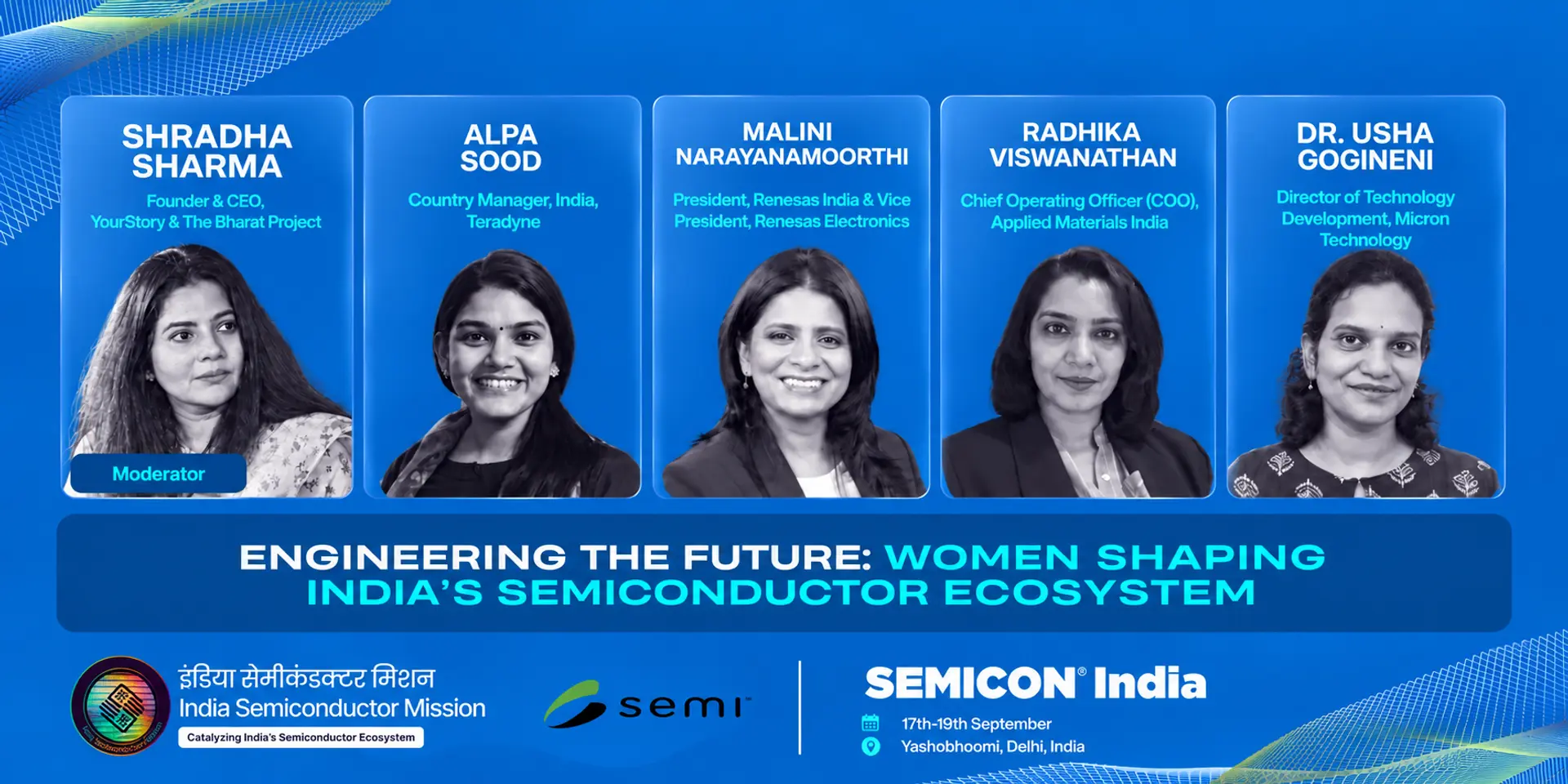

Four women who run India operations for some of the world's largest semiconductor companies will share a stage at Semicon India 2026 in a session titled "Engineering the Future: Women Shaping India's Semiconductor Ecosystem". The panel, moderated by Shradha Sharma, Founder and CEO of YourStory and The Bharat Project, brings together Malini Narayanamoorthi, President of Renesas India and Vice President, Renesas Electronics; Radhika Viswanathan, Chief Operating Officer of Applied Materials India; Alpa Sood, Country Manager, India at Teradyne; and Dr Usha Gogineni, Director of Technology Development at Micron Technology.
The session is part of the dedicated Women Empowerment and Leadership track at the fifth edition of Semicon India, which runs from 17 to 19 September 2026 at Yashobhoomi in Dwarka, New Delhi, and is organised by the India Semiconductor Mission and SEMI. Prime Minister Narendra Modi inaugurates the event on 17 September.
Why a women's panel at Semicon India 2026
The track exists because the numbers are not yet where the industry wants them. Amitesh Kumar Sinha, Additional Secretary at MeitY and CEO of the India Semiconductor Mission, told YourStory ahead of the event that women already make up more than half of India's electronics manufacturing workforce, 70% in places and the entire floor in some factories, and he expects semiconductor plants to follow once they are fully operational. The gap is at the top, and in the pipeline of girl students who never consider the field because, as he put it, "at first semiconductors sound very hard".
Sinha said the women's programming at Semicon India was designed with that student in mind: leaders sharing how they entered the industry, how hard or easy it was, and how they handled the moment many women face after marriage when career and family seem to pull in opposite directions. "These women leaders will explain how they navigated that balance, and what it feels like to be a woman tech leader today, so students can take it as inspiration," he said.
Who is on the panel
Malini Narayanamoorthi took charge as Vice President and President of Renesas Electronics India on 1 March 2026, moving up from India Country Manager. She has more than two decades in the industry, with earlier engineering and applications roles at National Semiconductor, Synopsys and Rambus across North America and India, and has overseen Renesas' expansion of its design footprint across several Indian cities and its partnership with MeitY's Chips to Startup programme.
Radhika Viswanathan has been Chief Operating Officer of Applied Materials India since April 2025, overseeing operations across all of the company's India sites, including its research labs and the India Validation Center, the first private facility in India able to process 300 mm wafers. She spent close to a decade at Micron before that, rising to Senior Director of Integrated Business Planning and Global Supply Chain Operations, and holds a Master of Engineering in Microelectronic Engineering from the Rochester Institute of Technology.
Alpa Sood is the newest of the four in her role, appointed Teradyne's Country Manager for India in June 2026 and based in Bengaluru, where the automated test equipment maker opened its India office this week and is setting up an AI centre of excellence. She brings more than 15 years across business, policy and government affairs, most recently leading government affairs, legal and strategic policy at Marvell India, and has worked closely with central and state governments on semiconductor ecosystem building.
Dr Usha Gogineni leads technology development for Micron in India. A device engineer by training, she studied at the Regional Engineering College in Warangal and Auburn University before a PhD at MIT, worked on silicon-germanium technologies at IBM Microelectronics, and led compact modelling work at Maxim Integrated and ams AG before joining Micron.
Between them, the panellists cover the parts of the value chain India is now trying to build at once: chip design and product engineering at Renesas, fab equipment and process R&D at Applied Materials, test equipment at Teradyne, and memory manufacturing at Micron, whose Sanand plant was among the first three under the mission to enter commercial production.
What does the semiconductor industry need from women engineers now
Sinha's own example of what the answer looks like on the ground is CG Power's plant in Sanand, Gujarat, where the operators working on semiconductor equipment and packaging chips are all women from Jharkhand, Madhya Pradesh, Bihar, Odisha and the North East, sent to Malaysia for training and now, in his words, explaining chip packaging "like confident engineers". The panel is meant to show the other end of that ladder.
It also sits inside a wider push at this year's event, with a Workforce Development pavilion running student mentorship and fab-process training, and a dedicated talent pillar under Semicon 2.0, the Rs 1,27,500 crore second phase of the mission notified on 31 August 2026.
Registration for Semicon India 2026 is through the event website, and the main sessions will be webcast for those who cannot travel to Delhi. For a girl student in an engineering college who has been told the industry is not for her, this panel is where four women who run it will say otherwise.