



Silence Laboratories is building privacy-first cybersecurity technology
Palo Alto-based startup Silence Laboratories works with around 35 clients globally, including a top US bank, and has research published in more than 10 Tier-1 publications.

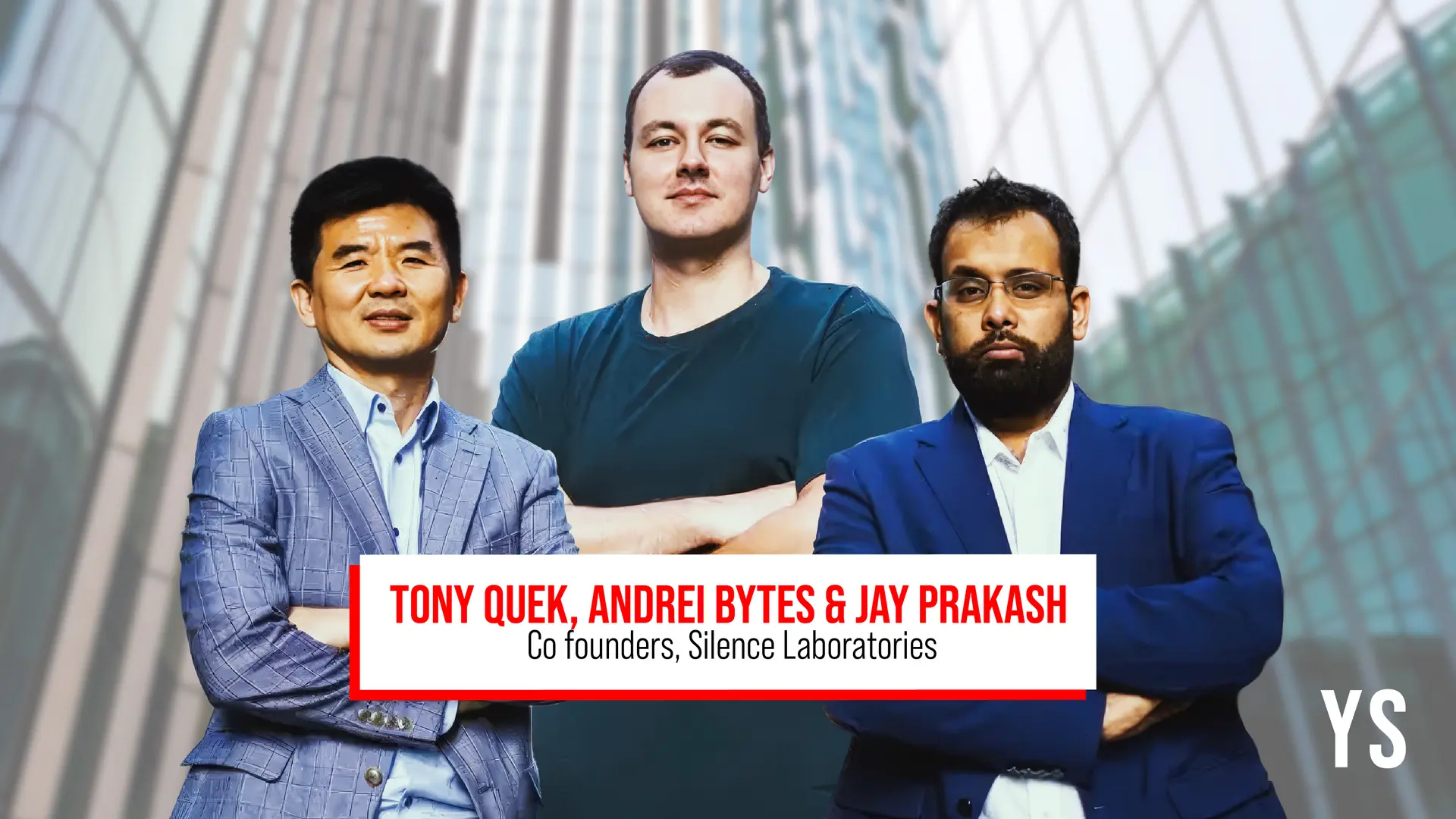

The foundations of cybersecurity startup Silence Laboratories are rooted in research. Its products are built on ideas that emerged from the doctoral research of each of its founders.
“One of our earliest products lived in the audio space. We worked on the fusion of sound waves and radio frequency (RF) waves for proximity-based verification,” says CEO Jay Prakash. “The idea was to use sound and wireless signals to confirm that a login device and a token device are physically close to each other when authentication is approved.”
That early work with silent, inaudible signals gave the startup its name. As the company expanded beyond audio into a broader suite of privacy-enhancing and cryptographic products, the name stayed.
Today, Silence Laboratories is a cryptography company focused on building cryptographic privacy-enhancing technologies.
“Our products empower organisations to compute on encrypted and distributed data sources, without ever exposing the data to any of the parties involved,” Prakash says.
Along with Prakash, the Palo Alto-based startup was founded by CTO Andrei Bytes and CSO Tony Quek. Its 30-member team is spread across 14 countries and includes former leaders from VMware, Snap, A.T. Kearney, and Oracle.
Collectively, the founders bring more than 40 years of cybersecurity experience. Prakash says the team’s research background is reflected in more than 10 Tier-1 publications and collaborations with Microsoft and IISc.
The startup recently won the Accenture Tech Next Challenge 2026 in the cybersecurity category. Prakash says the win validated the team’s technology and the growing market need for privacy-preserving data collaboration.
Products built around privacy
Silence Laboratories’ products are powered by a cryptographic computing virtual machine (CCVM), a secure virtual environment that allows applications to perform computations on encrypted data without exposing the underlying information.
The technology is built on Multi-Party Computation (MPC) and Zero-Knowledge Proofs (ZKP). MPC allows multiple parties to jointly compute on shared data without revealing their private information to one another. ZKP allows someone to prove a statement without revealing the information underlying it.
Prakash says this makes the technology different from conventional approaches.
“In most data-sharing arrangements, you're ultimately trusting policies, contracts and third-party intermediaries to behave and keep data safe. We replace that with trust in mathematics and cryptography,” he says.
The privacy guarantee, he adds, is not simply a promise written into an agreement. It is enforced by the cryptographic protocol itself, regardless of who is involved or how they behave.
“In practice, this means our collaborators always retain control of their own data. No raw data ever moves outside an organisation's boundary. The parties define exactly what can be computed and for what purpose. Each participant learns only the agreed-upon result and nothing about the other's private inputs,” Prakash explains.
The company has been in this space for around six years, although its founders’ work on the underlying cryptography goes back much further. While the underlying techniques have existed in academic literature for decades, Prakash says the team’s work has focused on bringing them from theory into practice and making them robust, performant, and deployable at scale.
Silence Laboratories currently works with around 35 clients globally, spanning banks, custodians, fintechs and payment ecosystems.
It has been part of cross-border initiatives including Project Mandala with the Bank for International Settlements (BIS), and a collaboration with Proxtera to enable cross-border credit data portability. The latter won the G20 2025 TechSprint.
“Parts of our Agentic Privacy Preserving Protocol (AP3) have been open sourced with Linux Foundation Decentralized Trust, and we have early design partners including Networks for Humanity, Weilliptic and EigenLabs,” he says.
Its client base also includes a top four bank in the US and players across digital assets and fintech, including BitGo, MetaMask, Fold, Finvu, Biconomy, Okto, Zengo and Easycrypto, among others.

Preparing for quantum threats
Prakash says much of today’s digital infrastructure still relies on signature schemes that were not designed to withstand quantum threats, leaving digital assets particularly exposed.
As a result, quantum readiness has become a research and product priority for Silence Laboratories.
“We launched a dedicated post-quantum MPC protocol that lets us bring quantum-safe cryptography into MPC workflows while preserving everything that makes MPC valuable: distributed key control, policy enforcement, and separation of duties,” he says.
The MPC protocol is built on ML-DSA (Dilithium), the digital signature algorithm standardised by the US National Institute of Standards and Technology (NIST) under Federal Information Processing Standard (FIPS) 204.
“We recently worked with BitGo to complete the first post-quantum MPC transaction simulation by a regulated custodian, showing that institutions can adopt post-quantum security without disrupting their existing wallet systems,” says Prakash.
He adds that this would allow institutions to upgrade gradually rather than rush to migrate when quantum threats become real.
A wider role for privacy technology
Prakash believes industries have not completely warmed up to the advances made in cybersecurity in recent years. He says there is a perception that privacy-preserving computation requires substantial investment of time and resources, while the technology is production-ready and deployable today.
“Closing that awareness gap is crucial. Closely tied to that is a shortage of advocacy and regulatory clarity. In many jurisdictions, the rules haven't yet caught up to what cryptographic guarantees can offer, and there's too little institutional voice championing these approaches,” he says.
The founder adds that privacy and compliance should not be treated simply as a checkbox, but as a way to create business value.
“The truth is that these technologies do more than just satisfy regulatory requirements. They unlock collaboration, new data partnerships and insights that simply weren't possible before.”

A growing business
Silence Laboratories is looking to expand geographically. Prakash says the company plans to expand into the US and Europe, bringing its infrastructure closer to the institutions and regulators driving privacy and post-quantum readiness in those markets.
“In parallel, we're broadening the range of use cases we support, extending the same cryptographic foundations across new problems in financial services and other industries such as telecom and healthcare. We’re also focused on scaling and platformising our products, so that what we've built can be adopted more easily and at greater scale,” he says.
The startup has raised $6 million in funding and is planning to raise more to support its proposed expansion.
Prakash says the capital will primarily go towards hiring talent across cryptography, engineering and go-to-market functions, as well as expanding into new markets.
Silence Laboratories competes with companies such as Fireblocks and Inpher. Prakash says the company differentiates itself through its focus on research.
Its work has been published and presented at security and cryptography forums including IEEE S&P, ACM Conference on Computer and Communications Security, and EuroCrypt.
“Through our research, we have been able to translate it into real-world systems like our post-quantum MPC protocol. Our products are production-ready with no specialised hardware, with data staying encrypted. There's no third party and no movement of raw data in the first place,” Prakash says.
Edited by Affirunisa Kankudti