



Why Beijing and New Delhi can’t afford to lose each other
Rivals on the border, partners on the factory floor. As Xi Jinping returns to New Delhi, India and China have pragmatic reasons to stop geopolitical distrust from derailing trade, investment and technology.

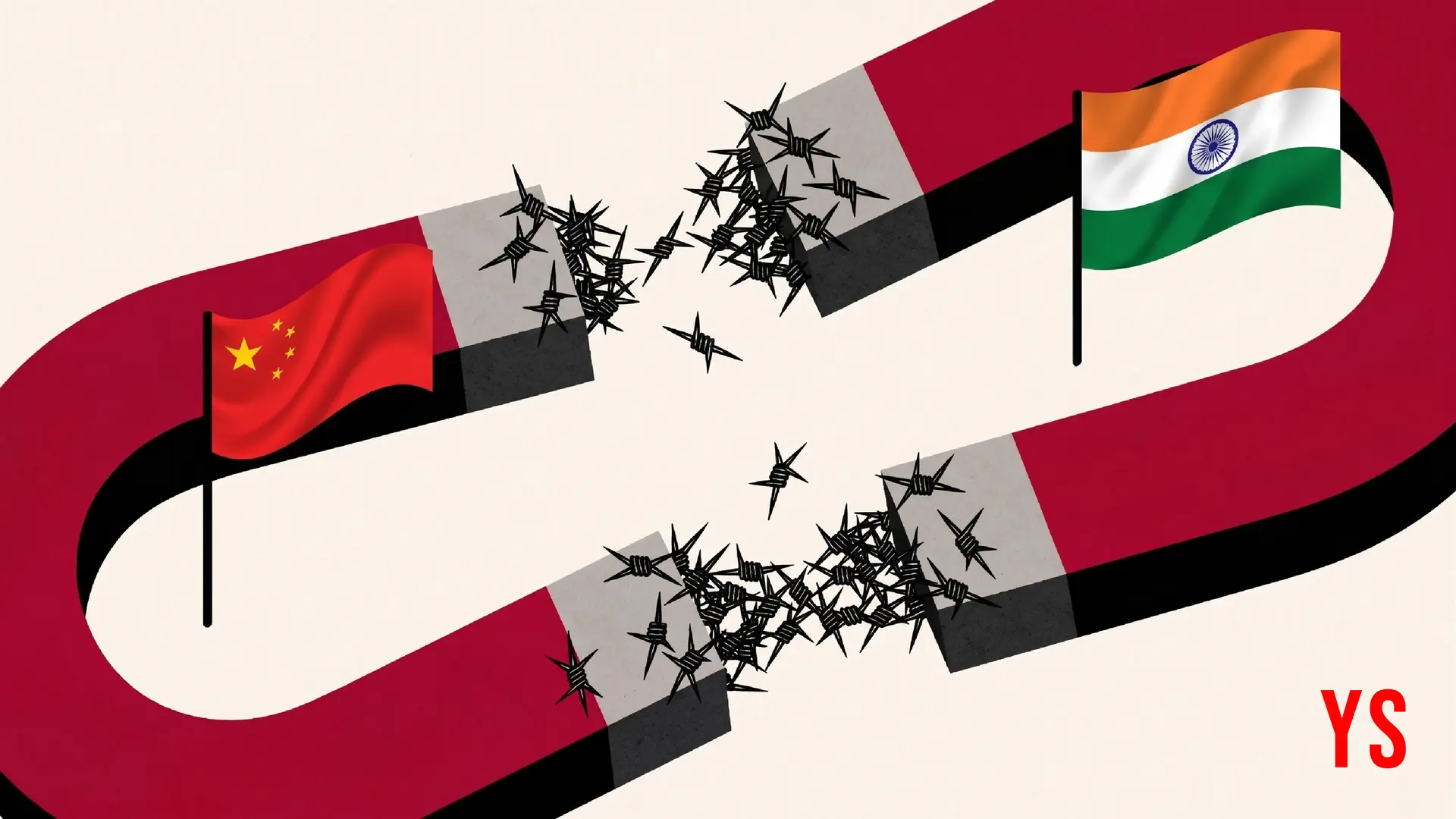

India and China are caught in a classic geopolitical paradox: pulling apart politically while growing closer economically. Six years of border tensions, tighter investment scrutiny and mounting security concerns have done little to cool commercial reality. Bilateral trade surged to a record $151.1 billion in FY26, with China overtaking the United States as India’s largest trading partner. Indian exports to China jumped 36.6% to $19.47 billion while imports rose 16% to $131.63 billion.
That momentum has carried into FY27, with Indian exports rising nearly 26% year on year in April-May. The imbalance remains enormous. India ran a record $112.16-billion trade deficit with China in FY26. But the relationship is not entirely moving in one direction. Chinese customs data show India bought about $135.9 billion of Chinese goods in 2025, up 12.8%, making it a significant market for Beijing at a time when trade barriers are rising elsewhere.
That is the contradiction Xi Jinping will encounter as he returns to New Delhi for the BRICS summit, his first India visit in nearly seven years: India depends heavily on Chinese industrial inputs, but Beijing increasingly values access to one of Asia’s fastest-growing consumer and manufacturing markets.
The import dependency trap
Look closely at what India buys from China and the reliance is hard to miss. China supplies India with industrial machinery, integrated circuits, telecom equipment, solar components, lithium-ion products, pharmaceutical ingredients and fertiliser. India’s exports to China remain far smaller and skew towards products such as iron ore, petroleum products, marine products and chemicals. Even after growing more than 36% in FY26, Indian exports were only a fraction of imports. But the $112-billion deficit cannot simply be read as India buying Chinese finished goods.
A large share consists of capital goods, components and intermediate products that Indian factories need to manufacture things themselves. Smartphones assembled in India still carry Chinese parts, solar manufacturers depend on Chinese equipment and inputs and EV makers remain exposed several layers down through batteries, magnets and power electronics.
The direction of travel, however, is towards deeper localisation. Global investment bank Jefferies expects Indian electronics manufacturers to cover about 50% of the mobile component value chain over the next six years, up from less than 20% today, while it expects roughly 90% of the solar manufacturing value chain to be localised by 2030. If those projections materialise, India’s dependence on China may not disappear, but its character could change significantly.
Decoupling is therefore easier to advocate than execute. New Delhi’s more realistic goal is more manufacturing and value addition at home, more domestic components over time and fewer critical vulnerabilities, even if Chinese supply chains remain part of the equation for years.
Why Beijing cannot write off New Delhi
Beyond domestic slowdown and Western trade barriers, China has growing reasons to value India’s market scale and manufacturing momentum. For years, the economic equation has largely been framed in one direction: India needs China’s factories while China can afford to do without India. That assumption deserves another look.
Chinese companies face intense competition at home and higher barriers in several Western markets, while India remains a large and fast-growing market for electronics, electric vehicles, renewable energy, data centres and advanced manufacturing. New Delhi is also trying to establish itself as an alternative global manufacturing base. Chinese suppliers can participate where Indian rules allow it or risk watching Japanese, Korean, Taiwanese and other competitors capture more of that opportunity.
Recent supply disruptions have demonstrated both the extent and the limits of Beijing’s leverage. China accounted for 91% of global refined output of magnet rare earths and 94% of sintered permanent magnet production in 2024, according to the International Energy Agency. Its export controls on rare-earth magnets disrupted Indian automotive supply chains, while restrictions involving fertiliser and industrial equipment created pressure elsewhere. Yet Beijing subsequently moved to address some of those concerns as bilateral engagement resumed.
The episode underlined the interdependence: restricting critical inputs can hurt Indian industry, but it can also shut Chinese suppliers out of a large and growing market. What may be emerging instead is competitive coexistence.
Testing the limits on investment
Investment is perhaps the clearest test of whether improving political ties can translate into a different economic relationship. After the 2020 border confrontation, Press Note 3 brought investments from land-bordering countries under government scrutiny, with Chinese capital among the most affected. The impact was particularly visible in startups, where Chinese investors had put billions of dollars into Indian technology companies and held stakes in several of the country’s best-known unicorns before 2020.
The door has now reopened, but only narrowly. India revised the framework this year to allow investments where ownership linked to land-bordering countries is non-controlling and does not exceed 10% to proceed through the automatic route, subject to sectoral rules. By August, 29 investments worth about Rs 4,895 crore had been reported under the revised framework across areas including manufacturing, AI, pharmaceuticals and data centres.
This should not be read as Chinese money flooding back into India. Much of it involves global funds with minority Chinese exposure. The larger opportunity is to distinguish between strategic risk and commercial capital, allowing investment that builds factories, jobs and local supply chains without giving up control of sensitive assets.
Where the friction gets real
Technology and people are where the relationship becomes more complicated. For years after 2020, Indian manufacturers complained that they could not get enough Chinese engineers into the country to install and commission machinery. India eased some of those bottlenecks late last year and business visas for Chinese professionals began moving faster. More recently, however, Indian companies have faced tighter Chinese visa approvals for executives who need to visit suppliers, inspect equipment and train staff.
The direction of friction may change, but the underlying problem is the same: restrictions intended as geopolitical leverage can quickly spill into factories and supply chains on both sides. Chinese technology is already entering India through licensing arrangements and commercial partnerships even where direct investment remains sensitive. India ultimately needs alternatives in critical minerals, batteries and advanced components, but those capabilities take years to build. Until then, a functioning commercial relationship with China buys Indian industry something valuable: time.
Could innovation become the next bridge?
Economic engagement need not stop at factories and supply chains. India and China could explore a narrowly defined innovation corridor for non-sensitive sectors such as healthcare, assistive technologies and selected areas of scientific research, allowing startups, universities and research institutions on both sides to collaborate without opening strategic technologies to unrestricted access.
There is precedent for separating research collaboration from geopolitical competition. The United States and China built deep scientific links even while competing strategically, though those ties have come under increasing political pressure. India and China could attempt a narrower model focused on areas where the public benefit is clear and national security risks are manageable. Healthcare affordability, ageing, accessibility and assistive technologies are obvious places to start, particularly for two countries that together account for a large share of the world’s population.
Predictability, not a grand reset
None of this means six years of distrust will disappear over one summit. Chinese companies still face scrutiny in India, especially around technology, financial services and data. India recently stalled a proposal to connect Alipay+ with the Unified Payments Interface over security and data concerns, while investment plans from companies such as BYD and Great Wall Motor have previously struggled to clear regulatory hurdles.
For businesses, the immediate prize is therefore not a dramatic reset but predictability: faster visa decisions, greater certainty around industrial equipment and critical inputs, clearer rules on Chinese investment and better access for Indian exporters.
The recent rise in Indian exports matters, but sustaining it will require a broader export basket and greater access to the Chinese market. India does not have to choose between engaging China and competing with it. It will have to do both. For New Delhi, the goal is fewer supply-chain vulnerabilities, more manufacturing at home, greater market access and a smaller trade imbalance. For Beijing, keeping access to a market of India’s scale and a place in its next phase of industrial growth is increasingly valuable.
India depends on Chinese inputs across important parts of its manufacturing economy today. But as Xi returns to New Delhi, Beijing has reasons of its own to ensure India does not decide it can do entirely without China tomorrow.