



She Builds Chips: The Women Powering India’s Semiconductor Revolution
Five senior women executives from Teradyne, Micron, Applied Materials, Renesas, and Tata Electronics shared candid career lessons at a SEMICON India 2026 panel moderated by Shradha

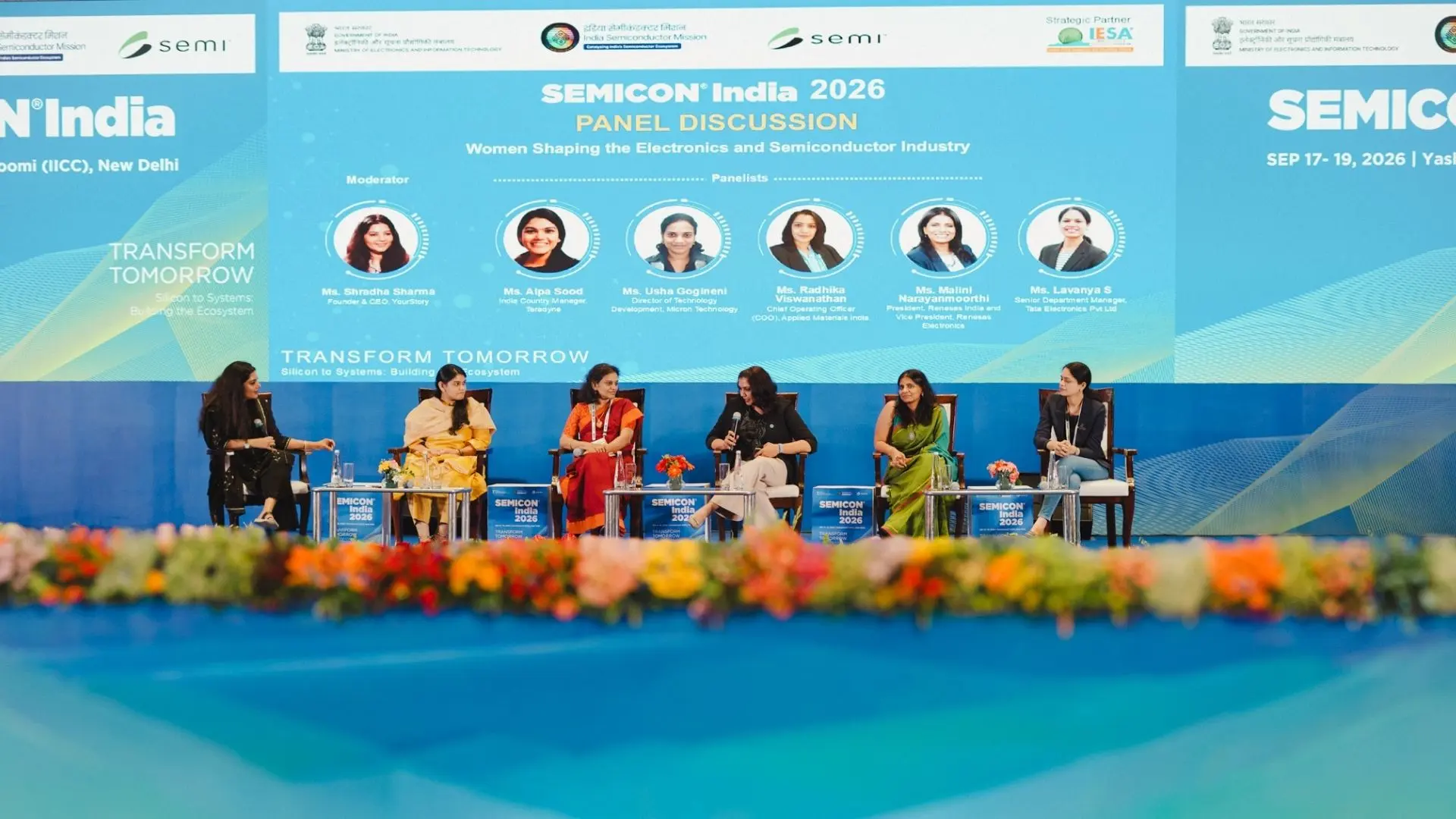

At SEMICON India 2026 in New Delhi, five senior women leaders from global chip companies came together on stage to talk about what it actually takes for women leaders in the semiconductor industry to rise to the top. The panel, titled "Women Shaping the Electronics and Semiconductor Industry," was held on 18 September 2026, the second day of the three-day event, and was moderated by Shradha Sharma, Founder and CEO of YourStory and The Bharat Project.
The panellists were Alpa Sood, Country Manager at Teradyne India, Usha Gogineni, Director of Technology Development at Micron, Radhika Viswanathan, Chief Operating Officer at Applied Materials India, Malini Narayanamoorthi, President of Renesas India and Vice President at Renesas Electronics, and Lavanya S, Senior Department Manager at Tata Electronics.
SEMICON India 2026 is being held from 17 to 19 September 2026 in New Delhi, jointly organised by the India Semiconductor Mission (ISM) and SEMI, and brings together global chipmakers, policymakers, and industry leaders over three days.
Opening the session, Shradha credited Amitesh Kumar Sinha, CEO of the India Semiconductor Mission, for making a deliberate choice to put a panel of women on the SEMICON India stage, noting that earlier editions of the conference had been filled with men. When people talk about R&D and deep tech, men come to mind, she said, admitting that she does it too. She asked the audience to read up on the panellists' accomplishments and go home and tell their stories to their daughters, sisters, and friends.
Five routes into the industry, and one common thread
Alpa, who trained as a lawyer and now leads Teradyne's India business, summed up her role in a line: the engineers make the best products, and she makes sure they reach the people who need them. The job takes resilience first, she said, and it is fine to cry it out as long as you show up the next day with a smile.
Usha described a winding route from IBM in the United States, through a PhD at MIT, to a return to India and a leadership role she had never planned for. She put it down to curiosity, a willingness to try different things, and the adaptability each new thing demanded. Not having a fixed 20-year goal, she said, meant she could take opportunities as they came without seeing them as distractions.
Radhika, who spent a decade on global semiconductor operations strategy and worked on the first project approved under ISM 1.0, recalled a photograph from SEMICON India 2024 showing about 28 men and no women. She kept it on her phone, showed it to her leadership team, and said it was part of why she moved to India in April 2025.
Malini, a mother of two, built her career in applications engineering, chose breadth over depth, and returned to India about five years ago to build and scale Renesas' design team.
Lavanya, who worked at TSMC in Taiwan before joining Tata Electronics to help bring up India's first fab, said TSMC's then chief executive used to say every CEO starts as an engineer. The way forward, regardless of gender, is to take on the hardest projects early.
How they answered the labels women leaders still get
The most pointed exchange came when Shradha asked about a pattern she said holds true globally: women in leadership are labelled either as too emotional or, if demanding, as difficult in ways rarely applied to male bosses with the same standards.
Malini said she was once told she was not ready for a role because she had teared up over something at work, which made her emotional in the eyes of the man assessing her. Her response was to hear him out and then examine honestly whether the criticism was fair, rather than dismiss it or accept it outright. Her conclusion was that she would lead by being genuine, logical, and communicative, and if that came with a tear now and then, it was part of who she was, and the people around her would have to be fine with it.
Alpa's story went back to her first four years at work, when she was repeatedly told a woman should go home early and the more interesting assignments went to others. The one person who backed her was the security guard at her office, where she was among the handful of people who stayed on until midnight. He was not even on duty at that hour, but waited every night until she finished and walked her to her auto-rickshaw. The lesson she took from it was that concern for a woman's safety is real but is not a reason to send her home, that there is always a way to work around it, and that support can come from someone with no obvious stake in your career.
Usha said her early confusion was about what kind of leader to be. Most leaders she had seen were men, and the stereotype was that leaders had to be strict and strong while women were expected to be gentle and empathetic. The one exception in her career, when her first-, second-, and third-line managers at IBM were all women with MIT PhDs, Lisa Su, now CEO of AMD, among them, only underlined how rare that was. Her answer, eventually, was to stop choosing between the two moulds and be authentic, and she said global leaders now recognise that the best style combines both.
Radhika raised a subtler problem: women often get less feedback than men because male managers worry they will take it personally, a point she said Indra Nooyi's autobiography makes well. She credited an Israeli mentor with the line that reframed how she handled pressure, that it is not personal, only business.
Lavanya said that if someone leaves a team saying they do not want to work for a woman, the response is not to take it personally. She urged first-time managers to seek mentors across functions and even at other companies.
Why Are There Still So Few Women In Senior Semiconductor Roles
The numbers explain why this conversation still needs to happen. According to a 2025 report by talent solutions firm NLB Services, women make up about a quarter of India's roughly 220,000-strong chip design and engineering workforce, a share projected to cross 30% by 2027 and reach 35% by 2030. The gap widens sharply at the top, with the same report finding that men hold between 93% and 95% of leadership positions in India's semiconductor sector, leaving women with only 5% to 7% of senior roles.
Part of this comes down to a pipeline that has historically steered fewer women into core engineering and deep-tech specialisations, combined with what Malini called the many points at which a career can "slide off": marriage, childbirth, a child's schooling. Her advice was that these are not exits if you are creative about balancing them and keep going.
Asked what practical advice they would give a teenager, the panellists were specific.
Lavanya said girls are still routinely steered toward information technology for their BTech and should instead take up electronics and communication or electrical engineering, backed by internships that put them on bigger projects. Usha told young women not to be limited by their gender or to software alone, and said women tend to overthink the difficulties they will face when, in her experience, the challenges are minor and credibility earns recognition.
Alpa's advice was to learn business and finances early and to build situational intelligence, the knack of reading a room and working out how to move things. Radhika said Sinha had asked her how the industry could stop women quitting early in their careers, and her answer was that the next two decades in semiconductors are likely to offer one of the most rewarding careers available, and that every problem, personal or professional, can be worked through with patience.
As India's semiconductor investments move from announcements toward operating fabs, packaging lines, and design centres, the industry will need a far wider talent pool than it has today. The panellists suggested that closing the leadership gap will depend less on one-off panels and more on whether companies keep building mentorship networks, flexible career paths, and visible role models. Shradha closed by saying the industry is still not telling women's stories properly, and credited ISM for moving from policy to execution in four years and for setting a benchmark by putting these leaders on the SEMICON India stage.