



Yaanendriya is building the sensors that help robots know where they are
Bengaluru deeptech startup Yaanendriya makes inertial sensors, navigation systems, and control software for autonomous machines, with applications across defence, automotive, robotics, and gaming.


Autonomous machines, drones, robots, and unmanned vehicles need to know where they are before they can decide where to go. That depends on sensors such as accelerometers, gyroscopes, and magnetometers, which help machines understand their position and movement.
Most of these sensors are imported into India. Building them in-house requires expertise across hardware, algorithms, and calibration.
Bengaluru-based Yaanendriya is working to fill that gap.
The startup designs and manufactures sensors, navigation, and control systems for autonomous machines, serving commercial and defence applications in India and overseas. It was officially incorporated in February 2025, following nearly two years of research.
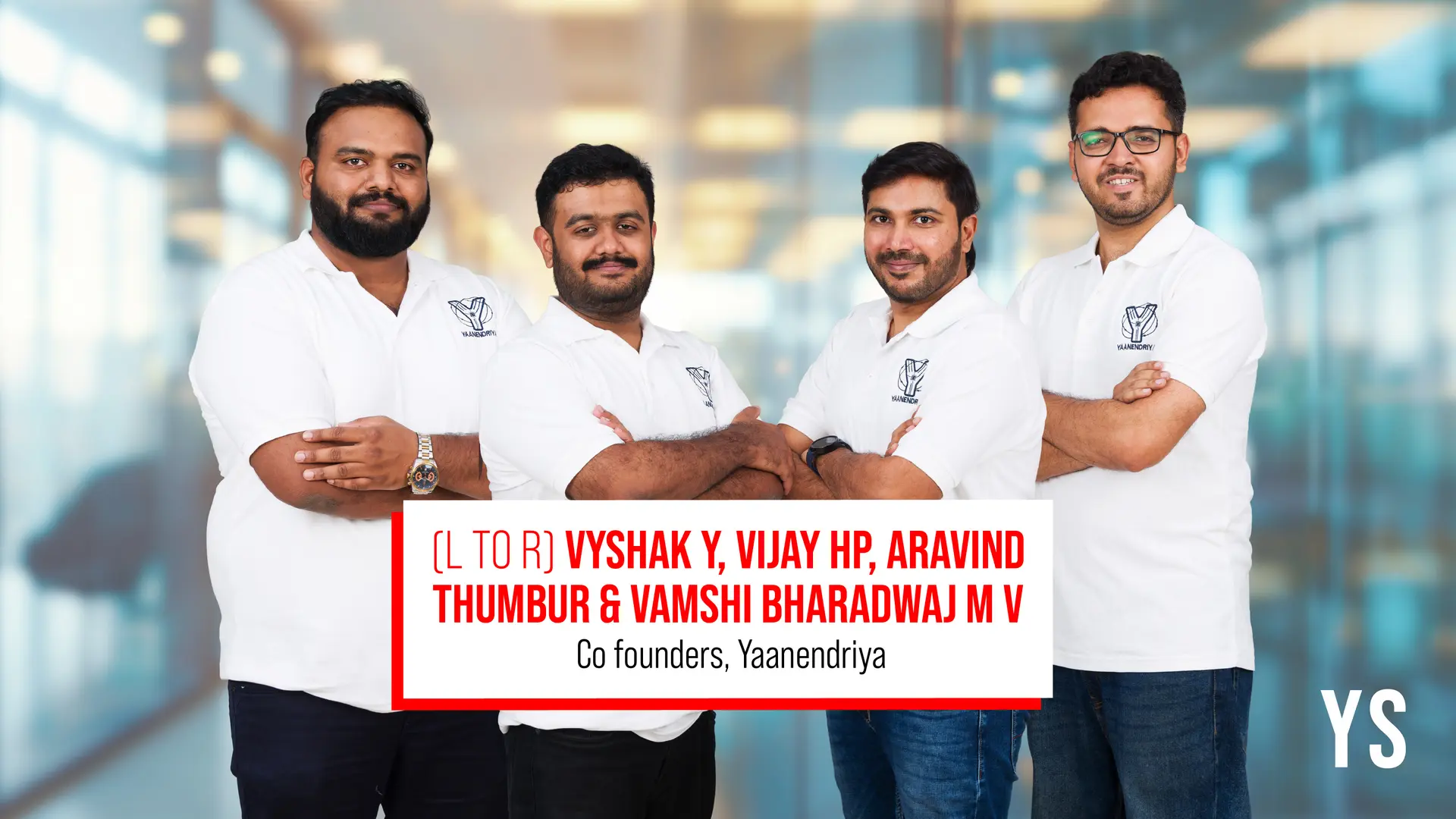
Vamshi Bharadwaj M V and Vyshak Y lead technology and manufacturing as CEO and COO. Vijay HP heads design as Chief Data Officer, while Aravind Thumbur, an IIM Ahmedabad graduate, serves as Chief of Staff, leading business and sales.
The team’s first products were sensors designed to track how the body moves after surgery, helping doctors monitor patients' recovery. They later realised that the same technology could help machines understand how they were moving.
The technology stack
Yaanendriya's products cover three parts of the sensing and navigation stack.
The first, YDX, is a range of motion sensors designed to fit inside drones, cars, and surgical robots. The sensors come in different grades, from simpler versions for everyday applications to more precise and rugged versions for defence and industrial equipment.
The second, SynCore, acts as the control system for an unmanned vehicle. It takes information from sensors and determines how the machine should move, correcting its path if it drifts and responding when something goes wrong during flight.
A version developed for the army does not store data and can wipe itself if it falls into the wrong hands.
The third, YPS, helps a machine determine its location. It currently uses satellite signals, while the company is developing radio-based positioning for environments where satellite signals are unavailable.
Yaanendriya competes with Indian companies such as Dilabs Systems and Aeron Systems, which also develop inertial navigation systems for defence and aerospace applications.
Inside the sensor
The challenge is not simply collecting sensor data. That data can be affected by vibration, magnetic interference, and other sources of noise, leading to inaccurate readings.
“Every sensor gives noise. Just like us, a lot of noise comes before the actual values,” Bharadwaj says. “So noise is one of the parameters we have to estimate.”
Yaanendriya uses filtering algorithms to correct for drift. Its calibration software also allows sensors to recalibrate when they enter a new environment.
The company uses machine learning to help combine sensor readings and understand noise, but Bharadwaj says it is not central to the system. “It is not AI per se. We use machine learning as a peripheral system,” he says.
A bigger part of Yaanendriya's longer-term plan is to develop MEMS chips in India. These chips contain the accelerometers and gyroscopes used inside the sensors. The company believes making them locally could reduce dependence on imported components, particularly those that are restricted for defence applications.
It is also developing Perception XIO, which combines cameras, lidar, and radar to help machines operate in places where GPS is unavailable, including deep indoors and underwater.
Manufacturing is outsourced to partners in Bengaluru, Ahmedabad, and Delhi, while design and calibration remain in-house. The founders compare this approach to Apple’s model.
The company has a 15-member team and keeps most of its operations within India, although some components are still sourced from the US and Europe.
From drones to surgical robots
Yaanendriya's systems are already being used in different applications.
Surveillance drones operated by the Karnataka State Police and built by drone manufacturers Neosky and Unisim use the startup’s flight controllers and GNSS modules. After an initial batch of 65 units, the company received a repeat order.
Its other customers include users of cricket simulators, surgical robots, satellite pointing systems, and underwater mapping equipment.
The company also makes serviceability part of its pitch. Rather than treating its components as disposable, it positions them as repairable assets. It points to repeat support requests from customers including the army and Neosky as evidence of this approach.
Yaanendriya sells components rather than finished products, with different accuracy tiers for commercial and defence customers.
The founders say its products are priced at roughly a quarter to a third of imported equivalents. Sensor modules cost between Rs 7,000 and Rs 80,000 depending on their precision. Controllers cost up to Rs 80,000, while positioning modules start at Rs 12,000.
The startup says its revenue crossed Rs 68 lakh in its first year. It recorded another Rs 48 lakh in the following quarter, helped by repeat orders.
Building for the next stage
Yaanendriya raised Rs 15 crore in a seed round led by Piper Serica in July 2026. The funding will be used for R&D, product development, and expansion of its navigation systems for mission-critical applications. Before the seed round, the startup operated with a grant from the Ministry of Heavy Industries, routed through ARTPARK and the IISc incubator ecosystem.
Over the next two years, Yaanendriya plans to develop an inertial navigation system for situations where GPS cannot be relied on, with the product due in 2027. It is also working on a new line of inertial systems for loitering munitions, long-endurance aircraft, and logistics drones.
The company’s own MEMS chips, which currently use accelerometers and gyroscopes sourced externally, are expected to enter their first production run in 2028.
India's deeptech market is projected to grow 2.5X over five years, reaching $27 billion to $33 billion by 2030, led by defence innovation and humanoid applications, according to RedSeer. The drone segment alone is expected to grow fourfold over the same period, driven by defence procurement and local manufacturing.
For Yaanendriya, the longer-term ambition is to bring the different parts of autonomous navigation under one roof.
“The longer kind of goal is to become that player who can provide sensors, perception, navigation, and control for all autonomous and unmanned vehicles and systems,” Bharadwaj says. "We want to be that one-stop company that can give reliable, repeatable, critical navigation systems for all their needs.”
The founders are also looking at expanding into Africa and Europe, alongside their push in the domestic market.
Edited by Affirunisa Kankudti