



AI Wrote More Than Humans in 2025, Becoming the Internet’s Biggest Writer
Machines wrote more than humans in 2025. And we didn't even notice. Here's the story of how AI quietly stole the internet.



For the first time, machines began producing more written content than humans. What started as a tool to assist writing has evolved into a system that now drives a significant portion of what we read online. And the shift happened faster than anyone expected. Let's take a close look at this trend and what lies ahead!
When AI quietly took over
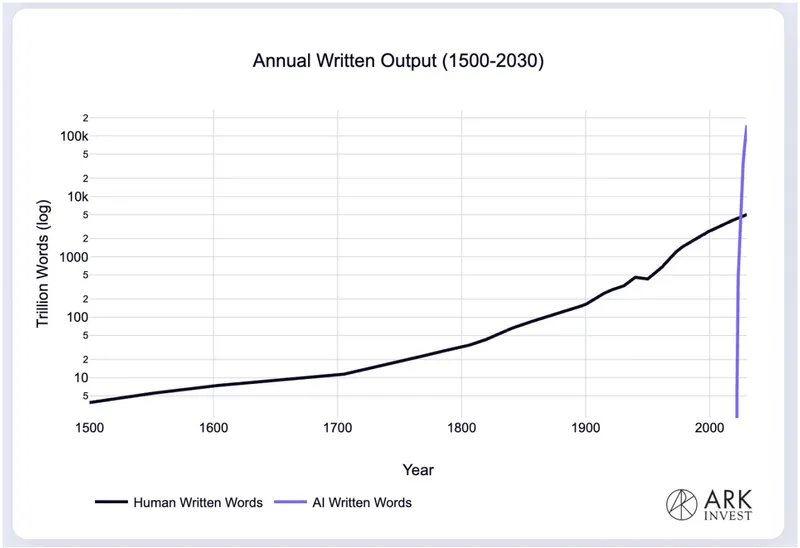
Recent data highlighted by ARK Invest shows that AI-generated text surpassed human-written output in 2025. This is not just about blogs or marketing copy. It refers to the total volume of written content produced globally.
Alongside this, research featured by AIhub suggests that more than half of newly published articles online are now generated using artificial intelligence. Together, these signals point to a clear conclusion. AI is no longer supporting content creation at the margins. It has become the dominant force behind it.
The scale is bigger than it looks
Credit: ARK Invest
Human writing has grown steadily over centuries, from printed books to digital publishing. The pace was gradual, shaped by education, access, and time. AI followed a very different trajectory.
Until a few years ago, its contribution to written content was negligible. That changed with the arrival of systems like ChatGPT, which made high-quality text generation accessible to anyone with an internet connection. What followed was not linear growth but a sharp acceleration.
Within a short span, AI tools moved from novelty to necessity for businesses, marketers, and even individual creators. By 2025, the scale had tipped decisively in favour of machines.
Even industry leaders are paying attention. When a viral post on X by Brett Winton, Chief Futurist at ARK Invest, broke down how AI had taken over the written internet, Elon Musk replied with 2 words: "wow." That's the reaction this shift deserves. Because this is the new internet.
Why has AI content exploded?
The reason is pretty obvious. AI scales content in a way humans simply cannot. Businesses can now produce hundreds of articles in the time it once took to write a handful. The cost drops, output increases, and speed becomes a competitive advantage.
For marketing teams, this unlocks a new level of efficiency. The internet, it creates an overwhelming surge of content. In many cases, the output is good enough that readers cannot tell the difference. However, the line between human-written and AI-generated content is becoming harder to spot.
The rise of an AI-driven internet
We are now entering what many describe as an AI-first internet. An environment where content is generated by machines, consumed by humans, and increasingly processed by other machines. This creates a feedback loop.
AI models are trained on internet data. But if that data is increasingly AI-generated, future systems may end up learning from their own outputs rather than original human input. Over time, this could lead to less diversity in ideas and more repetition in content.

But there is a catch
Despite its scale, AI content is not perfect. It lacks depth, misses nuance, and occasionally generates inaccurate or misleading information. There is also a growing concern around what many call “AI slop”, referring to low-quality content produced purely to game search rankings.
As a result, platforms and readers are becoming more selective. Quantity may be dominated by AI. But quality still depends on humans.
What this means for creators
This shift is forcing a reset. If anyone can generate content using AI, then content alone is no longer the differentiator. What starts to matter more is perspective, credibility, and lived experience. Human insight becomes the value layer. Creators who can offer original thinking, strong opinions, and authentic storytelling will stand out in an increasingly automated landscape.
The takeaway
2025 may be remembered as the year the internet stopped being purely human. AI did not take over with a single breakthrough or headline moment. It scaled quietly, steadily, and then all at once. Today, machines are producing more content than humans ever have. The question is no longer whether AI will shape the internet. It already is. The more important question is how humans choose to shape it next.