



How HyperVerge taps AI to streamline KYC, simplify user onboarding
Bengaluru SaaS startup HyperVerge leverages AI to help businesses across fintech, banking, and insurance streamline identity verification and onboarding, processing over a billion identities globally.

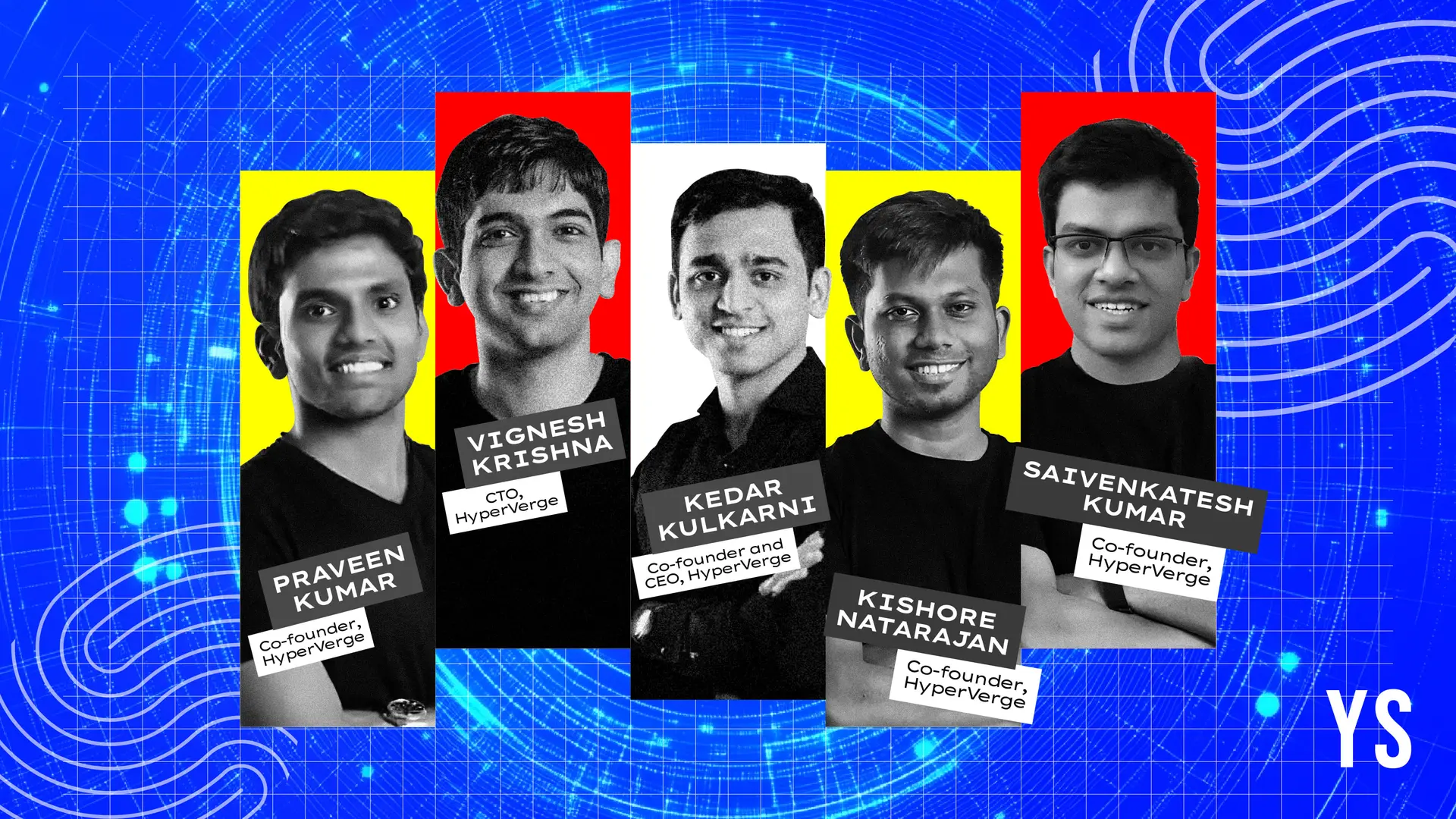

Kishore Natarajan’s passion for technology found new momentum in 2009, when he met Kedar Kulkarni—who had just launched a computer vision group at IIT Madras’ Centre for Innovation—along with Vignesh Krishnakumar, Praveen Kumar, and Sai Venkatesh, who later joined the team.
The then-young engineers tackled an eclectic mix of challenges, or as Natarajan puts it, ‘toy problems’. The group of friends first built a hairstyle modification system for US salon apps using cutting-edge deep learning. They also built volumetric analysis for Kerala's rubber plantations and created automated weld inspection systems for car manufacturer Renault-Nissan.
Despite their technical brilliance, the team struggled to build a sustainable business around their innovations. “We locked ourselves in our pantry in the IKP startup incubator in Koramangala in Bengaluru, and asked ourselves, if societal pressures weren't a problem, if money wasn't a problem, what would you want to spend the rest of your life energy doing?” Natarajan recalls the incident from 2016.
Things took a turn for the better when they met Zoho boss Sridhar Vembu, who told them to first focus on building “a strong economic engine”, and they discovered their calling in KYC solutions.
What seemed mundane compared to their previous cutting-edge projects has since evolved into the core business of HyperVerge—the business-to-business (B2B) SaaS company, founded in 2014, which specialises in AI-based identity and business verification solutions within the fintech, banking, insurance, and gaming industries.
“That was an accidental inbound that came our way. The first time we solved the problem statement, it wasn't even paying our pantry bill of 13 to 14 people. Many of us were wondering if this is what we want to spend our time on,” he says.

How a Chennai-born researcher helped build ChatGPT—the AI transforming the world
Solving for compliance
The Bengaluru-based deeptech company leverages its computer vision heritage into a full-stack, AI-powered identity verification and onboarding platform.
HyperVerge began with a simple dream to become the next Facebook or Instagram with its photo search app Picsaur. However, the team’s plan collapsed following the launch of Google Photos in 2015. After several iterations, the team realised its technology had more powerful applications in the enterprise world, leading to HyperVerge’s B2B pivot in late 2017.
Financial institutions aren't in the business of solving customer onboarding; they want to focus on their core products—personal loans, credit cards, insurance, and brokerage accounts. However, before they can do any of this, there's a critical prerequisite—onboarding customers in the most compliant way possible.
Natarajan explains, “Compliance is defined by regulators and can involve anywhere from 3 to 15 steps. It takes them anywhere from six to nine months sometimes to get the journey right.”
This is where HyperVerge uses neural network–based computer vision to perform tasks such as OCR (optical character recognition) on identity documents and facial biometric matching for user verification.
Product offerings
HyperVerge ONE is the company’s flagship onboarding platform that helps businesses launch fast onboarding journeys and iterate them rapidly.
Along with HyperVerge’s native SDKs and APIs, the platform offers an end-to-end experience which includes real-time verification checks, liveness detection, and fraud monitoring.
For example, HyperVerge’s OCR and face recognition engines can extract data from IDs and match a selfie to an ID photo in real time during onboarding. It can also perform text recognition on passports and licenses with high accuracy, read bank statements, pay slips, and documents in lending or underwriting use cases, thereby performing document fraud checks and data extraction.
In 2024, it was the only company to meet all performance benchmarks in the US DHS’s Remote Identity Validation test (Track 2) for selfie-to-ID matching, with an error rate below 1%.
A key component of HyperVerge’s tech is liveness detection to combat spoofing and deepfakes. Its system performs passive liveness checks using a single selfie image to ensure the user is physically present.
One of its key offerings, HyperStart—a contract lifecycle management tool—is designed to speed up the contracting process by reducing time by as much as 80%, and allows users to import legacy contracts from email, cloud storage, or CRM systems.
The platform uses AI to extract key metadata, automate renewals, and track obligations, aiming to bring more structure and visibility to how businesses manage contracts. It has found steady traction with 30–40 clients in the US.
At present, it has a library of over 200 APIs catering to onboarding use cases, including digital KYC, bank account verification, video-based validation, and auto payments. It has verified over one billion identities—processing Aadhaar, PAN, passports, driver licences, and other global IDs—across 450+ clients in more than 195 countries.
This includes major banks and financial services firms, from digital lenders and neobanks to large credit card companies.
"If your business is to sell insurance, get better at building great insurance products, at pricing them, or marketing your product. What we do is help you with making sure compliance is handled end-to-end,” the founder says.
The way ahead
According to the IMARC Group, the global eKYC market was valued at $806 million in 2024, and is expected to grow to $3.56 billion by 2033.
While the KYC automation space sees many new entrants, Natarajan believes HyperVerge's competitive moat lies in its foundational approach to the problem. Some of its rivals include Karza, Signzy, Perfios, and Bureau.
“When you look at our entire journey over the last 10 years, the first place where we came together was to solve deep learning and computer vision. Our first thought process was figuring out how to make machines think and give them the ability of vision," Natarajan explains.
In 2015, HyperVerge raised $1 million in a seed funding round from US-based VCs New Enterprise Associates (NEA), Milliways Ventures, and Naya Ventures.
As of FY24, HyperVerge—with offices in Mumbai, Coimbatore, Nigeria, and Vietnam and a workforce of 229 employees—is generating roughly $20 million in annual recurring revenue.
After onboarding SaaS major Zoho as its first paying customer, the startup has added Jupiter, HSBC, Vodafone, Jio, SBI Card, Bajaj Finserv, and Aditya Birla Capital, among others, as its clients.
In 2020, SBI Card adopted HyperVerge’s video-KYC system to enable fully remote credit card onboarding. Another early client, Slice, integrated its KYC APIs in 2017. Initially, Slice used the OCR solution for ID parsing, followed by face matching and single-image liveness, as well as central KYC and Aadhaar Offline KYC modules.
This stepwise adoption allowed the Bengaluru fintech startup to handle user growth without fraud or compliance issues. By 2021, Slice had over 7 million users, and during peak growth (e.g., marketing campaigns and IPL cricket season), it relied on HyperVerge’s solutions to onboard users.
The Bengaluru-based startup has also set up HyperVerge Academy (HVA), which offers free upskilling training to students from low-income families in in-demand technology skills. So far, it has placed over 190 students in software companies, with an average salary of Rs 4.2 LPA.
“‘When it comes to social impact problems, it also needs to generate the profits that are needed.’ Sridhar Vembu was the first person who separated these two and said, “Build a strong economic engine. Solve whatever problem it makes sense to solve. And if you retain the intent as a team long enough, whatever you will end up doing for the rest of your life, you will figure out how to be meaningfully impactful in people's lives,” Natarajan says.
(The copy was updated with additional changes.)
Edited by Suman Singh