



Mirofish AI: Is this the future of swarm intelligence or just hype?
Mirofish AI is blowing up with its swarm-based predictions. Is it a breakthrough or just AI sounding smart again? Here's all you need to know!



By now, you’ve probably seen Mirofish on your feed. It’s the open-source tool that’s currently taking over GitHub by simulating human behaviour rather than predicting it.
The idea is simple: build a digital environment, drop in a few AI agents, and watch them think, argue, and influence each other until an outcome emerges on its own. But is it worth the hype? Here's everything you need to know about this trending AI tool!
The tech behind Mirofish
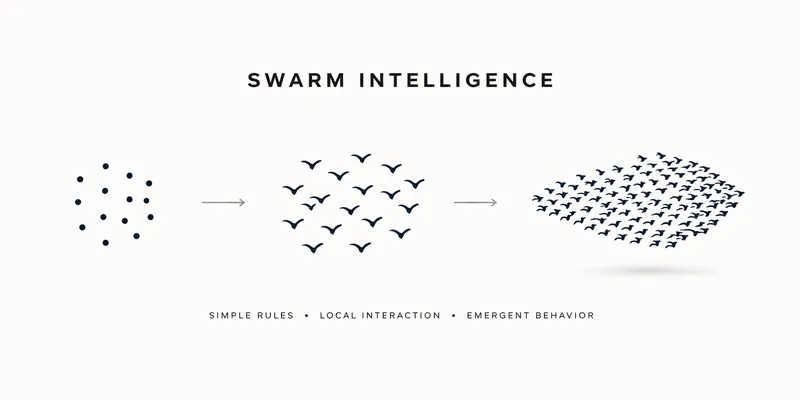
Mirofish is essentially a multi-agent simulation engine built on large language models. It first converts documents into a knowledge graph to set the scene. Then, it creates thousands of AI agents with unique personalities and memories to live inside it.
These agents interact like people in a digital crowd. This is swarm intelligence at work. Much like a flock of birds, there is no boss. Each agent follows simple rules, and a coordinated pattern emerges from their individual movements.
Instead of calculating an answer, Mirofish lets these agents argue and persuade until a collective decision forms naturally. A memory layer tracks how their opinions shift, showing you exactly how a consensus is reached. At the end, a reporting agent summarises everything into a structured output for users to analyse.
Under the hood, this involves:
- Transformer-based language models
- Persistent memory systems
- Parallel simulation frameworks
- Knowledge graph construction
The system runs on a Python backend with a Vue-based interface, designed to feel like a chat workflow.
Why developers are paying attention
Mirofish is gaining traction partly because of timing. Multi-agent AI is quickly moving from research into real-world tools, and Mirofish packages it into an open-source system. It reportedly even topped GitHub’s trending charts in mid-March.
There are also claims that investor Chen Tianqiao has committed around 30 million yuan (roughly ₹35 crore), with student developer BaiFu becoming CEO of a new venture. However, these details have not been officially confirmed.
Even without confirmed funding, the project has sparked serious discussion about where AI systems are heading next.
Why scepticism is just as strong
Despite the hype, there are real concerns. The biggest issue is validation. There are no widely available independent studies proving that Mirofish’s simulations match real-world outcomes. Without proper backtesting, it’s unclear whether the system is truly predictive or just convincing.
Repeatability is another issue. Because it relies on probabilistic models, running the same simulation multiple times can give different results. That makes it harder to treat outputs as reliable. Apart from that, there’s also a structural risk.
If all agents are built on similar models, they may start thinking alike, creating fake consensus instead of diverse opinions. But can it actually scale? Running thousands of agents simultaneously is both a technical and financial strain, leaving many to wonder if the return on investment justifies the massive cost of entry.
A shift in how AI is used
What makes Mirofish interesting is how it approaches AI. Most AI systems are built to generate answers. Mirofish tries to simulate processes. It focuses on interactions, not only results.
This reflects a broader shift towards multi-agent systems, where intelligence comes from many interacting agents rather than a single model. If this approach evolves, it could change how we think about forecasting, strategy, and decision-making.

The takeaway
Mirofish is an ambitious experiment at the edge of AI. It combines knowledge graphs, multi-agent systems, and memory to model human behaviour instead of just predicting outcomes. That makes it one of the more interesting directions in AI today.
But it’s also highly uncertain. Until there’s stronger evidence, better benchmarks, and more consistent results, Mirofish is best seen as a tool for exploring scenarios, not a reliable prediction engine. For now, it offers a glimpse of where AI might go next.