



UniX AI unveils home robot that promises to run daily chores
UniX AI launches a household robot that claims to run your home. Here’s what it can do, what’s unclear, and whether it will work in real life.


We’ve seen robots cook, clean, and make beds in demo videos. But the real question is simple. Can they actually do it in your home?
China-based UniX AI is betting that they can. The company has been showcasing its humanoid robots, including the Panther model, as systems capable of handling everyday tasks such as cleaning, organising, and assisting in household routines.
Unlike viral clips that label these robots under vague names, the actual technology comes from a growing lineup of real products designed for service environments, not just demonstrations. Let's take a closer look at this robot!
What is the Panther robot?
Credit: www.unix-group.ai
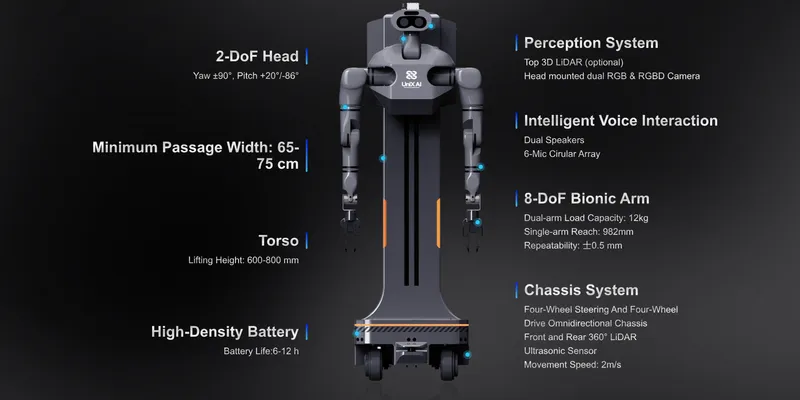
Panther is a full-size wheeled humanoid robot built for both household and commercial use. It combines mobility, manipulation, and perception into a single system.
According to UniX AI, the robot features:
- 34 high-degree-of-freedom joints for flexible movement
- Dual 8-DoF bionic arms with adaptive grippers
- A dual-arm payload capacity of up to 12 kg
- Omnidirectional wheeled movement for navigation in tight spaces
It also includes a perception system with RGB and depth cameras, along with microphones for audio input, allowing it to understand and interact with its environment. In short, this is not a stationary robot. It is designed to move, see, and act in real-world settings.
Built for real environments, not just demos
One of Panther’s key differentiators is its mobility. Instead of walking like traditional humanoids, it uses a wheeled base with 360-degree movement. This makes it more stable and efficient in indoor environments such as homes, hotels, or offices.
The robot can operate in spaces as narrow as 75 cm and is designed to handle complex, multi-step tasks. Its arms are capable of precise manipulation, with repeatability down to ±0.5 mm, allowing it to interact with objects carefully.
Battery life ranges between 8 and 16 hours, which suggests it is built for extended operation rather than short demonstrations. This focus on practicality signals a shift in robotics, from showcasing isolated abilities to enabling consistent, repeatable tasks.
What it can actually do
UniX AI positions Panther and its related robots as general-purpose service systems. Demonstrations and company materials show use cases such as:
- Cleaning and surface wiping
- Bed-making and room organisation
- Handling objects and delivery tasks
- Assisting in hospitality or retail environments
These are not one-off actions. The goal is to execute workflows, meaning a sequence of tasks performed reliably over time. That is where most robots still struggle.
The real challenge is consistency
Even with advanced hardware, the biggest hurdle remains reliability. Homes are unpredictable. Objects vary in shape and texture, lighting conditions change, and tasks are rarely identical. Handling soft items like clothes or bedsheets, for instance, is still a complex problem for robots.
While Panther’s specs suggest strong capabilities, real-world performance will depend on how well it can adapt to these variables without constant supervision. This is where many humanoid robots still fall short.

A larger shift in robotics
UniX AI is part of a broader trend in what is known as embodied AI. Instead of focusing only on software, companies are combining AI with physical systems that can perceive, plan, and act in real environments. The goal is to move beyond demos and into deployment.
The company’s lineup, including Panther, Wanda, and Martian, reflects this direction. These are not experimental prototypes. They are being positioned as scalable service robots for industries such as hospitality, retail, and home services.
What this means for homes
The idea of a robot managing household chores is becoming more tangible. However, widespread adoption will depend on factors beyond capability. Cost, maintenance, safety, and localisation will play a major role, especially in markets like India, where home environments vary significantly. Even with advanced specs, the transition from controlled demos to everyday reliability is where the real test lies.
Closing thoughts
The idea of a robot that can run your home is no longer science fiction. But it is not reality yet either.
UniX AI's announcement offers a glimpse of what could be possible. Whether it becomes practical will depend not on polished demos, but on how the robot performs in the messiness of everyday life.