



This Bengaluru startup’s screen-free AI toy is teaching kids to talk, think, and imagine again
MyWonder offers a palm-sized, screen-free, AI-powered device that helps kids aged 3 and 10 years learn, play, and imagine through voice-based interaction.


In most Indian homes today, a child lost in a screen is a common sight. Between online classes, cartoons, and YouTube rabbit holes, kids today spend hours tapping and scrolling, their imaginations quietly dimming behind glass.
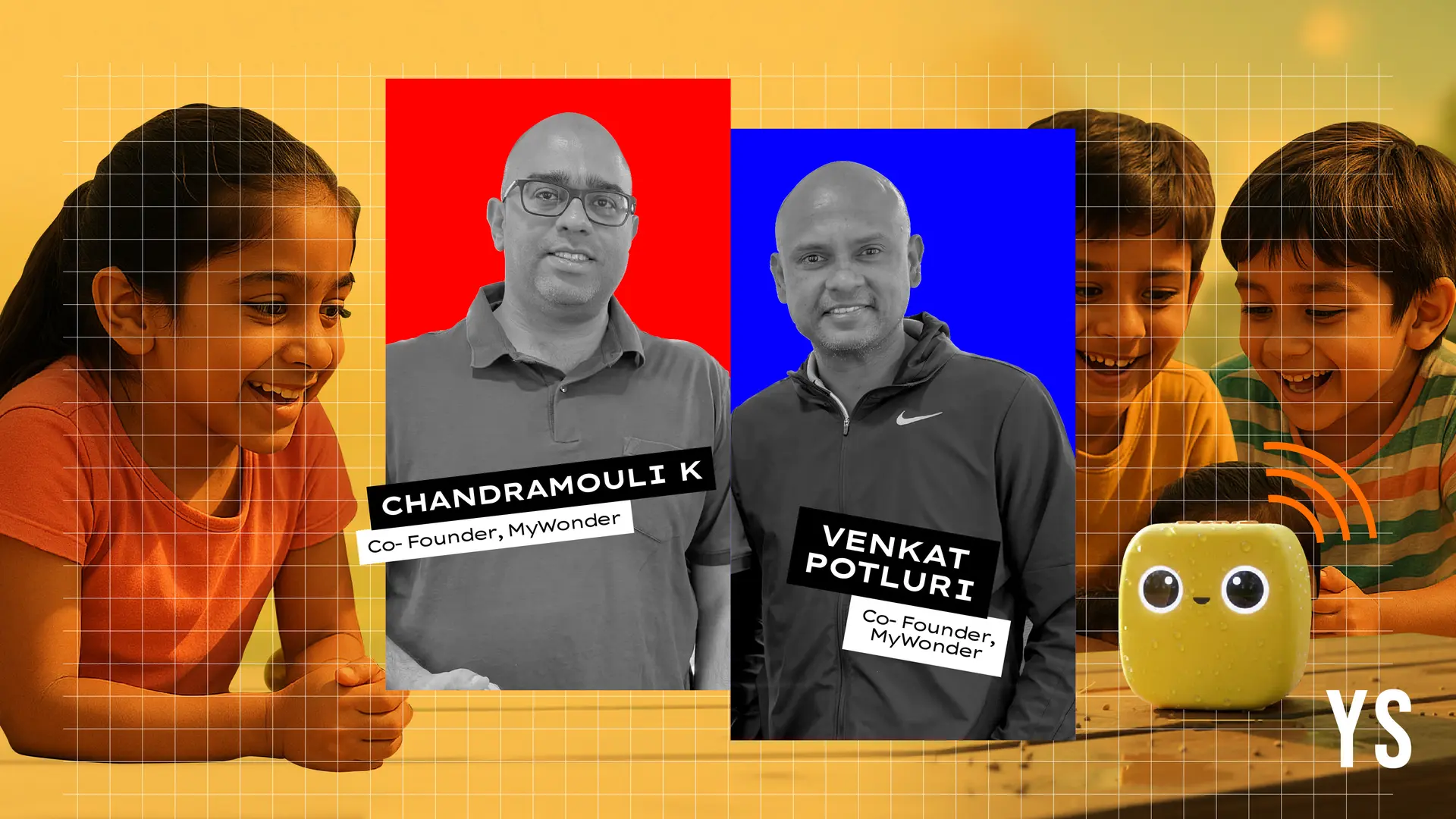
That’s the world Bengaluru-based MyWonder, founded by Chandramouli K and Venkat Potluri, wants to change.
Founded in 2024, the startup is reimagining playtime with Wonder, a palm-sized, screen-free, AI-powered device that helps kids aged 3 and 10 years learn, play, and imagine through voice-based interactions. In October this year, the startup announced its launch from stealth.
“We want to bring back the wonder years—that phase where curiosity, storytelling, and play come naturally,” says Chandramouli. “Our mission is to make technology that talks with children, not at them.”
Where play meets AI
At first glance, Wonder may seem like a toy. But once switched on, it transforms into something more—a teacher, storyteller, and companion designed to spark curiosity in children. Simply tap one of its colourful Wonder cards on the Pod, and an entire world of stories, songs, and adventures opens up instantly.
There’s Astro, the explorer who guides kids through space adventures; Riddles, an owl that challenges them with puzzles; Mind Reader, a voice-based 20-questions game; and Make Your Adventure, a storytelling module where children decide how the story unfolds.
“Children don’t just listen to Wonder—they talk to it,” says Venkat. “Every tap opens a world of curiosity, imagination, and safe exploration.”
Each Wonder starter pack comes with 10 interactive cards, and more are available across themes like science, nature, math, stories, and music. The device recognises each card instantly, activating a character that responds through conversation and sound.
Built on AI, designed for imagination
At the heart of Wonder is MyWonder’s proprietary conversational AI engine, designed to deliver real-time voice interactions on low-cost hardware.
“We re-engineered the entire AI pipeline to make real-time voice conversations possible without relying on heavy cloud processing,” says Chandramouli, one of the founders.
Each character functions as a defined AI entity—meaning Astro stays within space exploration, Riddles focuses on puzzles, and Mind Reader sticks to guessing games. This structure keeps conversations safe and relevant.
“We built these characters as tightly defined AI entities,” Chandramouli explains. “They can go deep within their worlds but never cross the line into unsafe or unrelated content.”
The startup is part of Google’s AI for Startups programme, which it says is helping strengthen Wonder’s adaptive learning and multilingual capabilities, including support for Indian languages.
To expand its content base, MyWonder has partnered with Hachette India, Pratham Books, and other publishers. “Soon, Sudha Murty’s children’s books will also be available in immersive audio format,” says Chandramouli.
About 90% of Wonder’s listening library comes from publishers, with the remaining 10% created in-house by writers, musicians, and child experts. All content is reviewed for age-appropriate themes and language before release.
Adaptive learning that grows with the child
Wonder’s AI monitors how children interact, adjusting the difficulty of questions or stories based on their responses.
“We call them micro-challenges,” says Chandramouli. “The system gently pushes the child to think — never too easy, never too hard. That’s how learning happens naturally.”
For parents, the companion app offers usage summaries like “Your child spent 20 minutes exploring space with Astro,” helping them track interests and learning patterns. The system also flags signs of stress or discomfort, giving parents discretion on how to respond.
Engineered for Indian homes
The global edtech hardware market size was estimated at $46,744.6 million in 2023 and is projected to reach $106,356.0 million by 2030, growing at a CAGR of 12.5% from 2024 to 2030, driven by the rapid integration of AI, personalised learning, and smart devices into everyday education. The startup aims to capture 3% of this market.
MyWonder’s hardware has been designed for everyday environments — busy homes with ambient noise from TVs or kitchens.
After multiple iterations, the team arrived at a dual-microphone setup with active noise cancellation, placing the mic near the toy’s “beak” for better sound capture.
“We wanted kids to just talk—not shout,” Venkat says. “So we optimised it for real-life conditions, not soundproof studios.”
The device is priced at Rs 4,999 with ten cards included. Additional cards, which unlock new characters and content, range from Rs 399 to Rs 999. Parents can also create custom cards that play personal stories or songs—including recordings from family members.
“We’ve had kids abroad listening to bedtime stories in their grandparents’ voices back home in India,” says Venkat. “That’s the emotional layer we wanted—tech that connects, not isolates.”

'Artificial intelligence can only augment human efforts'
The road ahead
“MyWonder is already live on its website, with deliveries set to begin in December,” the founders said. They are also planning to list on Amazon and Flipkart. It’s also piloting collaborations with schools and early-learning centres.
The company plans to introduce subscription-based content packs, regional-language support, and integrations with educational partners over the next 12 months.
“Our goal is for every child to have a Wonder at home,” Chandramouli says. “We want kids to talk, ask, and imagine again—without a screen telling them what to see.”
The startup has recently raised $300,000 in pre-seed funding from Antler India and was selected for the Google for Startups AI First Accelerator programme. The company is now planning to raise about Rs 20 crore, Chandramouli confirmed in an interaction with YourStory.
In a world overflowing with visual noise, MyWonder is betting on something deeply human—conversation.
“Voice is the most natural interface we have,” Chandramouli says. “Children learn through dialogue, curiosity, and play—not scrolling.”
By combining AI, storytelling, and tactile play, MyWonder isn’t just making a gadget—it’s creating a new language for childhood.