



Reasoning LLMs, AI agents: Infibeam looks beyond fintech with Rs 700 Cr rights issue
Infibeam Avenues is investing nearly Rs 300 crore to fund an ambitious pivot into AI agent infrastructure that extends far beyond payments. Founder Vishal Mehta sheds light on this ambitious plan.

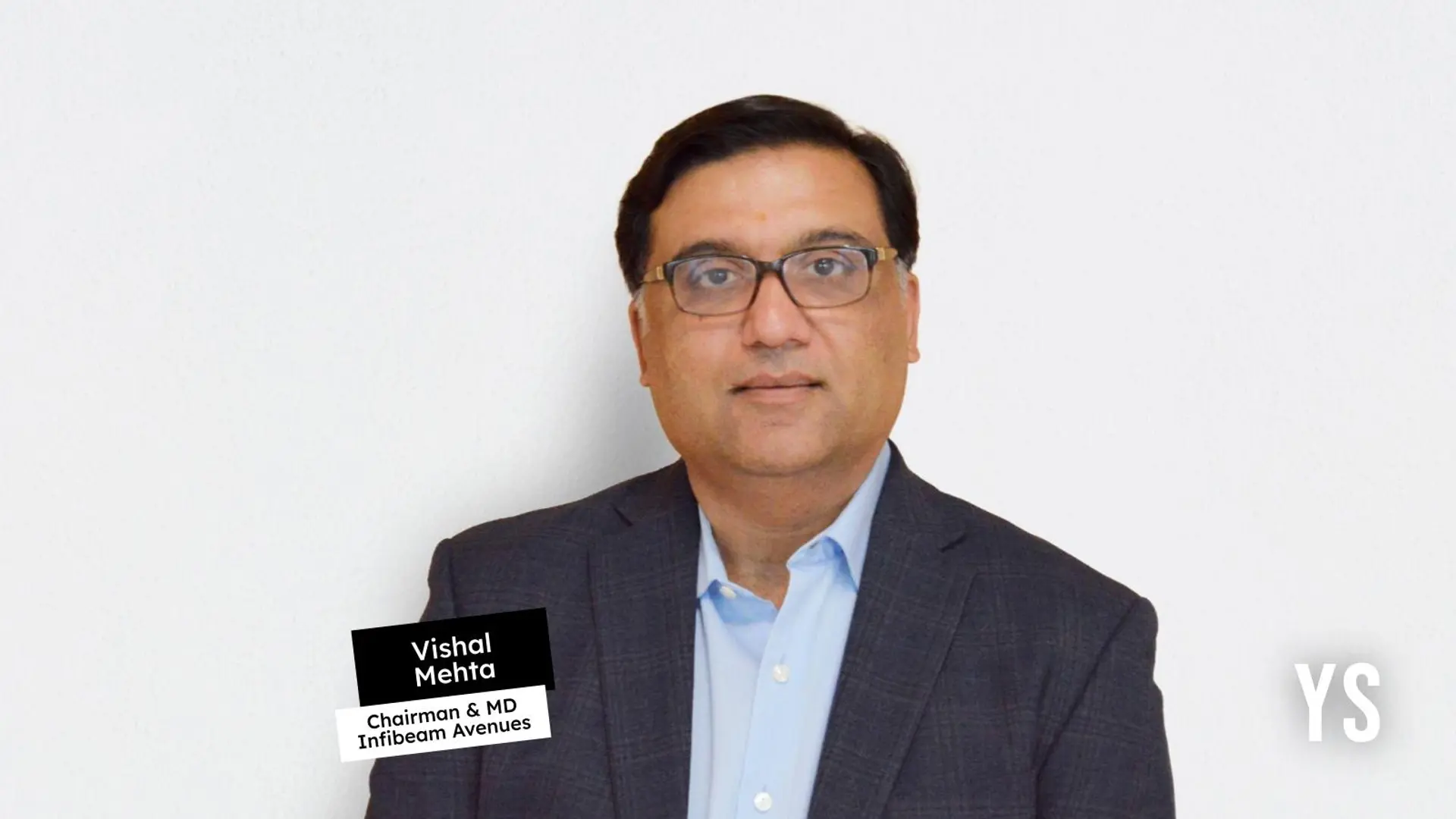

Infibeam Avenues is branching out by placing a bold bet on artificial intelligence. The Ahmedabad-based fintech is launching a rights issue worth nearly Rs 700 crore to fund what its founder Vishal Mehta calls the “full-stack agent AI ecosystem of the future.”
With this ambitious raise, Infibeam is looking beyond its core payments and fintech operations, doubling down on a vision that spans multimodal models, AI agent infrastructure, and marketplace and custom e-mail solutions, thanks to its recent acquisition of Rediff.
“This is not just about fintech. It’s about creating an open, scalable agentic AI platform that works across industries—something that allows any entrepreneur or enterprise to build, deploy, and monetise intelligent agents without needing to write a single line of code,” Mehta, also the managing director of Infibeam Avenues, tells YourStory during an interview in June.
Of the Rs 700 crore capital, the company plans to set aside nearly Rs 300 crore for its AI initiatives, which rest on three pillars—reasoning models, agentic frameworks, and real-world deployment platforms.

Infibeam Avenues’ Rs 700 Cr rights issue oversubscribed 1.4X
Spearheading this is Phronetic AI, Infibeam Avenues’ wholly-owned subsidiary focused on building AI models, orchestration systems, and developer tools, led by Rajesh Kumar SA.
Prior to this role, Rajesh was the director of machine learning at Meesho, and in 2016, co-founded Streamoid, an AI startup focused on virtual try-on solutions for fashion retail. His earlier stints include technology roles at InMobi and Yahoo!.
At present, Infibeam’s video large language model (V-LLM)—originally conceptualised for gas stations and retail payments—interprets real-time camera footage, identifies objects, understands scene context, and analyses human activity.
Already deployed in the Middle East, gas stations use the technology to automatically deduct money from a customer’s wallet based on video feed and data from the pumps. Meanwhile, another contract manufacturing client uses the system to ensure consistency across global operations.
The company is also finding use cases in hospitals and public infrastructure, as Mehta explains, “We give it to ICUs to monitor patient activity. You start by tagging and understanding video scenes, and over time, it builds accuracy. That’s the foundation for eventually enabling it in payments, logistics, or public safety.”
According to the founder, the technology is generating revenue across multiple sectors with contracts worth an estimated $1 million annually.
Agent economy
At the heart of Infibeam’s vision are AI agents. These agents—autonomous software entities that can reason, act, and learn—will go beyond traditional LLM-based chatbots to perform complex tasks across financial services, healthcare, and retail sectors.
Infibeam powers these AI agents with its proprietary models like Owlet, a family of fine-tuned vision-language models (VLMs) optimised for real-time video analytics; and Thea, an LLM that processes and interprets visual inputs like video, screen shares, and image sequences.
Meanwhile, its RZN reasoning engine enables AI agents to plan, use tools, recall memory, and adapt across complex, multi-step tasks in domains, including HR, finance, and IT, where it can assist small enterprises with invoice processing, reimbursement tracking, employee onboarding, and leave management.
A core component of its AI vision is to have “agent engineers”—individuals who, without coding expertise, can build and manage intelligent agents using the company’s orchestration tools.
“Think of it like this: you don’t need a software developer anymore,” Mehta explains, adding, “You need someone who understands data, can manage workflows, and instruct agents using tools. The agent itself can call APIs, use foundation models, and even build new tools. It’s orchestration, not coding.”
Unlike closed ecosystems like Salesforce’s AgentForce, Infibeam’s agents are designed to work across platforms, allowing developers and businesses to retain control over tools, data, and IP. It will distribute these agents via Rediff.com, now repositioned as an open marketplace for digital tools.
Infibeam sees this as a foundational step forward in India’s enterprise AI landscape, where millions of entrepreneurs and SMEs can use AI to automate operations and decision-making.
This approach reflects a deeper belief that India’s vast, tech-aware workforce can leapfrog into the next paradigm of AI deployment—not by building models, but by deploying them meaningfully.
“AI will replace jobs, yes—but it will also create millions of agent engineering opportunities. You don't need to know Python. You need to know how to work with an AI stack,” he adds.
This year, it released an early version of its reasoning model RZN-T—a compact model optimised for task-specific inference—on the open-source model repository, Hugging Face. “It's just 680 million parameters, but it outperforms many larger models on specific tasks,” adds Mehta.
So, what’s Infibeam’s ultimate plan? To combine reasoning models with agents and then give those agents a place to live and work: Rediff.
Infibeam Avenues FY25 profit jumps 43%; Q4 profit inches up 5.3%
Since acquiring Rediff in August 2024—an early Indian internet portal—Infibeam has quietly been modernising its backend infrastructure. Rediff’s enterprise email business still serves major clients like ICICI Bank and HDFC Life, while its consumer email sees 5-7 million daily active users. The platform, Mehta says, is ripe for a new layer of AI intelligence.
“There’s a big opportunity in building privacy-first AI agents for email users,” he says. “We want Rediff to be the agent marketplace. If you've built an agent, we’ll help you distribute it, monetise it, and connect it to 170 million Rediff mail users.”
By combining Rediff’s scale, localised data infrastructure, and Infibeam’s payments stack, the company aims to create a full-loop ecosystem—one that allows AI agents to be created, trained, metered, deployed, and monetised.
“We already have the payments stack, the enterprise relationships, and now, the AI infrastructure,” Mehta adds.
Edited by Suman Singh