



Elon Musk’s xAI Launches Grok Build for Coders
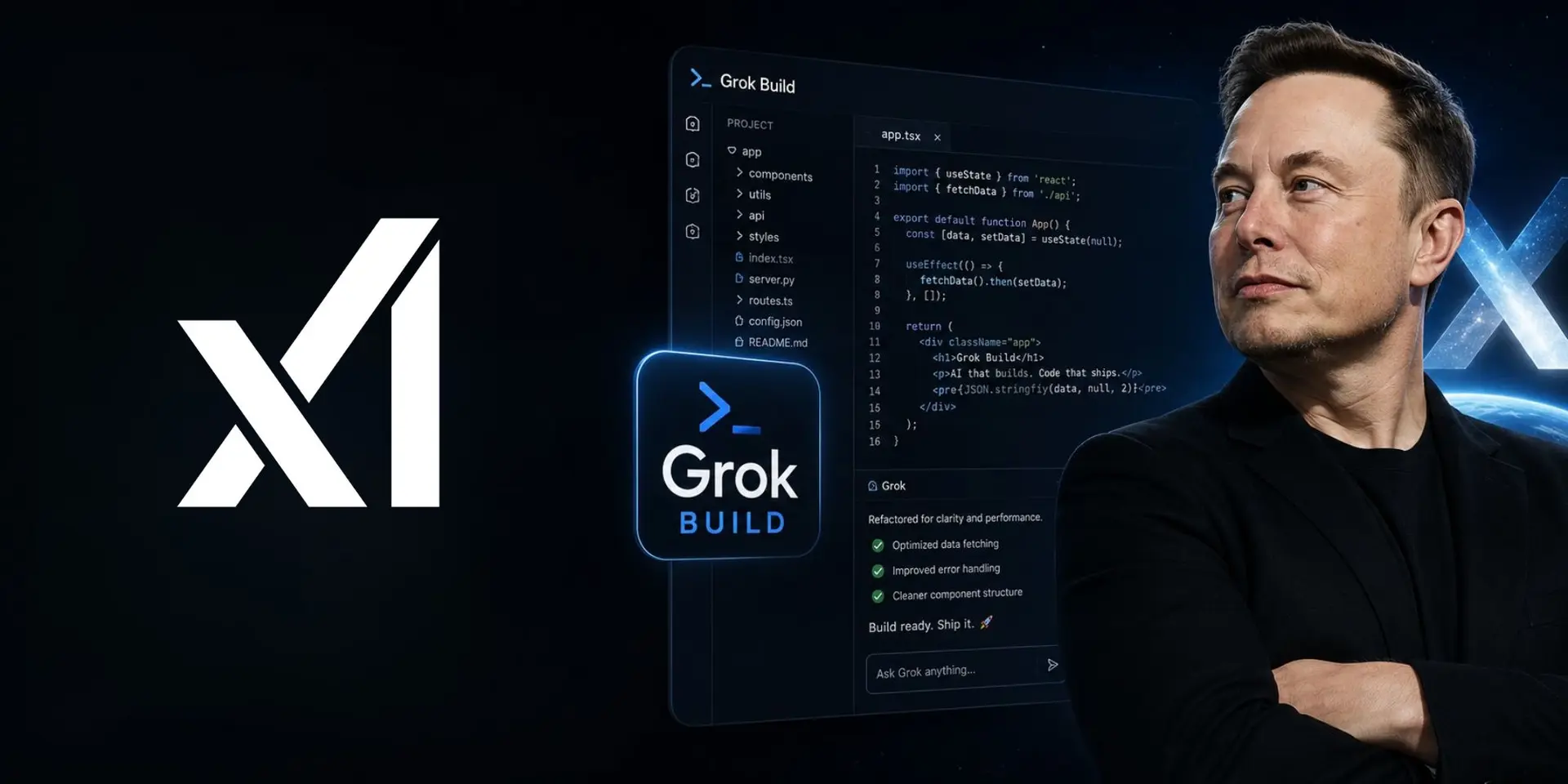
Elon Musk’s xAI has launched Grok Build, a new coding tool designed to help developers write, edit, and ship software with AI assistance.


A new AI coding battle has just entered the terminal.
xAI has launched Grok Build, its first coding agent designed to help developers plan, edit and review software directly from the command line. The release places Elon Musk’s AI company into direct competition with tools such as Claude Code and Codex as the race around agentic coding assistants intensifies.
The move signals a broader shift happening across the AI industry. Coding tools are rapidly evolving beyond simple autocomplete systems into autonomous agents capable of handling multi-step software tasks with limited supervision.
What Grok Build actually does
Grok Build is being introduced as an “agentic CLI” for software engineering workflows. In simpler terms, it is an AI coding assistant that works directly inside a developer’s terminal rather than through a standard chatbot interface.
Developers can describe a task in natural language, such as fixing a bug, restructuring a feature or updating part of a codebase. Grok Build then analyses the repository, creates a step-by-step execution plan and proposes code changes before editing files.
Importantly, developers can review, approve or modify the plan before any changes are applied. Once edits are made, the system presents clean code differences, known as diffs, allowing engineers to inspect exactly what changed. This “plan first, act second” structure is designed to reduce errors and give developers more control over automated coding workflows.
Why terminal-first AI matters
Unlike many consumer-facing AI coding tools, Grok Build is leaning heavily into a terminal-first design philosophy. The terminal, or command-line interface, remains one of the most widely used environments for professional software engineering.
By operating directly inside those workflows, Grok Build aims to integrate more naturally into how developers already work rather than forcing them into separate interfaces. The tool also supports integrations through protocols and plugins that allow teams to connect it with existing development environments, automation systems and custom tooling.
xAI says Grok Build can delegate subtasks to parallel “subagents”, potentially helping teams handle larger codebase updates more efficiently.
How it compares with rivals
The launch places xAI into one of the fastest-growing segments in enterprise AI. Anthropic, OpenAI and Google are all aggressively expanding their coding assistant ecosystems. These tools are becoming increasingly important because software development remains one of the clearest commercial use cases for generative AI.
For now, Grok Build appears focused on flexibility and workflow integration rather than mass consumer adoption. xAI is emphasising compatibility with established developer conventions, extensibility through plugins and automation-friendly deployment options.
However, it remains too early to judge how the tool performs against more established competitors. xAI has not yet released detailed benchmarks or broad reliability data.
Limited access, high pricing
At launch, Grok Build is only available to subscribers of xAI’s SuperGrok Heavy plan, priced at $300 per month. That high entry point will likely limit adoption in the short term, but it also allows xAI to gather feedback from a smaller group of professional users before expanding availability more widely.
For enterprise buyers, pricing may matter less than reliability. AI coding tools are increasingly evaluated not just on code generation quality, but also on how safely they fit into production engineering workflows.

Why engineering leaders are watching closely
The larger appeal of coding agents lies in workflow automation. If tools like Grok Build can reliably plan changes, update codebases and integrate into testing pipelines, they could significantly reduce repetitive engineering work.
Features such as headless execution and automation support hint at future use cases in continuous integration systems and large-scale software maintenance. That could make AI coding agents less like assistants and more like collaborative engineering systems.
The bottom line
Grok Build marks xAI’s transition from chatbot maker to AI infrastructure competitor. The tool is still early, expensive and limited in access, but it reflects a much larger trend reshaping software development. AI companies are no longer just building conversational models.
They are building autonomous systems designed to participate directly in technical workflows. Whether Grok Build becomes a mainstream developer tool will depend on one thing above all else: reliability.