



STSPL is the largest technology development arm of Siemens globally: CEO Pankaj Vyas
In an interview with Enterprise Story, Pankaj Vyas, CEO and Managing Director, STSPL, says, the GCC has tripled the number of inventions and there is only going to be more value driven out of this location.

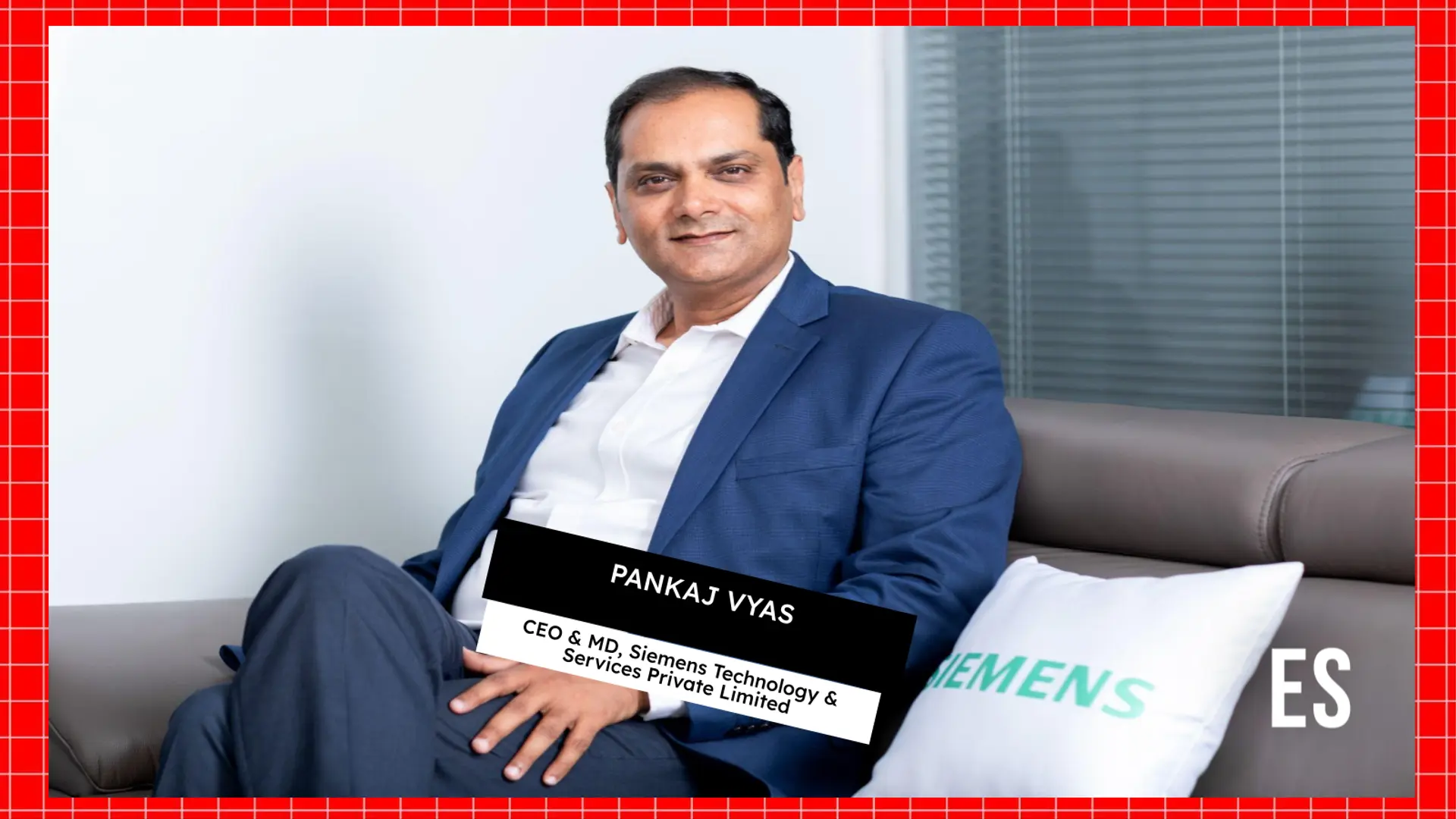

India has emerged as a global technology hub, driving innovation and digitalisation agenda for companies worldwide. Siemens, the German technology conglomerate with a strong presence in industrial, infrastructure, and mobility sectors, is relying on its Global Capability Centre (GCC) in India—Siemens Technology and Services Private Limited (STSPL)—to transform into a modern digital enterprise.
STSPL currently employs around 10,000 people, with around 6,000 engaged in research and development. Today, the primary focus for this GCC is to drive the digitisation agenda for Siemens worldwide, particularly from a software perspective, and it has already established a leadership position. This journey is expected to help India taken on global roles with a lot more ownership over the software products being developed.
In an interview with Enterprise Story, Pankaj Vyas, CEO and Managing Director, STSPL, said, over the years, this GCC has tripled the number of inventions and there is only going to be more value driven out of this location.
“Our aspiration is to be at the forefront of being the digitalisation hub for Siemens and its customers,” he said.
Edited excerpts from the interview:
Enterprise Story (ES): Can you please provide us with a brief overview of STSPL?
Pankaj Vyas (PV): At present, STSPL operates across five locations in India—Bengaluru, Chennai, Pune, Gurugram, and Noida.
As a GCC entity for Siemens, STSPL is structured around three functional entities. The first is Foundational Technologies, which is focused on developing products and solutions for Siemens’ three core businesses—industrial, infrastructure, and mobility. The second is Global Business Services, which handles back-end business support functions. And lastly, Engineering Services is about pre- and post-commissioning of the products and solutions which get deployed.
ES: What is the kind of work being done by STSPL?
PV: Ten years ago, we did more domain-specific work like the human-machine interface, building management systems or railway signalling, etc.
Over the last five to eight years, there has been a focus on digitalisation, driven by the launch of Siemens Xcelerator. From being a closed-system company, the company has evolved into an open-system company, taking advantage of all the digital technologies available. Today, it is an amazing combination of both real and digital world product development.
In our Bengaluru office alone, we house 50 labs, which are one of its kind across Siemens AG worldwide.
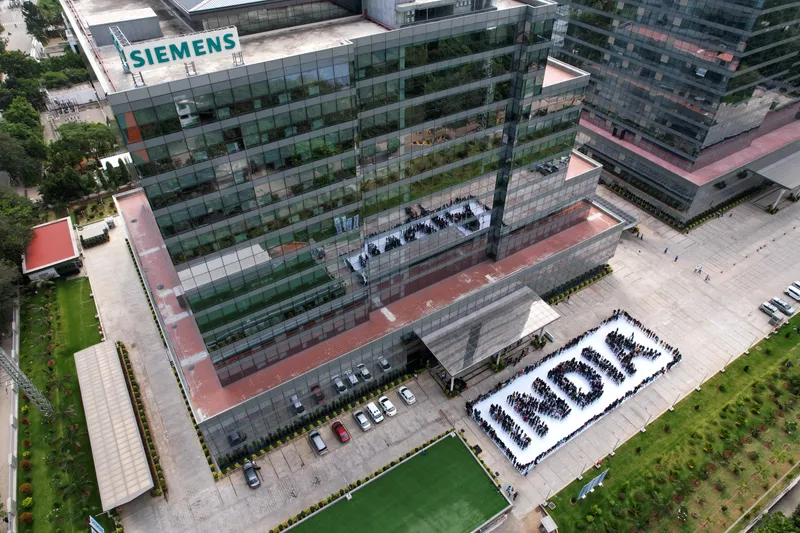
These labs are dedicated to cutting-edge work, particularly in software development that is integral to our products. If you look at it, our efforts span the entire technology stack—right from the field devices to the digital layers.
ES: Is there greater thrust on foundational technologies by STSPL?
PV: Absolutely. This is the largest technology development arm that Siemens AG has globally, with no other location matching the scale of our workforce working across all the businesses. Interestingly, in the last five years, we have pivoted the whole organisation towards value creation.
The four virtues of this organisation are competent, agile, collaborative, and being innovative. In line with this, we have added close to 200 new global roles in this organisation.
Also, the senior software architects at Siemens are not something that you get easily. You really have to earn it. About five years ago, we had just one. Today, we have eight. Having eight senior software architects in one location is a big thing.
Our participation in the internal ecosystem inside Siemens has also increased. We are getting invited to a lot of Siemens conferences. Our people drive global topics like Gen-AI today, sitting from India.
ES: What have been the dominant themes for STSPL?
PV: Ownership and innovation. Those are really the dominant themes. I mean the way I look at the organisation going forward is really about high ownership, there’s high agility, and there’s high innovation. Those are our solid strengths that we are really building on.
It’s not just about labs, it is really about how people are approaching their work now. It’s more about owner mentality rather than a renter mentality.
You can also see that the conversations with business partners are changing. It’s not really about will we tell you what to do, it’s another way around. To the point where, if you look at two major digital applications or solutions which have come out of Siemens AG—Electrification X and Portfolio Manager—I would say, pretty much 90% of that is in India.
ES: How is STSPL approaching the tech platforms of AI and GenAI?
PV: There is predictive AI and then there is generative AI. Predictive AI has been around for a little bit longer than generative AI. We have already started infusing predictive AI into our products and solutions. Now, within generative AI, there are some elements that go into the product enrichment itself as to how the human and machine interact because GenAI makes it easier with multimodal. Then there’s a productivity element where you're saying the paradigm shift, that’s really happening.
Our approach is through three steps. First, we have to enable our people. How do you make your workflows smarter and faster and with higher quality? The second part is really about how you start experimenting. When you apply Gen AI, it’s not one brush that you can put across projects. We experiment as to what we are going to get out of each of these kinds of projects. Lastly, we get into the acceleration of this whole adoption. So, I would say, enablement and training are largely in place. We are in the experimentation phase and then we get into the acceleration phase.
Upskilling is part of training our people, and it starts with how you start doing the prompting. How do you do the right kind of prompting? There’s a science on prompting because these tools work differently. Second, it’s also how you integrate these things into the workflows. Enablement means equally important to know when you want a human in loop. Identifying those areas also are equally important.
ES: How is STSPL hiring and retaining talent?
PV: Firstly, it is very important that we brand ourselves as a technology company. For us, to attract the kind of talent that we need for the kind of work that we talked about. Second thing for Siemens is really about technology with purpose. It is not about just coming here and developing a technology, but really solving a problem. You’re solving a real-world problem. We also have enormous learning opportunities for our employees.
ES: What will be the future roadmap for STSPL?
PV: Our global CEO, Roland Busch, talks a lot about our Northstar being a one tech company. This means how do we transform ourselves from a traditional technology product company to being a modern technology company? It is about how you accelerate innovation faster. How do you collaborate in different ways in spite of being a large conglomerate? That’s where we come into play for a very interesting reason. We are a mini Siemens AG.
I see more and more value coming out of this place. Going forward, I would say, it’s really about a lot of infusion of newer technologies into the traditional products and solutions that we have. And these new technologies are cloud compute, edge compute, new ways of UX, and then of course data and AI.
As a closed system company, we don’t really have to worry much about cyber security in the past. But once you become an open system company and once you start getting connected to the world out there, you pretty much start becoming vulnerable to cyber-attacks and things like that. So that’s another area we are focused on.
We will just accelerate further infusion of all these new technologies into the businesses that we are getting.
Edited by Megha Reddy