



Building AI skills is the new currency of innovation: IBM India MD
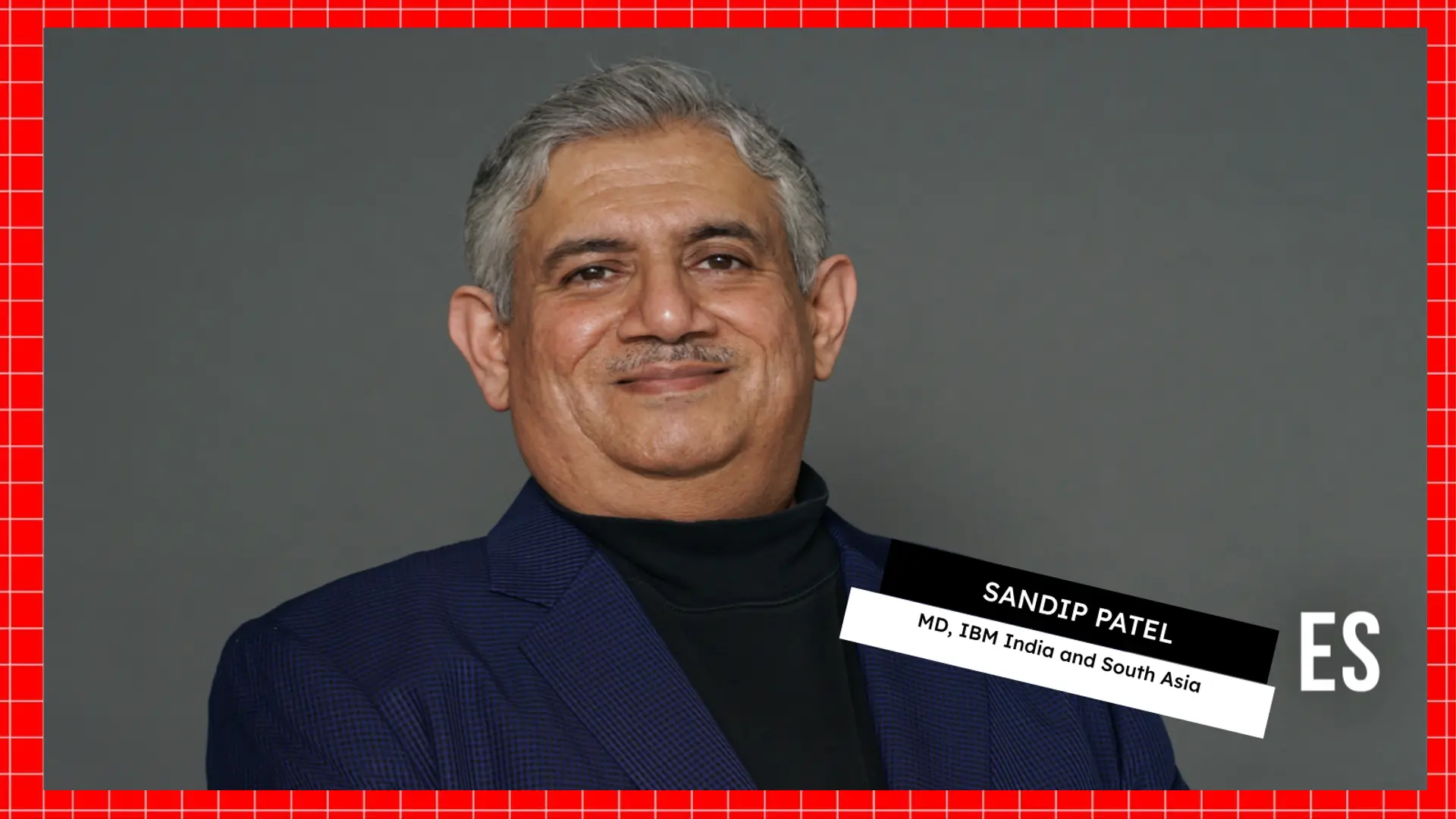
IBM India Managing Director Sandip Patel believes a multi-pronged approach towards AI skilling in India can transform the talent dividend into a technology dividend to bring in innumerable benefits.


What will the jobs of the future look like in the age of artificial intelligence? GenAI, foundation models, and intelligent agents are not just reshaping how we work—they’re redefining what’s possible.
However, to fully unlock their potential, the AI skills gap across industries, roles, and regions must be closed, and India stands at the cusp of becoming a leading player in this segment.
“India stands at a pivotal moment, where digital ambition meets demographic strength. As we move toward the vision of Viksit Bharat, there’s a unique opportunity to turn our vast and diverse talent base into a global AI powerhouse,” says Sandip Patel, Managing Director, IBM India & South Asia.
“AI isn’t just a tech trend; it’s a powerful economic driver. One unit increase in AI intensity could boost India’s GDP by $67.25 billion. Yet, 42% of enterprises cite a lack of skills as a key barrier to adoption,” he adds.
According to Patel, with focused investments in GenAI and LLM skilling, India can drive inclusive growth, open new markets, and create future-ready jobs. “This is more than a digital shift. It’s a national opportunity to transform our talent dividend into a technology dividend and lead the world responsibly, confidently, and at scale.
In an interview with Enterprise Story, Patel explains how IBM India has rolled out several AI skilling initiatives for tech and non-tech people in India.
He says, “In this AI-driven era, access to tools is no longer the edge—knowing how to use them is. When everyone has access to similar AI tools, the differentiator isn't technology—it’s the talent. Hence, skills are the new currency of innovation.”
Edited excerpts:
Enterprise Story [ES]: How is IBM India addressing the AI skill gap?
Sandip Patel [SP]: In today’s modern economy, skills > degrees. That’s not just a tagline; it’s a paradigm shift every forward-thinking business is embracing.
At IBM, we have made a bold commitment to skill 30 million people globally by 2030. That’s not just ambition; it’s action. AI is a major focus. We’ve pledged to train 2 million learners in AI by 2026, with special attention to underrepresented communities. So far, over 16 million learners have benefited from our skilling programmes worldwide.
Our flagship platform, IBM SkillsBuild, is open, modular, and inclusive, with over 1,000 courses in 20 languages, for learners across the spectrum—from high school students and university faculty to mid-career professionals. Besides the online courses, we partner with expert organisations globally to expand the reach and impact.
However, our approach to skilling doesn’t stop at external ecosystems; it starts from within. At IBM, we see skilling as a dual responsibility: enabling learners everywhere, while also equipping our teams to stay ahead.
Continuous learning is embedded in our culture. From digital credentials and learning pathways to immersive innovation experiences, we make upskilling a lived reality. Programmes like the watsonx Challenge invite IBMers to co-create AI-powered solutions to real-world problems, blending creativity with application.
But that’s not all. In India, we’re going beyond AI. Since 2021, over 200,500 people in India have accessed IBM Quantum learning resources designed by IBM India’s quantum experts in close collaboration with Indian universities.

In partnership with DST and AICTE, IBM is co-developing undergraduate courses and textbooks on quantum technologies, alongside IITs, industry partners, and startups.
In short, we’re not just teaching AI. We’re building ecosystems around it.
A testament to this impact is Divyam Gothi, a 13-year-old student at ITL Public School, Delhi, who leveraged IBM SkillsBuild to develop EcoRover—an AI-powered robot that autonomously detects and collects litter using ultrasonic sensors and the YOLOv8 neural network.
Divyam’s vision includes waste segregation and capturing images of littering vehicles. It’s a powerful example of how democratising access to cutting-edge skills can empower even the youngest minds to address real-world challenges.
ES: Does IBM India’s AI skilling programme focus only on tech professionals?
SP: Let’s bust this myth: there’s no such thing anymore as a “non-technical role” in the AI era.
AI is redefining every job, from the frontline to the C-suite. So no, this isn’t just about coders. It’s about empowering everyone to understand, challenge, and co-create with AI.
Tomorrow’s workforce will be made up of what we call new-collar jobs, and every one of them will require an AI edge, making AI literacy essential for everyone.
So yes, we upskill technologists, but we also upskill teachers, sales representatives, operations managers, product leaders, and students. Why? Because responsible AI adoption starts with understanding, and understanding starts with education.
The truth? In today’s competitive landscape, companies that prioritise upskilling will outperform those that don’t. AI won’t replace jobs, but professionals who know how to use AI will.
Take the example of Awantika, Bidhya, and Shubha, who developed PANDI, a multilingual AI assistant to improve patient and visitor experience at STNM Hospital. Built using IBM SkillsBuild, PANDI enables conversation-based interaction in multiple languages, reducing stress and bridging communication gaps.
Its portability and low maintenance make it easily deployable, and the team is already planning PANDI 2.0—a version to assist tourists in Sikkim. It’s a brilliant example of how non-technical backgrounds can create transformative AI solutions for the public good when given the right tools.
At IBM, we nurture curiosity. We prepare people for roles that don’t yet exist, and we help them fill their “skills suitcase” with both technical know-how and the context to use it meaningfully.
This is about giving everyone, not just a privileged few, the tools to participate and be successful in the future. That commitment applies both within IBM and far beyond it.
ES: How is IBM partnering with other players in the ecosystem in addressing this skill gap?
SP: We can’t solve the AI skills gap in silos. The moment demands collaboration at scale—and we’re answering that call.
IBM is deeply engaged with India’s key public institutions, including the Ministry of Education and the Ministry of Skill Development & Entrepreneurship, to embed AI and digital skills into school, college, and vocational education frameworks. With the Ministry of Electronics and Information Technology, we are accelerating innovation in AI, semiconductor, and quantum technologies for India.
We’re working closely with the CBSE to modernise AI and cybersecurity curricula for grades 11–12; the Gujarat government to set up an AI cluster in GIFT City; IIT Bombay, IISc, and C-DAC to advance research in hybrid cloud, GenAI, and chip innovation; as well as with the universities to provide access to IBM’s AI offerings, such as watsonx (our GenAI platform) and Granite (our family of open source LLMs), to build future-ready AI talent and foster student developers.
Starting in 2025, IBM India is one of the first few tech firms recognised as a Dual Category Awarding Body by the Indian government’s National Council for Vocational Education and Training. This accreditation enables us to assess, certify, and officially recognise AI skills, in alignment with India’s National Qualification Framework.
ES: What is the USP of IBM’s AI skilling programmes?
SP: Three things: trust, access, and impact.
First, trust. We’re not just training people to use AI; we’re training them to use it responsibly. That’s non-negotiable. Our philosophy is simple: no responsible AI, no real progress.
Second, we’re obsessed with democratising access. Whether you’re a student in Patiala, a professional in Nagpur, or a teacher in Bengaluru, our learning journeys are flexible, stackable, and built for scale.
And finally, impact. Lifelong learning is our core DNA. Between 2022 and 2024, we saw an over 350% increase in credentials earned by IBMers. These are not vanity badges; they’re validated indicators of deep expertise in AI, quantum, cloud, and industry domains.
By 2025, we are on track to cross 1 million industry-recognised digital credentials. IBM ranks among Credly’s Top 10 Global Issuers, a testament that our programmes are not just high-volume but high-impact.
Edited by Suman Singh