



Siemens Healthineers India GCC deepens its deeptech partnership with Indian startups
Global medtech company Siemens Healthineers is actively partnering with Indian deeptech startups to deliver advanced healthcare solutions, and sees this collaboration only strengthening going forward.


Siemens Healthineers, a leading medtech company with a legacy of over 125 years, is always on the search for new technological breakthroughs in healthcare. In Bengaluru, it has found the perfect match for driving innovation.
Bengaluru is one of the four global innovation hubs for Siemens Healthineers, with its Bengaluru global capability centre (GCC) equipped with competencies in areas such as data analytics, artificial intelligence, immersive technologies like augmented and virtual reality, user experience, and cybersecurity.
In addition, Siemens Healthineers is also actively partnering with deeptech startups in India, especially those from the healthcare sector. This collaboration is largely thriving on the growing convergence between medtech and emerging technologies like GenAI, digital twins, robotics, sensors, and immersive technologies.
The idea is to harness the relationship to the fullest. Indian deeptech startups have the specialised expertise in emerging technologies, and Siemens Healthineers brings the much-needed experience as well as reach, making such partnerships complementary. This collaboration has already brought in certain breakthrough ideas and fresh thinking to the ecosystem.
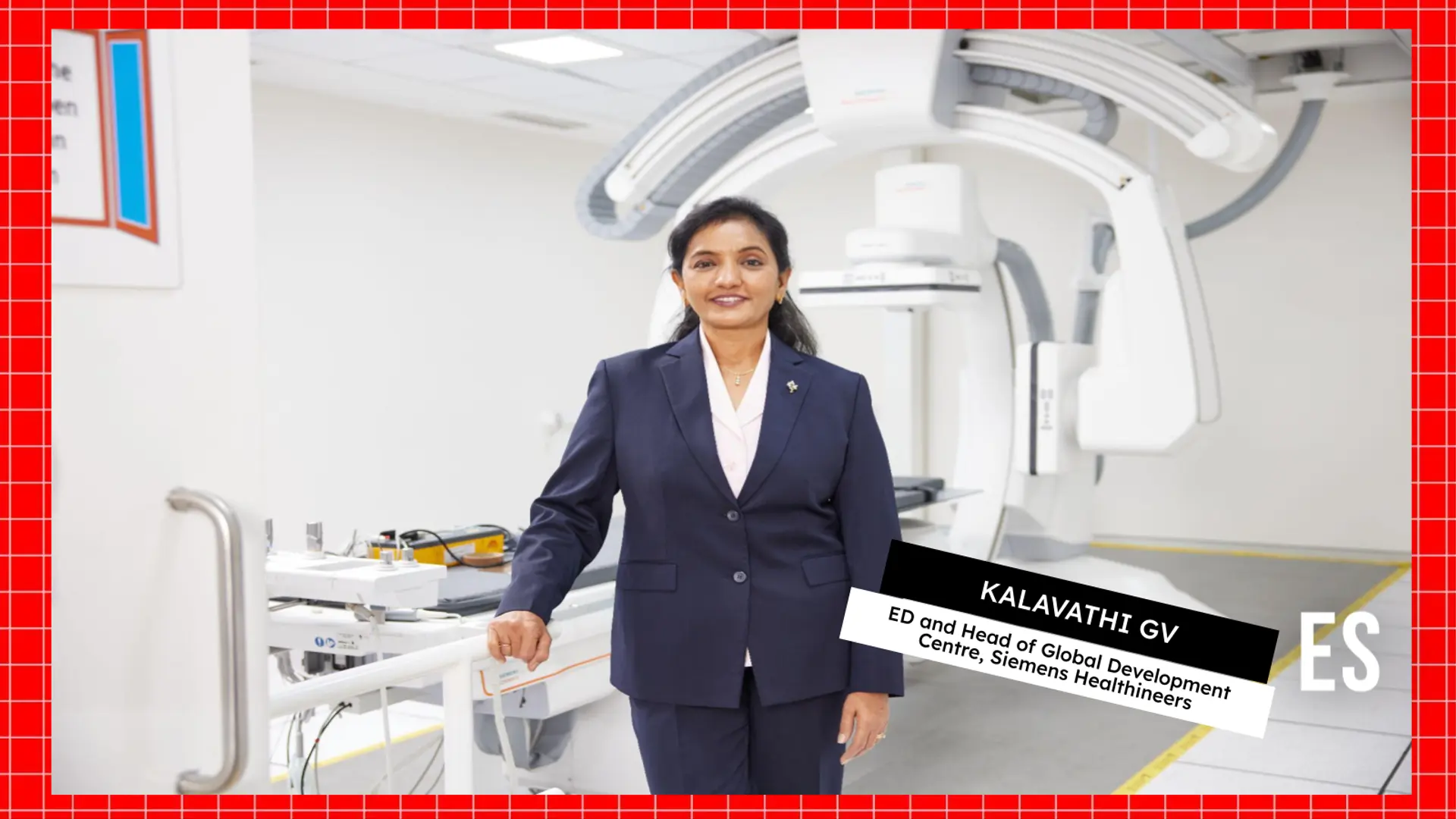
In an e-mail interview with Enterprise Story, Kalavathi GV, Executive Director and Head of Global Development Center, Siemens Healthineers, said, “Working closely with the startup ecosystem is a key part of how we envision advancing healthcare through new technologies and business models. “
Edited excerpts:
Enterprise Story [ES]: Can you talk about Siemens Healthineers’ profile in India?
Kalavathi GV (KGV): Siemens Healthineers in India has a strong and long-standing presence of close to 100 years. Through our integrated setup that includes a robust customer services organisation, manufacturing facilities, and one of our largest global innovation centres in the country, we serve local and global markets across the entire value chain.
India is a strategic location that drives innovation, access to care, and impact across the global organisation. The Development Center (DC) in Bengaluru, a core pillar of our Technology Excellence framework, lies at the heart of our global research and development efforts. With almost 50% of all software professionals in Siemens Healthineers housed in India, DC contributes to all businesses of the organisation; this includes diagnostic imaging, ultrasound, advanced therapies, and diagnostics.
At DC, our teams are at the forefront of shaping next-generation innovation that addresses healthcare challenges and gaps faced by the world today, and those that data has predicted for the future. The focus is on AI-based support, diagnostic automation, remote scanning solutions, predictive diagnosis, and personalised treatment. These innovations are developed through a deeply collaborative approach that brings together expertise from academia, startups, and end-users—this ensures that we maximise our patient touchpoints and deliver solutions that are clinically relevant and human-centric. Empowered by the commitment of close to 3,500 colleagues in India, we continue to pioneer breakthroughs in healthcare for everyone, everywhere, and in a sustainable manner.
ES: What is Siemens Healthineers’ vision for the startup ecosystem in India?
KGV: Startups are powerful partners that can help us transform how healthcare is delivered in India and globally. Working closely with the startup ecosystem is a key part of how we envision advancing healthcare through new technologies and business models.
The Technology Accelerator is a dedicated team and program in Siemens Healthineers that works with startups in India and globally. The idea is to create impact for both our business and customers by increasing our patient touchpoints. Our goal is to identify startups that align with our core business areas and collaborate on solutions that address real-world healthcare needs. These partnerships bring breakthrough technologies and fresh thinking into our ecosystem, provide access to bold ideas, and enhance our existing R&D efforts. Moreover, by working together, we can bridge technology gaps faster, complement each other’s strengths, and accelerate the development and delivery of impactful, patient-centric solutions.
In 2023, we announced our Startup Accelerator Program in partnership with the Nasscom Center of Excellence AI and IoT. It connects us with startups to focus on six domains—access to care, networked care, digitally-enabled services, radiology imaging, in-vitro diagnostics and advanced image-guided therapy—to improve care in disease areas such as cardiology, neurology, oncology, and infectious diseases. Collaborating startups get access to mentorship as well as our global platforms, software and equipment so they can build, test, and scale their solutions faster and more effectively.
ES: What is the broad outline of the Technology Accelerator programme?
KGV: Technology Accelerator plays a pivotal role in identifying innovative technologies and startup solutions from various ecosystems that lead to co-creation, new suppliers, and joint go-to-market opportunities that create a meaningful impact for our businesses and customers globally. We identify the key business needs and strategic focus areas, such as clinical, technology and business growth, and then explore startups aligned with these priorities. We facilitate end-to-end collaboration, from guiding selected startups through proof-of-concept, to validation, and finally to commercialisation. Over the past three years, we have initiated over 25 startup-driven proof-of-concept projects and established several commercial collaborations from India.
In addition, startups gain access to impactful business projects, real-world market access, and mentorship in critical areas such as intellectual property, regulatory, business development and data access. We enable this through a strong partner network with ecosystem enablers like Nasscom, Centre for Cellular and Molecular Platforms (C-CAMP), MedTech Innovator, and other accelerators.
ES: How has the experience of Siemens Healthineers partnering with Indian healthtech startups been?
KGV: India’s dynamic and vibrant startup ecosystem continues to bring forward agile, forward-looking solutions that align perfectly with our goal of making healthcare more predictive, accessible, and sustainable. Our collaborations extend beyond medtech startups as we actively engage with a wide range of innovators whose technologies intersect with our business requirements across clinical, digital, and operational domains.
Several of these collaborations have already been translated into meaningful outcomes. Our global partnership with Qure.ai on an AI-based tuberculosis screening solution is an important example. This solution is available on our SyngoOpenApps digital marketplace and is closely aligned with our Access to Care growth vector. We have also worked with Imaginate, an AR/VR startup, to co-develop pre-sales demos and customer training mixed reality applications for CiosFit, our mobile C-arm product. More recently, we have partnered with BioCliq for its AI-based urology solution.
We are also working closely with generative AI startups like TruFoundry and Relicx.ai, which are helping drive internal productivity improvements through automation, demonstrating how such partnerships go beyond products to support operational transformation.
ES: What is the future roadmap of Siemens Healthineers vis-à-vis the Indian startup ecosystem?
KGV: Our current collaborations reflect a strong belief in the power of co-creation and underline India’s growing role as a strategic hub for healthcare innovation. Strengthening and scaling such partnerships remain a key priority for us, as we continue to explore new ways of delivering healthcare that is smarter, faster, and more efficient.
We are particularly excited about the growing convergence of medtech and emerging technologies like generative AI, digital twins, robotics, sensors, and immersive technologies. These are areas where we see significant potential for co-developing solutions that advance precision medicine and expand access to health for everyone, everywhere, sustainably.
Edited by Kanishk Singh