



Tata Steel bets on AI to become the ‘Zepto and Blinkit’ for the industry
Tata Steel's investments in digital frameworks and AI over the years have kept the company at the frontier of new technologies and are paying rich dividends in areas of productivity and savings.


Steel and artificial intelligence (AI) seem to be opposite ends of a spectrum but for the 118-year-old iconic company, Tata Steel, they just go hand-in-hand as the company plans to use tech to accelerate steel delivery — from weeks to days.
In an interview with EnterpriseStory, Tata Steel Chief Information Officer (CIO) Jayanta Banerjee says, “We are now trying to become the Zepto, Zomato or Blinkit of the world. Being a steel company, I will not be able to deliver steel to you in 10 minutes, but through our digital platform Aashiyana I can deliver steel to you in 72 hours.”
The company is well-positioned to meet its lofty goals, boasting a crude steel capacity of 35 million tonnes per annum with plants located across India, the UK, the Netherlands, and Thailand. It has around 169 companies under its network.
Tata Steel's digital journey, which began over eight years ago, has now resulted in the company building 600 AI tools, with collected data approaching 11.2 petabytes.
Tata Steel’s digital platforms have helped it sell products online. Additionally, by mapping its entire operations spread over multiple sites with many different functions, the company gains better visibility on how it can serve customers better once an order is placed.
“Today we are in a position to give order confirmation within 72 hours instead of seven days,” says Banerjee.
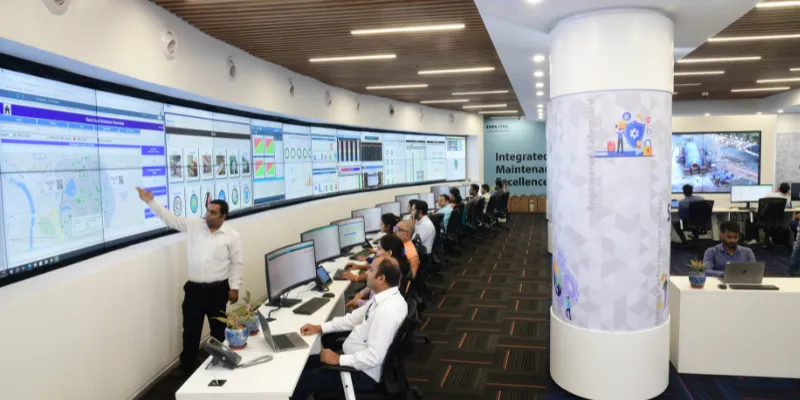
Integrated Remote Operations Centre, Tata Steel Jamshedpur

AI, according to the CIO, monitors everything, from buying raw materials to the logistics and delivery.
Digital start
Tata Steel began its digital transformation journey in 2017-18 and was a pioneer in implementing ERP (enterprise resource planning) software.
“Tata Steel has been a company that is a leader in steel, but also has been an early adopter of technology, whether it's a steel technology or digital,” says Banerjee.
According to the CIO of Tata Steel, the company has been in the forefront of getting accreditation from several global organisations such as World Economic Forum Lighthouse, which he described as the epitome of digital transformation accreditation. The certificate covers around 80-82% of the steel production.
Besides, Tata Steel also goes through the frameworks of Gartner and the Massachusetts Institute of Technology (MIT) for accreditation, which are also tough benchmarks to achieve. The company is associated with MIT in the AI segment.
According to Banerjee, Tata Steel laid out a formal technology roadmap in 2018 with two key goals: one to become a global leader in the steel industry by 2025, leveraging digital technologies and the second was to generate at least $2 billion in potential savings through digital technologies. The savings were achieved in 2025.
However, this required putting foundational digital blocks first. This meant collecting data within the expansive operations of Tata Steel and also getting key insights from this information.
Under one head
The Tata Steel CIO remarked that the company made substantial investments in digital technologies. It also brought all the functions of the company, from engineering and digital, to information technology under one head so that it would have a single source of truth.
“This is important because to do a business transformation, one needs to look at the entire tech stack,” says Banerjee.
More importantly, it also ensured that all these changes are business driven, that is it has met the key performance indicator (KPI) for Tata Steel. The KPIs for a steel company are: yield, energy, throughput, quality, and productivity.
“Our investment became an ROI-based construct, where for every dollar we spent we had to get some money back to the company,” remarks the CIO.
AI models
Given this backdrop, Tata Steel built around 600 AI models which are being deployed across various functions of the company. Around 80% of them are used in its manufacturing division: from helping production to safety.
For example, Tata Steel uses an AI imaging model to determine if there are any defects in any manufacturing process. Among other things, the models also check for the moisture content of the procured coal.
The company also uses tech to ensure employee safety. Tata Steel can now remotely monitor through an algorithm whether the correct safety steps are being followed by its workers.
The company says its investments in digital processes ultimately benefit the end user. According to Tata Steel, it doesn’t just supply the raw material but also helps its users. For example, through its Aashiyana website, it provides advice on how to go about building their house.
Future
India is globally the second largest producer of crude steel after China, according to the Union Ministry of Steel. For FY25, the crude steel production was 152.18 million tonnes and finished steel production at 146.69 million tonnes. The consumption of steel was 152.13 million tonnes. India's steel industy is a mix of public and private sector companies which includes SAIL, Tata Steel, and JSW Steel.
Now, Tata Steel is working on what’s next for the company in leveraging AI and GenAI. These could address questions like how it can reduce the time to deliver its products, improve the safety issues, and create new service models.
“The future is in AI, and there is no doubt about it. It will transform things,” says Banerjee.
He believes GenAI will be able to create new content and also analyse a larger volume of data to generate insights.
“The next form of agentic AI is humanoid where there is a robotic operating system that takes command from a natural language,” says Tata Steel CIO.
Advancements in AI have also led to fears about job cuts and unemployment.
Banerjee believes that one cannot blindly implement the existing template of productivity or efficiency in manufacturing, as he believes that these are designed for developed Western economies where there is a scarcity of labour. This is not the case in India.
“We have to be responsible as a society, as a company. So here we will use technology as a co-pilot. Where robots can help a human, then I will use it as a co-pilot, he remarks.
The digital journey has started to pay rich dividends for Tata Steel not just in monetary or productivity terms. Banerjee says, “Due to our digital interface we are able to attract more customers from different demographics.”
(The copy was updated on the company's request.)
Edited by Affirunisa Kankudti