



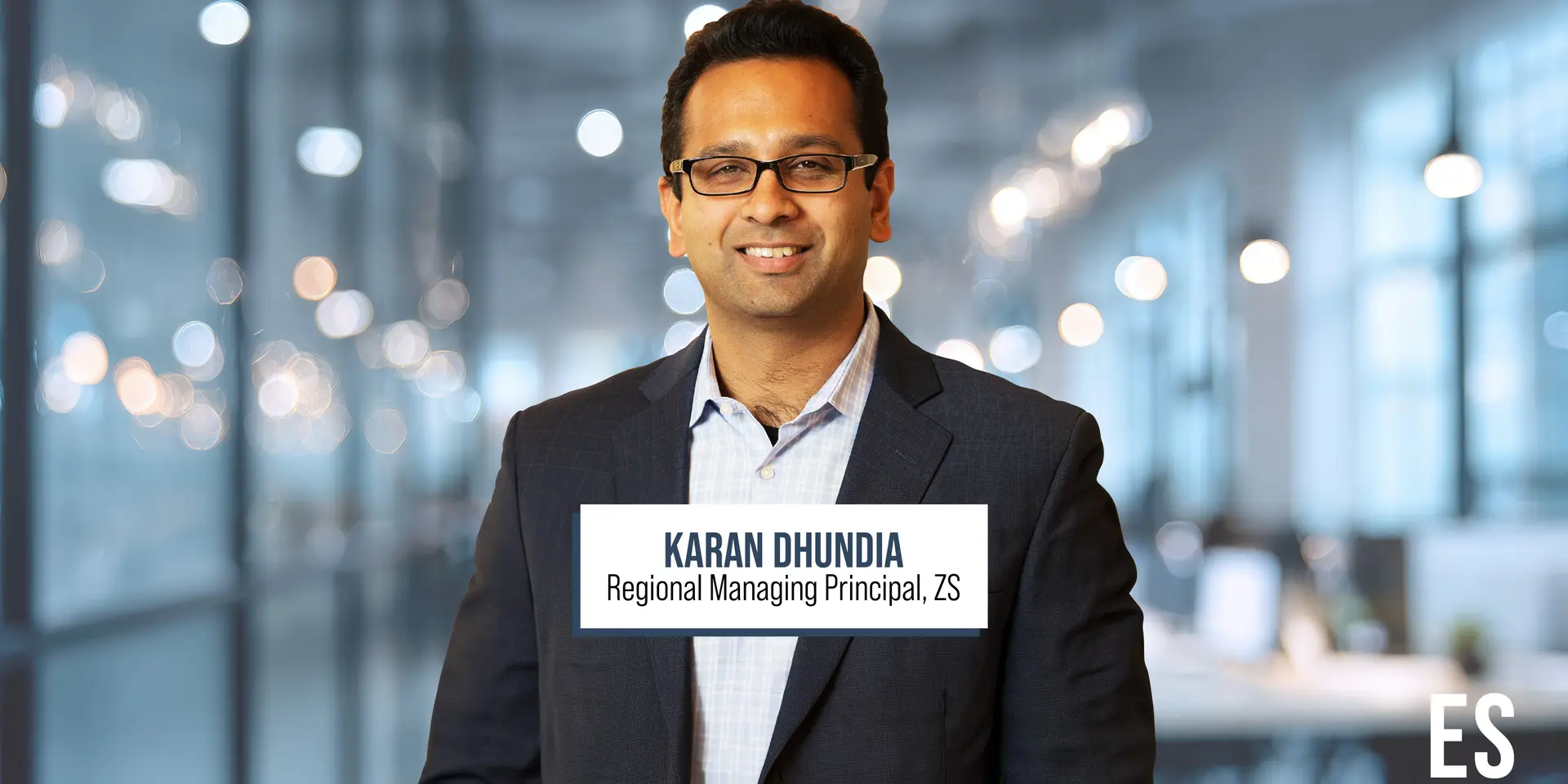
Pharma’s real AI challenge is embedding it into day-to-day operations: Karan Dhundia
In an interview with EnterpriseStory, Karan Dhundia, Regional Managing Principal at ZS, says that as pharma moves beyond AI pilots, the focus is shifting to scaling the technology across operations while ensuring measurable business outcomes, responsible adoption, and effective governance.


Artificial intelligence (AI) is becoming deeply embedded in the pharmaceutical and life sciences industry, moving beyond pilot projects and proofs-of-concept to deliver tangible results. The biggest driver for this is the ability of AI to unlock value from the vast volumes of unstructured data generated by the healthcare industry on a daily basis.
AI is now touching almost every aspect of the healthcare industry. Questions are also being asked around the adoption of this technology at scale while delivering measurable business outcomes.
ZS, a global management consulting and technology firm with deep expertise in healthcare, says the sector is still transforming from pilots and points solutions to enterprise-wide, governed, AI-led transformation.
In an e-mail interview with EnterpriseStory, Karan Dhundia, Regional Managing Principal at ZS, said while deploying AI is one thing, the real challenge lies in embedding it into day-to-day business operations. Edited excerpts:
EnterpriseStory (ES): How is the pharmaceutical and life sciences industry adopting AI?
Karan Dhundia (KD): AI is fundamentally reshaping how life sciences organisations discover, develop, commercialise, and deliver healthcare. It’s no longer confined to the lab, it’s increasingly used to answer the industry’s hardest questions: which molecules are most likely to succeed, how to optimise a launch, how to understand physician behaviour, and how to make patient engagement genuinely more relevant.
More significantly, AI adoption is now moving beyond pilots to enterprise-scale transformation. In India, nearly 50% of pharmaceutical companies are investing in AI technologies, with about 25% already implementing GenAI solutions in production environments.
A key driver of this acceleration is generative AI’s ability to unlock value from healthcare's vast volumes of unstructured data. In R&D, AI is already expected to compress drug discovery and development timelines by 25% to 50%. It is also transforming diagnostics, clinical trial design, and patient recruitment, where India's diverse patient base provides a unique advantage for building more representative datasets.
The other important shift is that AI adoption is no longer being driven only from inside the enterprise—it is also being shaped by patients. They are more informed, more digitally engaged, and much earlier than before.
ZS’s Future of Health Report 2026 found that approximately 90% of people who use AI and digital tools for health information trust it nearly as much as their doctor. AI and AI-powered search are becoming increasingly important sources of health information and early decision support, helping people navigate care before they meet a physician. That shift is reshaping clinical conversations, with nearly 68% of physicians reporting more patients asking about specific therapies by name.

Image: Shutterstock
Together, these developments reflect an industry where AI is becoming embedded across the life sciences value chain, connecting scientific innovation, enterprise transformation, and the patient experience.
ES: Has AI entered the core operations of the pharma and life sciences industry, or is it still at the periphery with certain pilot projects?
KD: I think we have moved well beyond the pilot phase. A few years ago, most organisations were experimenting with isolated AI use cases. Today, AI is increasingly becoming part of core business operations—from R&D and manufacturing to commercial functions, supply chain, and patient engagement.
The nature of conversations has also changed. Earlier, organisations wanted to understand what AI could do. Today, they are asking much more fundamental business questions: How can we improve the probability of success for molecules in development? How do we launch products more effectively? How do we improve commercial performance or redesign customer engagement?
AI is becoming central to answering these questions because it allows organisations to combine vast amounts of structured and unstructured data into actionable decisions.
That said, technology alone doesn't create transformation. One of the biggest lessons we've seen is that AI may provide the answer, but organisations still need people, processes, and operating models to change. So, the more accurate view is that AI has moved well beyond experimentation, but the sector is still in a transition phase—from pilots and point solutions to enterprise-wide, governed, AI-led transformation.
At ZS, our focus is on helping clients bridge that gap between AI ambition and business impact, ensuring AI becomes part of how the business operates every day rather than remaining confined to isolated use cases. Ultimately, the organisations seeing the greatest value are those treating AI as an enterprise capability rather than a collection of pilots.
ES: How is a pharma consulting firm like ZS engaging with the industry in the changed landscape of AI?
KD: The life sciences industry has moved beyond asking, “How do we adopt AI?” The bigger question today is, “How do we make AI deliver measurable business outcomes at enterprise scale?” While there’s enormous excitement around AI, many organisations still face a gap between ambition and impact. Deploying AI is one thing; embedding it into day-to-day decision-making and business operations is where the real challenge lies.
That's where our role at ZS has evolved. We work alongside clients as the connective tissue across strategy, data, technology, and operations, helping break down organisational silos so AI delivers end-to-end impact rather than isolated use cases. What differentiates our approach is the combination of deep healthcare expertise with decision-centric AI.
Equally important, we believe value is realised not at the point of deployment, but through adoption and scale. That's why we continue supporting clients beyond strategy and implementation by helping transform workflows, evolve operating models, and embed AI into the fabric of the enterprise so it delivers sustained business impact.
ES: Given the fast-paced changes in AI platforms and a highly regulated industry like pharma and life sciences, how is ZS bringing about the balance while also delivering value?
KD: Healthcare has always operated on trust, and AI only raises the standard. In life sciences, success isn't defined by how quickly organisations adopt the latest model; it is defined by whether AI can deliver decisions that are trusted, explainable, and scalable in a highly regulated environment. That is why we believe innovation and governance cannot be separate conversations; they must be designed together from the outset.
As AI becomes more autonomous, governance must evolve alongside it. Governance can no longer be a checkpoint at the end of the deployment. It needs to become an embedded capability that ensures quality, transparency, and accountability.
Ultimately, AI transformation is not a technology journey—it’s an operating model transformation. The organisations that will create lasting advantage won’t be those deploying the most AI, but those embedding it responsibly into the way they work, measure success by business outcomes rather than AI adoption, and build the trust needed to scale innovation across the enterprise.
Edited by Megha Reddy