



Developers need to continuously hone their skills to avoid AI slop: AWS technologist
Darko Mesaroš, Distinguished Developer Advocate at AWS, believes developers will continue to play a key role in ensuring high-quality output as they work alongside AI agents.



As much as generating software code through artificial intelligence (AI) agents has become commonplace, developers still need to hone their skills to ensure high-quality output and avoid falling into the trap of AI slop, according to a leading technologist.
Darko Mesaroš, Distinguished Developer Advocate, Amazon Web Services (AWS) said, “I always encourage fellow developers to still keep honing their craft as they really know what they are doing and an agent is only going to make them more productive.”
Speaking to the media, Mesaroš highlighted that while AI agents have become increasingly capable, they cannot always address unforeseen developments, such as software running into problems or operational metrics changing unexpectedly.
Today, AI slop, which is low quality output, has become a big challenge across the spectrum given the rising dependence on autonomous tools. The AWS technologist believes that the role of a developer is much broader today as it extends beyond just software coding and needs the skill of orchestrating different AI agents to come out with a high quality output.
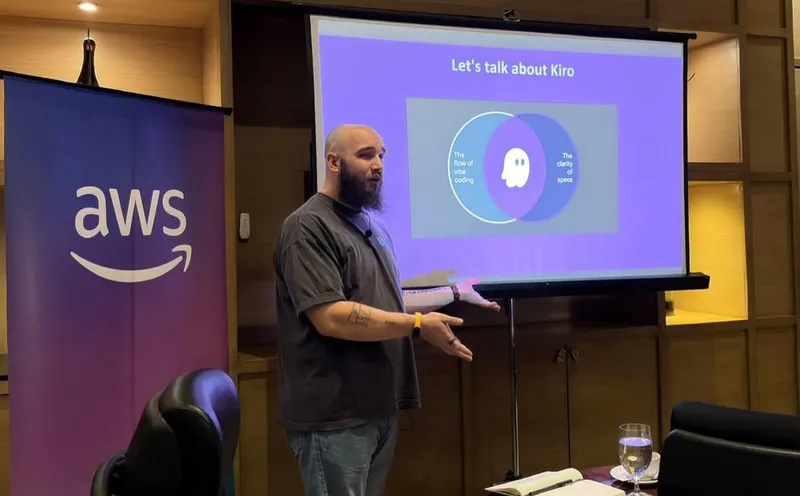
Darko Mesaroš, Distinguished Developer Advocate, AWS
“The responsibility of a developer is to make sure that the project they're building is resilient to AI slop,” Mesaroš remarked.
AWS has also sought to address the issue of AI slop with the introduction of Kiro last year, an agentic development platform that comes with a spec-driven guardrail, meaning it works based on clearly defined requirements.
According to Mesaroš, spec-driven software development is a practice developers have been using for a long time, but it can also be tedious as developers have to create requirement documents, explain features, and describe how they are expected to work for users.
Mesaroš said Kiro gives developers the best way to build high-quality software by ensuring correctness, specific guidance and how to properly address software development.
According to AWS, Kiro has a growing base of users in India with startups such as Dhan, Pristyn Care, Analytics Fox, and Glimmertech to name a few.
In the case of Dhan, a stock trading platform, it used Kiro to ship a new real-time charting handling 170 plus indicators with zero tolerance for errors in 8 weeks with a single engineer, a project that originally was planned for 12–24 months.
Healthcare startup Pristyn Care used Kiro for its marketing functions and saw this cost going down by 8%.
On vibe coding, Mesaroš said this is a good way to quickly ship software but the challenge comes when one starts introducing potentially sensitive information and here the need will be to build a solid product.
He further stressed that Kiro will not produce code like the typical vibe coding sessions but will build based on the requirements.
According to Mesaros, ultimately it will be human beings who will pull the strings to make the choices. “A developer will sit there and produce software with an engine.”