



ServiceNow bets on AI agents to reshape enterprise workflows
AI workflow software company ServiceNow believes AI agents will play a key role in automating employee workflows and getting tasks done, while operating within human-defined guardrails.

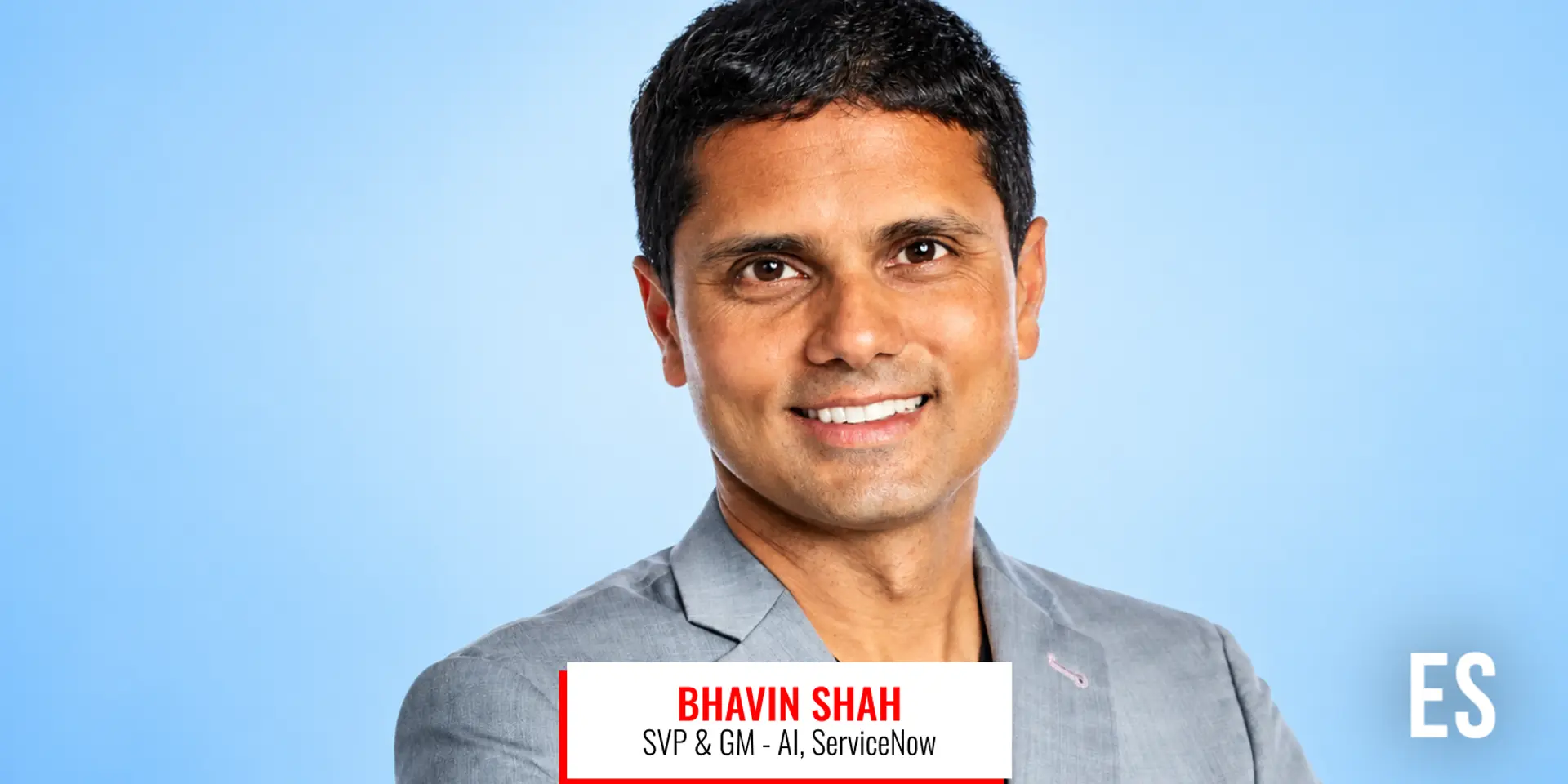

Artificial intelligence (AI) workflow software company ServiceNow expects AI agents to play an important role within enterprises, helping complete tasks while operating within human-defined guardrails.
ServiceNow has already deployed its AI Control Tower, a centralised platform designed to provide an overview of AI functions and activities across different departments within an enterprise.
In an interaction with EnterpriseStory, Bhavin Shah, Senior Vice President & General Manager—AI, ServiceNow, said: “AI is an enabling technology that will itself get incorporated into almost everything we do or build.”
However, he added that while AI is democratising intelligence, the real test will be how organisations apply it and act on it.
Shah was previously the founder of MoveWorks, an agentic AI platform that was acquired by ServiceNow for $2.85 billion in March 2025.
“The transformation from companies just thinking of AI as an answer system to something that can now be really agentic. Agents can think, rethink, and then do something else,” Shah remarked.
Shah believes the agentic platform can provide a completely different employee experience within the enterprise where it could be used to complete tasks.
For ServiceNow, the goal is to bring all the experiences of different functions within an enterprise onto a single interface. For example, a new employee joining an organisation should have a seamless experience across different departments
“Our real ambition is to create a system that is simple but also very powerful,” Shah said.
The goal is to enable many of these functions through self-service, with an agentic layer handling tasks and allowing employees to focus on more meaningful work.
The company believes that a self-service environment within an enterprise can drive business transformation while also delivering significant cost savings.
The agentification of a process also enables AI to become an active participant in workflows and consider the broader structure of a task. In this model, AI is not merely a tool but increasingly becomes a member of the team.
According to Shah, the goal is to build a system that can talk to different components within an organisation and come out with answers.
As agentic models become even more commonplace, the differentiation will not come from these having more data but the ability to get the tasks done. However, there is also an element of distrust within enterprises on going fully ahead with an agentic environment.
“The lack of trust comes down to two things. One is the ability to govern what it does and to control what does. And to be able to observe what it does,” Shah remarked.
He said one cannot have AI acting in a way that could potentially compromise the system, and this is where guardrails and governance comes into play. “What is important is making sure that you have the control and have that sort of ability to do that.”