



A signature saree challenges the idea that consent ends with marriage
At Mumbai’s Royal Opera House, an “infinite” saree was unveiled on January 28, bearing thousands of signatures of gender-based violence. The exhibit, by Red Dot Foundation and designer Nivedita Saboo, uses art and memory to demand legal change.


On January 28, a 4 km-long saree was unspooled across the Royal Opera House in Mumbai. A closer look at it revealed that it didn’t have patterns or zari, but names - thousands of them–printed, stitched, and embroidered into the pallu; each signature belonging to a survivor of gender-based violence.
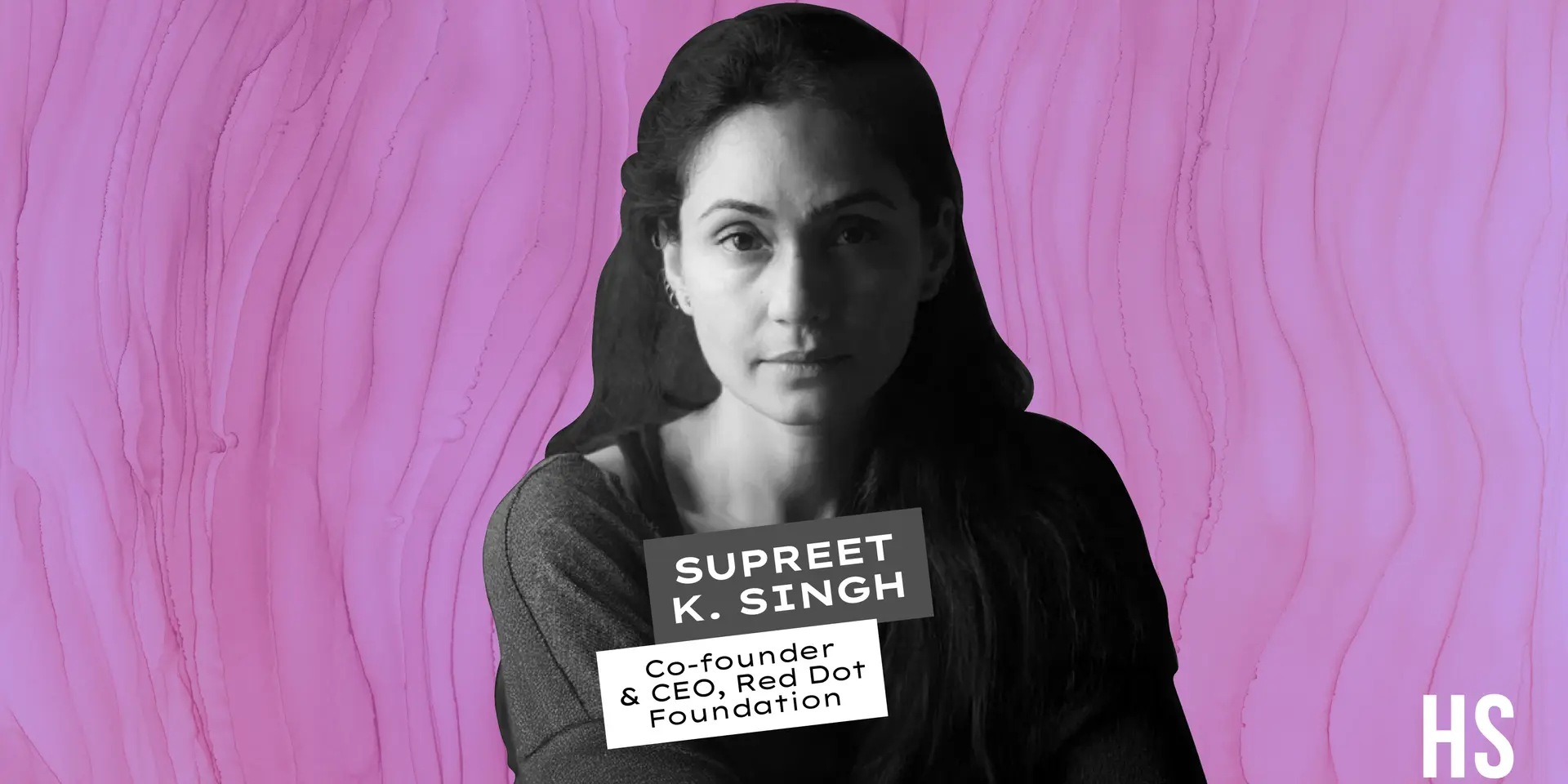
A collaboration between Red Dot Foundation, a Mumbai-based non-profit organisation that works to prevent sexual and gender-based violence, and designer Nivedita Saboo, the artwork was conceptualised as a signature saree– an “infinite” garment imagined as a living petition demanding the removal of the marital rape exception from Indian law. “The saree is still growing, more signatures are being added. The fabric, like the conversation it seeks to provoke, is not meant to end,” says Supreet K. Singh, Co-founder and Chief Executive Officer of Red Dot Foundation.
For Singh, the saree is one of the most personal symbols of womanhood in India, worn every day, passed from grandmother to granddaughter. “It’s what women wear when they step into marriage.”
Singh’s advocacy to criminalise marital rape gained urgency and speed after a case in February last year, where the Chhattisgarh High Court acquitted a husband who had previously been convicted of raping and sexually assaulting his wife, which led to her death, because the law in India does not recognise marital rape as a crime if the wife is above the age of 15.
“That was the moment when the conversation could no longer remain abstract,” she says. “We had to ask ourselves what it would take for people to feel this, not just debate it.”
For her the answer came through art.
“Law is necessary. Policy is necessary,” Singh says. “But laws don’t change in isolation. They change when society understands the harm it has normalised.” Art, she believes, does what legal language often cannot; it enters homes and opens conversations without accusation. “It reaches places where shame and silence have lived for decades,” she says.
The saree, stitched with more than 5,000 signatures so far, became a collective assertion that marriage is not a blanket permission slip and that violence does not become invisible just because it happens behind closed doors. “This is a living petition,” Singh says. “It holds collective courage and resistance in a form that Indian culture instantly recognises.”
This fight for visibility of gender-based violence has shaped much of Singh’s work. In 2012, she co-founded Safecity, a crowdsourced platform that maps sexual harassment and violence through anonymous survivor reports. Over the years, Safecity has shifted conversations around safety from isolated incidents to patterns, showing how violence clusters around certain spaces, timings, and conditions.
“Data is important because it moves the focus away from individuals and towards systems,” says Singh. When authorities see patterns—repeat locations, peak hours, environmental risks—denial becomes harder and action becomes measurable.
She recalls a neighbourhood in Faridabad where women reported feeling unsafe near a liquor shop in the evenings. Safecity data showed clear patterns, and following this, there was increased police patrolling, along with small but meaningful changes on the ground. “Reporting from the area went up, because people felt seen,” says Singh.
But what Singh is clear about is that neither data nor law can dismantle patriarchy if inside homes, things remain unchanged. Much of her advocacy is deeply personal. Raised in an army family where she was encouraged to speak up and claim equality, she remembers the shock of being told after marriage that “a girl has to change.” “The message was delivered to me plainly, like a fate that I must accept.
“For a long time, I thought something was wrong with me,” she says. “That I wasn’t adjusting enough, that I wasn’t submissive enough.” It took time and support to understand that what felt like personal failure was structural conditioning.
That conditioning is often reinforced by women themselves, she adds. “Advice to endure, to stay quiet and to protect family honour. If trauma has been normalised for you, it becomes very easy to pass it on to the next woman who enters the family.”
Her work with men and boys is often met with discomfort, embarrassment and resistance. So, in her engagement with them, she begins with questions - about control, responsibility and fear. “Who is being protected? Who is being restricted? If 50% of the population is facing harassment,” says Singh, “it’s because the other 50% is not being taught differently.”
She insists that change cannot rest on women alone. It has to travel through brothers, sons, husbands, partners, friends and colleagues.
“Consent should not end at the altar,” Singh says. “This is not about destroying families. It’s about ensuring dignity and justice, and recognising that marriage or love do not cancel out the right to say no.”
Edited by Affirunisa Kankudti