



Indian whisky on the global map: Why Amrut thinks producing 6 million cases isn’t enough
From distilling 1,000 litres a day to producing 6 million cases annually, Amrut Distilleries has redefined how the world perceives Indian whisky. With a cult following, multiple awards and global recognition, the Bengaluru-based distillery continues to set benchmarks for the Indian spirits industry.

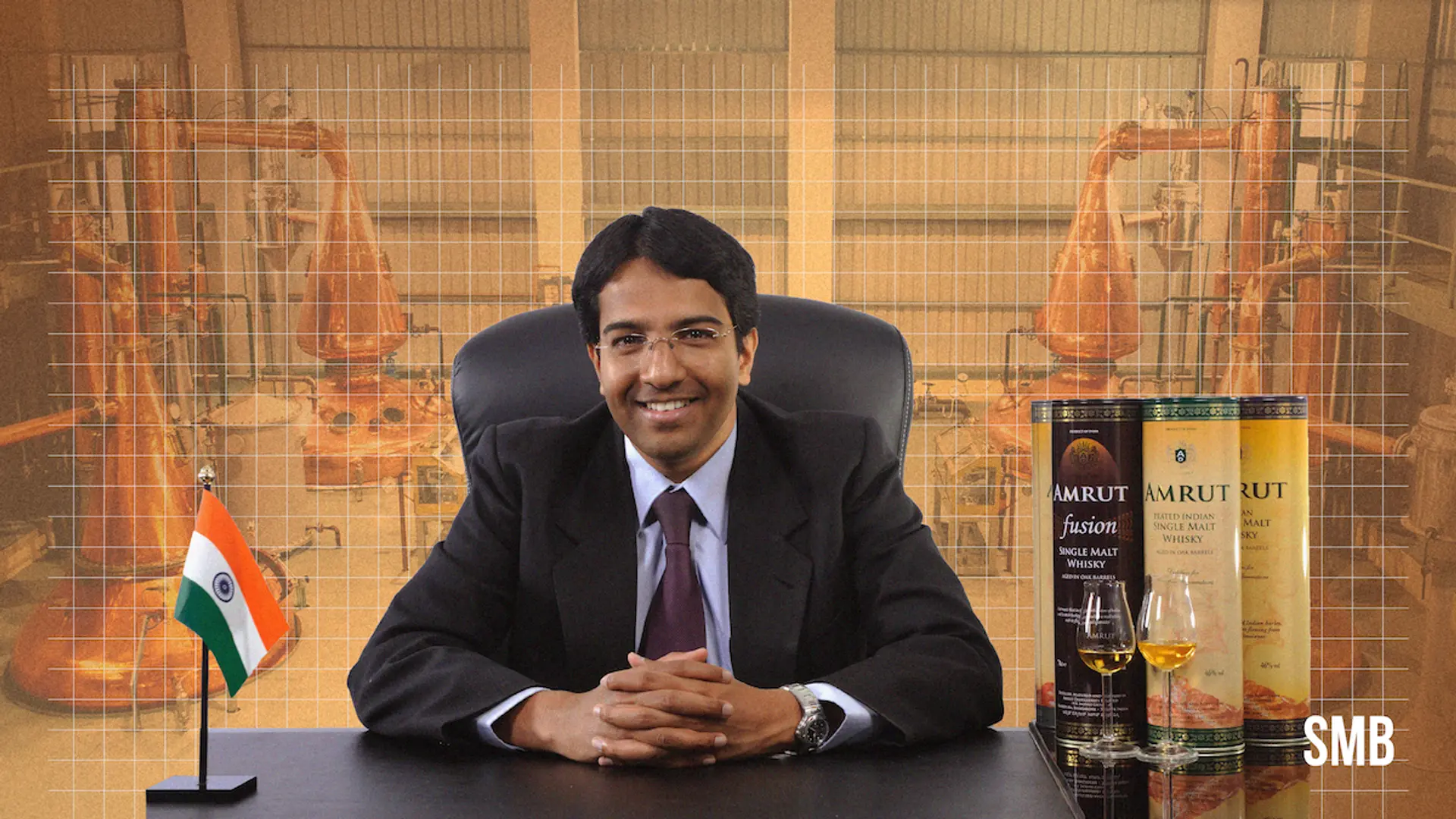

Long before Bengaluru came to be known as the Silicon Valley of India, the city had already nurtured a culture of enterprise and innovation.
In 1948, Amrut Distilleries made Bengaluru its home as a family-run venture that eventually became the pioneer of India’s single malt whisky. What started as a bottling and blending unit for IMFL (Indian Made Foreign Liquor) by the late JN Radhakrishna Rao Jagdale has developed into a globally recognised whisky brand, particularly famous for its use of Indian barley and climate for single malt production.
Amrut has multiple awards under its belt—Silver Award Winner at the International Wine and Spirit Competition 2016, London; World Whisky of the Year by Malt Advocates Whisky Awards in 2011, which recognises excellence in the whisky industry through blind tastings by an expert panel; and has been recognised as the ‘World’s best Whisky Brand’ at the International Spirits Challenge 2024.
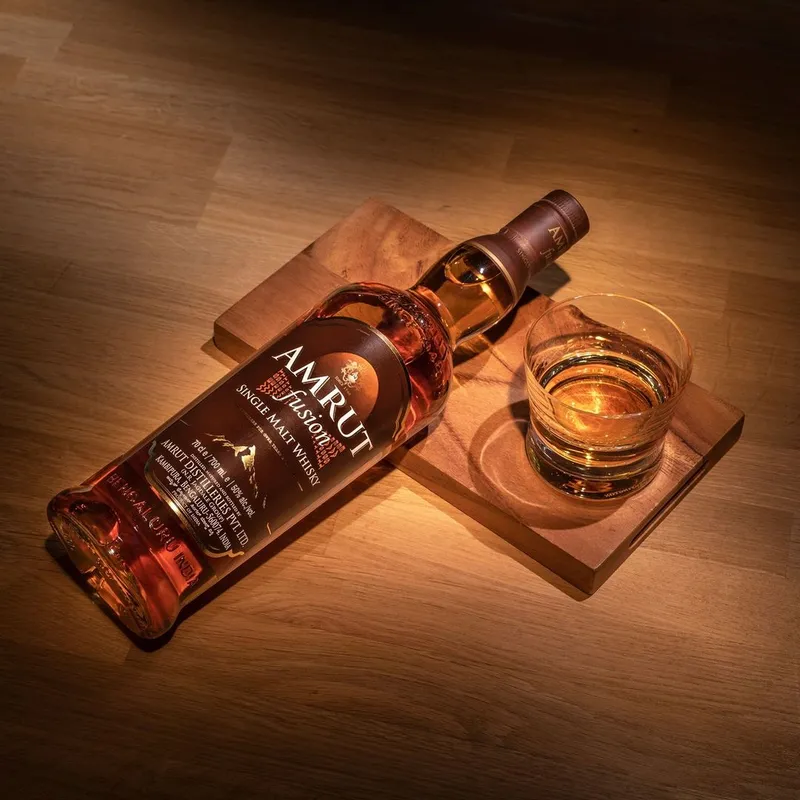
Amrut Fusion Single Malt Whisky was ranked as the third finest whisky in the world in 2010 by journalist and whisky critic Jim Murray
The turning point for the business came when Amrut Fusion single malt whisky made it to the 2010 edition Whisky Bible—often touted as the world’s leading whisky guide. Penned by journalist and whisky critic Jim Murray, Amrut was ranked as the third finest whisky in the world. For an Indian liquor brand in a market long dominated by imported whisky, this was nothing short of revolutionary.
Today, 77 years into the business, Amrut has stood the test of time in the fast-evolving alcobev market, producing about 1.4 million litres of single malt whisky annually and selling over 60 lakh cases a year.
Despite the scale, the demand continues to outpace the supply, “A nice problem to have,” tells Rakshit Jagdale, third-generation co-owner and managing director at Amrut Distilleries, during an interview with SMB Story.
The inception
Amrut Distilleries’ history dates back to India’s independence.
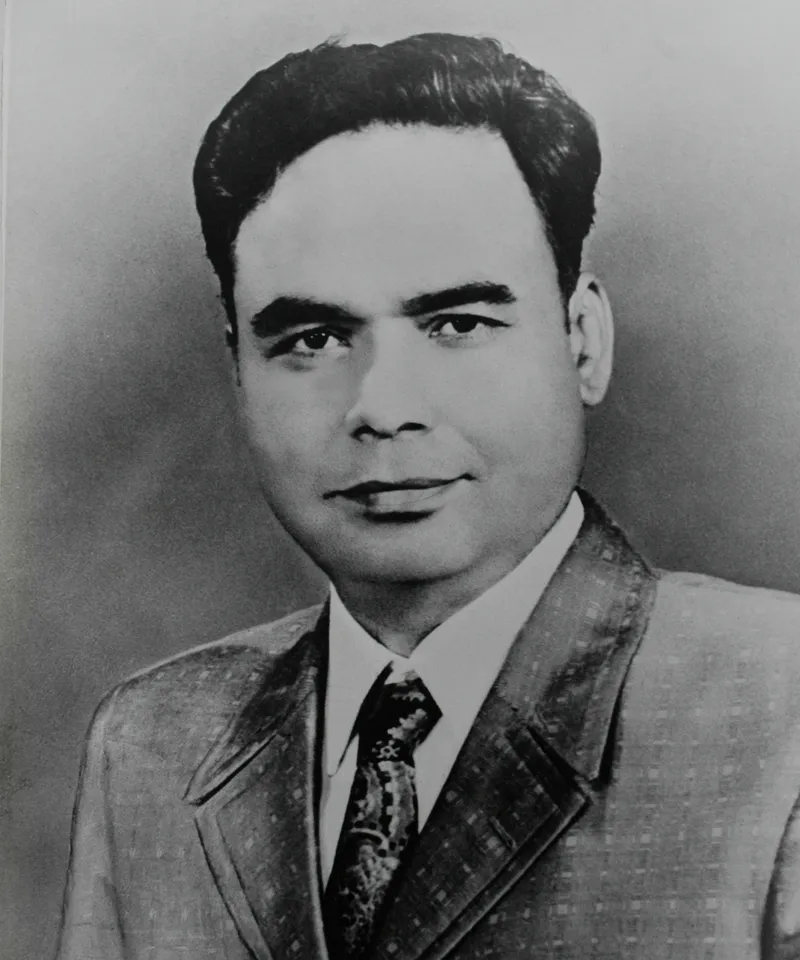
JN Radhakrishna Rao Jagdale, Founder, Amrut Distilleries
With a strong background in pharma, founder JN Radhakrishna Jagdale first started pharmaceutical company Amrut Laboratories, before entering the liquor market in 1948, following the liberalisation of alcohol licensing laws in India.
Under JNR’s helm, Amrut launched its first product, Silver Cup Brandy, in 1949, followed by the Amrut XXX Rum in the mid-1950s. In 1972, his son Neelakanta Rao Jagdale joined the business; he introduced premiumisation and set up branded distillation.
In 1972, Amrut Laboratories pivoted to Amrut Distilleries, and under Neelakanta’s helm, the company launched Bejois, a 100% grape brandy.
The real turning point came in the 1980s. At a time when most Indian distillers were supplying molasses-based blends for domestic consumption, Neelakanta saw the opportunity to create something premium—a whisky made from barley.
Sourcing barley from Punjab, Haryana, and Rajasthan, coupled with the Indian climate that accelerates the maturation process, ageing whisky faster than in Scotland, gave Amrut a foundation to craft whiskies with a distinctive Indian identity.
“It took beyond guts to be there and to do something which has never been done before… From day one, my father was very clear—we don’t want to compare ourselves to Scotch or Irish or Japanese. We are Indian. And we make our own unique style of single malt whisky,” says Rakshit.
Thus, Amrut MaQintosh was launched in 1982 as one of India’s first premium whiskies.
Putting India on the global spirits map
In 2004, Neelakanta launched Amrut Single Malt Whisky as India’s first single malt in an Indian restaurant in Glasgow, Scotland. “My father was very specific; he wanted to launch it overseas first, to earn recognition abroad before bringing it home,” Rakshit says.
Following the Glasgow launch, the brand entered Western Europe, followed by Canada in 2007.
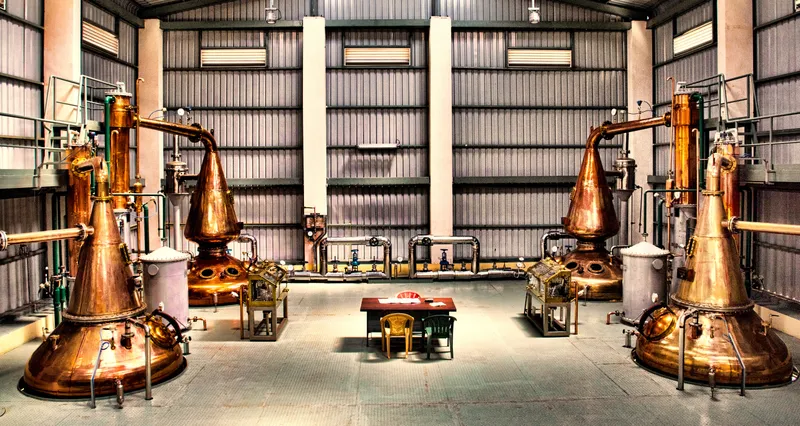
Inside Amrut Distilleries
It was only in 2010 that the Amrut Single Malt Whisky was launched in India after receiving international accolades.
Unlike global giants with access to external funds, Amrut continues to rely on its family-owned model. “We are still a privately held firm and we are proud of it… the flexibility allows us to make a decision today and roll it out by tomorrow… unlike multinational companies that require multiple levels of approval,” Rakshit asserts.
Amrut’s portfolio spans mass-market whiskies, single malts, rum, brandy, and gin. It has close to 50 variants of single malt whisky being sold across 58 countries, with India being a strong market, followed by the US and Europe.
While international markets account for just 5% of revenue, they play a crucial role in Amrut’s brand identity. However, its fastest-growing market remains home turf, India.
Numbers that matter
According to GourmetPro, the Indian spirits market was valued at $52.5 billion in 2024, and is expected to reach $64 billion by 2028. India is also the world’s largest consumer of whisky by volume.
Over the last few years, homegrown brands like Amrut, Indri, Paul John, Rampur, and Godawan have gained significant international acclaim.
Amrut has consistently been a first mover in the industry, introducing products and categories years before competitors caught on. “We have competed very well by staying ahead of the market trend,” says Thrivikram Nikam, Joint Managing Director of Amrut Distilleries, adding, “Amrut has earned its respect because of honesty, simplicity, heritage, and legacy. We have never imitated anybody.”
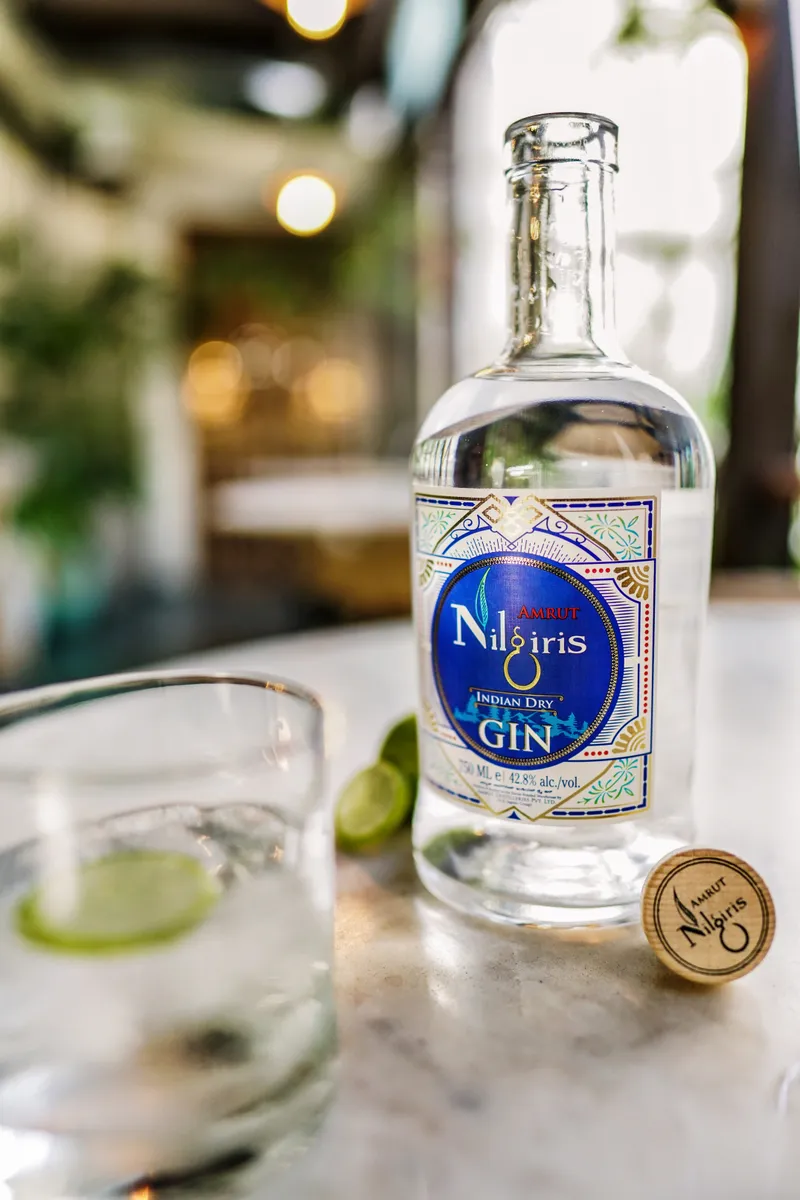
Amrut Nilgiris Indian Dry Gin
Beyond putting India on the global whisky map, Amrut has also introduced the Two Indies Rum, a blend of Indian and Caribbean rums—a world-first concept. Its Bella Rum, made from jaggery, was launched after Amrut lobbied the Karnataka government to license jaggery-based distillation. “Jaggery is very auspicious to us. In all our festivals, we use jaggery, so we wanted to show our culture outside,” Rakshit explains.
More recently, Amrut launched Expedition, a 15-year-old single malt priced at over $12,5oo a bottle, limited to just 75 bottles globally. It’s the brand’s most expensive launch to date.
In its initial years, Amrut distilled only 1,000 litres of whisky per day. Over the years, the brand has scaled dramatically. By 2018, Amrut had increased its capacity to 3,000 litres a day, and now it stands at 4,500 litres daily, with 1,300 employees working in the backend.
“In about eight years, we have quadrupled our production capability, and yet we are falling short,” Rakshit says.
On an annual basis, Amrut now produces about 1.2–1.4 million litres of single malt whisky, while overall, the company produces 24 million litres of alcohol to fill its six million cases of whisky.
Revenue-wise, 65% of Amrut’s topline comes from mass and deluxe categories, while 35% is contributed by premium and luxury products. Within the luxury and premium portfolio, Amrut Fusion remains the flagship. In the mass segment, Amrut Rum and Silver Cup, the company’s heritage brands, continue to lead.
Looking ahead
Amrut runs its primary facility on the Bangalore–Mysore highway, with additional licensed and contract bottling units in Karnataka, Kerala, Punjab, and West Bengal. The company is currently reviving its West Bengal operations to serve the eastern market more effectively.
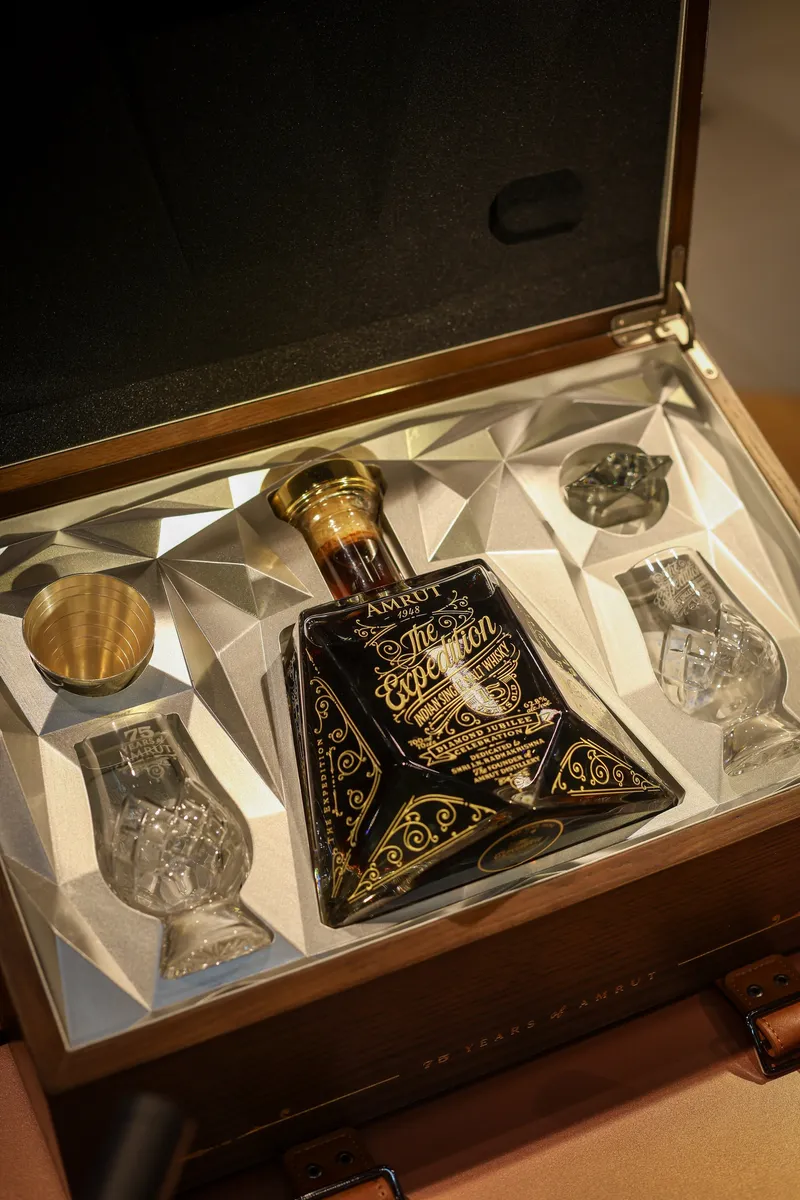
With only 75 bottles released globally and a retail price of over $12,500, Amrut Expedition is a rare 15-year-old single malt whisky
For now, whisky remains the brand’s pride and focus—with close to 65% of spirits sales coming from Karnataka alone. However, the company is also exploring other categories to stay relevant with younger consumers.
Ready-to-drink beverages (RTDs), despite their mixed track record in India, are on the radar. “We can’t shy away from RTDs, otherwise, we will become obsolete very quickly,” Rakshit acknowledges.
While gin and rum are already part of Amrut’s portfolio, tequila might be the next. “I have a strong feeling towards tequila. In the US, tequila is booming, and whatever happens there usually comes to India a few years later. Mature tequilas are very nice on the palate. I feel people may start enjoying good tequilas here as well,” he adds.
Still, the leadership is cautious about overreach. “Earlier, we could plan five years at least. Now I don’t know what will happen after six months. The next generation gets bored so easily. They may want something quick, easy to drink. We are watching closely,” Rakshit concludes.
Edited by Kanishk Singh