



Founded by India’s ‘Crocin Man’ in the 70s, ENTOD is driving innovation in eye care
ENTOD Pharmaceuticals has grown over 48 years into a multi-generational company specialising in ophthalmology, ENT, and dermatology.


Eye care remains a critical segment. India alone performs more than 12 million cataract surgeries a year. Other conditions, such as corneal ulcers and fungal keratitis, continue to cause preventable blindness. Yet for many of these conditions, the world still lacks effective or accessible treatments.
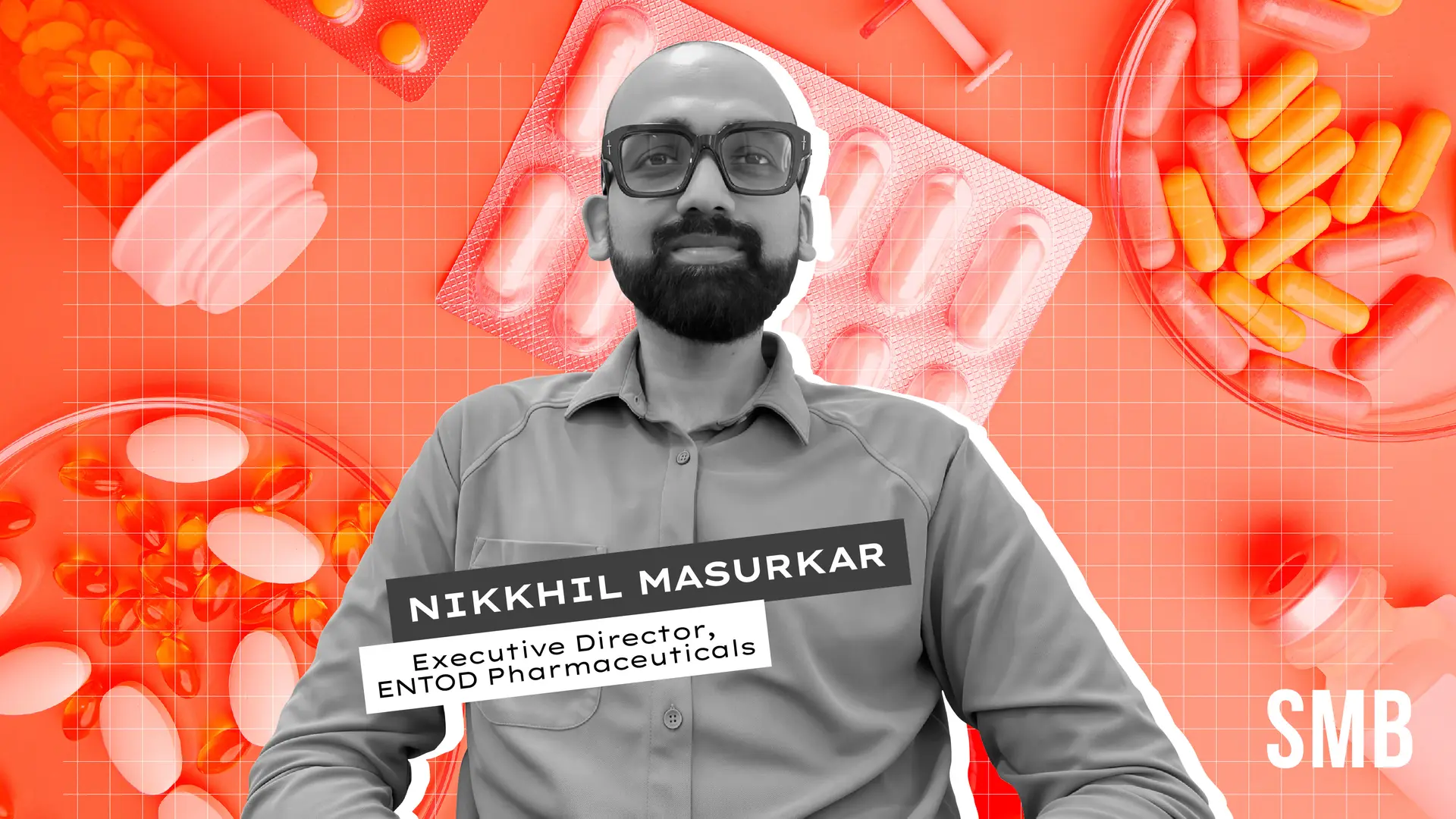
This widening gap is what drives Nikkhil Masurkar, Executive Director of ENTOD Pharmaceuticals.
“For several eye conditions, the world is still waiting for active treatments. We want to fill those gaps globally, not just in India,” Nikkhil tells SMBStory.
Founded in the late 1970s by GV Masurkar, Nikkhil’s grandfather, ENTOD Pharmaceuticals began as one of India’s earliest contract manufacturers for ophthalmic products. Nearly five decades later, it has grown into a multi-generational, 1,000-member organisation with a 250-plus product portfolio spanning ophthalmology, ENT, and dermatology, backed by strengthened R&D capabilities.
Nikkhil joined ENTOD in 2011 after completing his education in the UK. Under his leadership, Mumbai-based ENTOD is developing world-first formulations for corneal wound healing, severe keratopathies, and insulin-based ocular therapies, while also using generative AI to accelerate drug discovery.
A legacy rooted in science and resilience
Nikkhil represents the third generation of the Masurkar pharmaceutical journey. But he is quick to point out that ENTOD’s values were shaped long before balance sheets and R&D roadmaps.
“My grandfather didn’t come from money, connections, or an industry ecosystem,” he says. “He built everything from first principles—science, humility, and curiosity. Those values are what we still try to protect today.”
His grandfather, GV Masurkar, was among India’s first registered pharmacists. In the 1960s and ’70s, he played a critical role in shaping India’s pharmaceutical market. As marketing manager at Duphar Interfran (formerly Crookes Interfran), he introduced Crocin to India, earning the nickname “India’s Crocin Man”. He also brought vitamin D formulations and lacto-calamine lotion into the country—products that later became household staples.
“He had this instinct for identifying a molecule’s long-term potential before it became obvious to others,” says Nikkhil. “That scientific foresight is something we still rely on.”
The family’s entrepreneurial roots, however, date back even further. In the 1930s, in rural Karwar, Nikkhil’s great-grandmother, Rukhma Vitthal Masurkar—a single mother—created her own herbal skin medicines using forest-sourced medicinal plants. Her ointments became well known across villages.
“She didn’t have capital or a lab—just knowledge and a desire to solve problems,” Nikkhil says. “Innovation was survival. That spirit stayed with the family.”
It was this combination of scientific discipline and entrepreneurial grit that pushed G. V. Masurkar to take early retirement in the late 1970s and establish ENTOD, focusing on ophthalmology, ENT, and dermatology—a niche segment at a time when Indian pharma was dominated by antibiotics and analgesics.
Building an innovation engine
When Nikkhil joined decades later, ENTOD had credibility but was far from the innovation-driven enterprise he envisioned.
“We didn’t just want to manufacture medicines. We wanted to create new categories,” he says.
ENTOD has since directed its research toward neglected or underserved ophthalmic conditions.
“We’re working on frontiers like corneal wound healing where active therapeutic solutions barely exist,” he says. The company is also experimenting with insulin-based ocular therapies and advanced formulations for severe keratopathies. The term keratopathy refers to any disease of the cornea, which is the transparent dome shaped structure in the front of the eye.
To move faster, ENTOD built generative AI models trained on ophthalmic and dermatological data, allowing rapid molecule screening and formulation optimisation.
“AI helps us test more hypotheses in months than we could in years. But the final scientific judgment still belongs to our team,” he says. “AI is a tool, not the scientist.”

How Laxmi Dental revolutionised digital dentistry in India
Expanding beyond ophthalmology
Alongside its core strengths in eyecare, ENTOD sees significant opportunity in dermatology, respiratory and paediatric therapies.
“These areas demand the same scientific depth and long-term clinical thinking as ophthalmology,” Nikkhil explains. “We only enter segments where we can create real scientific value.”
The company has already initiated clinical studies, supported new molecular development, and begun work on advanced formulations targeting unmet needs in dermatology and paediatrics.
“This diversification strengthens our presence in high-value specialty categories and reinforces India’s position in advanced pharmaceutical innovation,” he adds.
Looking ahead
ENTOD today has around Rs 500 crore in revenue has grown at an average of 30% year-on-year since 2018, Nikkhil says. The company now wants to scale more aggressively.
“Our ambition is to reach Rs 1,000 crore in net revenue in the shortest possible time—certainly within the next four years,” he says. “We’ve built a strong organic growth engine, but the next phase will include inorganic expansion as well.”
Until now, ENTOD has remained entirely self-funded and debt-free. But that may change as the company evaluates acquisitions and deeper global bets.
“We’ve never needed external capital so far, but to scale faster and pursue inorganic growth, we’re open to bringing the right partners on board. We’re a debt-free company today, and now we’re looking for strategic investors who can be part of our next chapter,” Nikkhil adds.
ENTOD is present in more than 20 countries today, but Nikkhil sees this only as “Phase One.” The focus now is on developing global-first products, expanding clinical pipelines, and forging research collaborations across Europe and Southeast Asia.
“We want India to be seen as a source of innovation, not just manufacturing,” he says. “If we can solve for the most difficult ophthalmic conditions, we can change how the world looks at Indian science.”
Edited by Affirunisa Kankudti