



Meenu Subbiah Diamonds strives to preserve the heritage and intricacies of Chettinad jewellery
Founded in 1993, jewellery designer and entrepreneur Meenu Subbiah’s brand Meenu Subbiah Diamonds blends technology with craftsmanship to keep the legacy of Chettinad ornamentation alive.



In 1993, when jewellery designer Meenu Subbiah returned to her hometown of Karaikudi in Tamil Nadu after completing a graduate diamonds programme at GIA–USA, she was struck by how the essence of Chettinad jewellery had faded away.
Chettinad is a region in Tamil Nadu named after its inhabitants, the Chettiars, a sea-faring community of merchants and bankers. Karaikudi is a major town in the Chettinad region.
Jewellery has always been an integral part of the Chettiar community. Chettinad jewellery is known for its intricate handcrafted designs inspired by temple architecture and has motifs featuring peacock, swan, and paisley. It is not just ornamental but also reflects the region's rich heritage.
“But the jewellery I saw being sold as Chettinad wasn’t authentic; it had lost the detail, the balance, and the essence that made it unique,” recalls Subbiah.
That moment set the course for her lifelong mission to restore the integrity and craftsmanship of Chettinad jewellery.
That same year, she and her father, S M Subbiah, founded a company that would eventually evolve into Chennai-based Meenu Subbiah Diamonds.
What began as a small workshop rooted in regional traditions has grown into a fine jewellery house known for its in-house craftsmanship, ethical sourcing, and commitment to cultural continuity.
Today, the brand operates four showrooms across Tamil Nadu: in Chennai, Coimbatore, Karaikudi, and Tiruchirappalli, and has two corporate offices in the United States to serve clients abroad. In international markets, the brand sells its products through events and exports.
Foundations of craftsmanship
At a time when most jewellery brands sourced readymade pieces and focused primarily on retail, Subbiah chose to retain complete control over design and production.
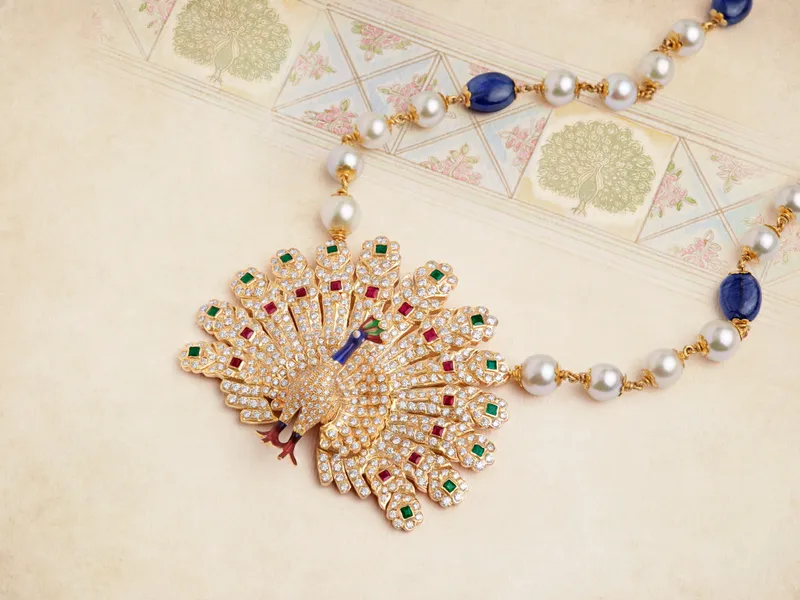
Mayil Maguri: A necklace features a large peacock pendant adorned with numerous small gems, likely diamonds, and colored stones like rubies and emeralds.
“We built everything from the ground up, our own design, our own casting, and our own finishing,” she says.
Every piece is designed and manufactured in-house, following traditional methods refined over generations.
Artisans use the close setting method, a hallmark of diamond jewellery, where stones are securely enclosed to enhance brilliance and longevity.
After the stone is placed, the jewellery is hand-polished to achieve a lasting sheen. Gold is hand-beaten into thin strips and carved with precision tools to create deep relief patterns featuring motifs such as peacocks, swans, mangoes, and vines—each piece individually crafted without the intervention of machines.
The production unit in Chennai, led by long-time collaborator and her husband, Ganeshan Suppiah, employs 35 skilled artisans and designers. Many of the goldsmiths (aasari) come from the historic regions of Chola Nadu and Pandya Nadu.
Through long-standing, respectful partnerships, Subbiah works closely with the goldsmiths to ensure this heritage craft not only survives but also thrives for future generations.
“Our aasaris are fifth-generation artisans carrying forward a legacy that’s fast disappearing. Working with them is about more than jewellery, it’s about preserving a piece of our cultural history,” says Subbiah.
The new recruits undergo training for six months to a year to master the brand’s exacting standards.
“This business is built on trust. From raw material sourcing to finishing, every stage must carry the same integrity,” says Suppiah.
The language of design
Historically, Chettinad jewellery was a synthesis of influences. The Chettiar community’s trade links across Southeast Asia introduced them to Burmese rubies, Sri Lankan sapphires, and European filigree work into local traditions.
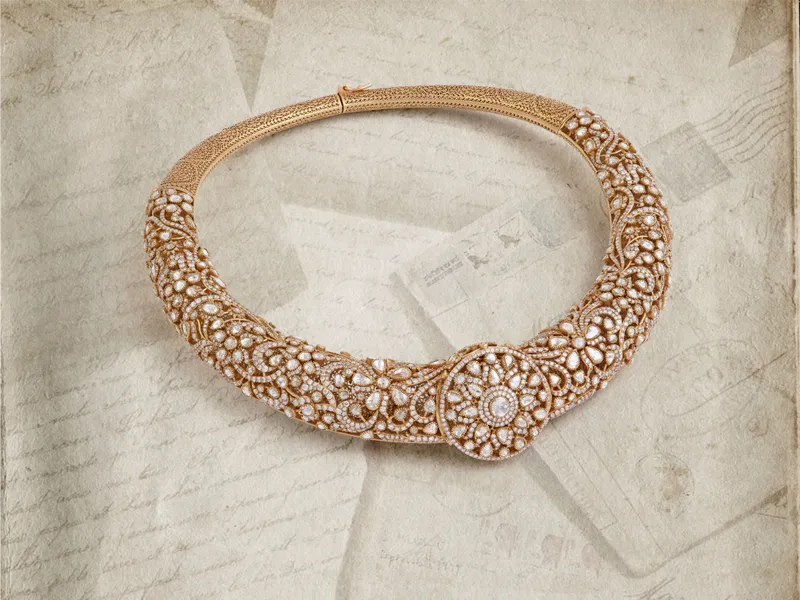
Ranakpur Chakra Choker
“Our ancestors brought back not just wealth but ideas, and they translated those ideas into adornments that symbolised identity and pride,” says Subbiah.
Determined to preserve this cultural vocabulary, she spent years studying archived photographs and consulting community elders who recalled classic ornaments such as Kandacharam (intricately layered necklace), Kasumalai (coin necklace symbolising prosperity), and Mullaicharam (delicate jasmine-bud patterned chains).
“When I listened to their descriptions, it felt like they were sketching history in words. My work was to give those sketches form again,” she says.
By the early 2000s, the brand had built a reputation for handcrafted diamond jewellery, rings, earrings, bangles, and necklaces, using traditional close-setting techniques.
The brand’s collections reflect the grandeur of Chettinad architecture and temple art, combining gold and diamond in symmetrical floral and geometric compositions. Certain pieces, like the Kazhutheeru (thali/mangalsutra necklace) and Gowri Sangam (men’s ornament), hold ritualistic and cultural significance, reflecting the deep social and spiritual roots of Chettinad craftsmanship.
Balancing handwork and technology
Handcrafting remains central to the brand’s identity, though modern tools have become vital in ensuring precision and scale. Designs often begin as hand sketches before being developed through computer-aided design and manufacturing.
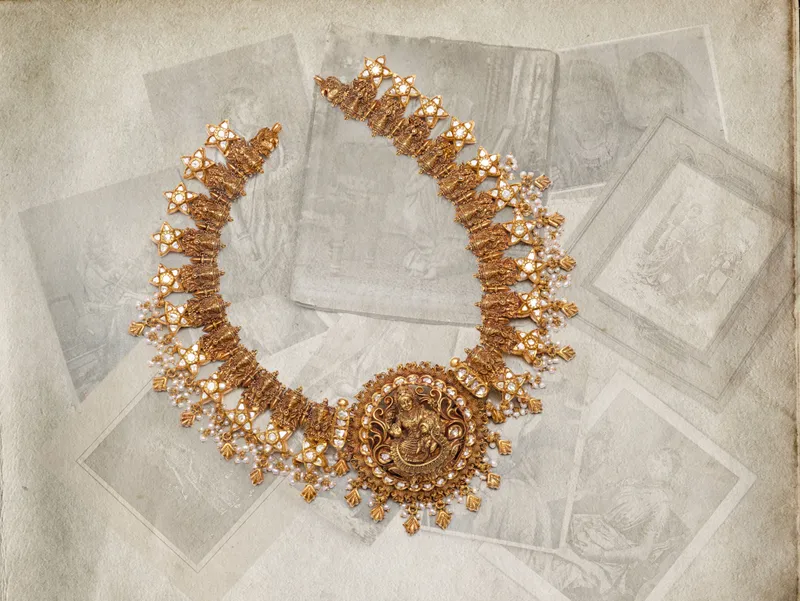
Meenu Subbiah - Vamsam - Divya Alankaram
For techniques such as close setting, the human touch remains indispensable. Close setting, used in less than 10% of fine jewellery worldwide, continues to define the brand’s aesthetic. “It’s slow and labour-intensive, but it’s what gives our jewellery its soul,” Suppiah explains.
Each piece undergoes rigorous quality checks, including destructive testing for purity and individual gemstone grading.
Each design goes through a journey of four to eight weeks from concept to completion. “Uniform brilliance doesn’t happen by chance. Every earring is tested for balance, every bangle for fit, every necklace for natural drape. Jewellery must not only look beautiful but also feel effortless when worn,” says Suppiah.
Building a distinct identity
Through the 2000s and 2010s, Meenu Subbiah Diamonds grew steadily, expanding its retail footprint and entering B2B manufacturing for both domestic and international clients.
Over the last five years, the company has recorded consistent growth of 14–16% year-on-year, catering to a few thousand customers annually across India, Singapore, Malaysia, Dubai, the United States, and the United Kingdom.
Meenu Subbiah’s design archive today spans lakhs of individual creations, curated by four in-house designers. “Every collection begins with a conversation about context, where the motif comes from, what it meant, and how it can live again in a modern form,” Subbiah explains.
After years of research into traditional design vocabularies, the company launched three distinct sub-brands this year: Vilasam, Vamsam, and Menaya, each representing a different interpretation of Indian craftsmanship.
Vilasam celebrates traditional Chettinad craftsmanship, highlighting temple-inspired motifs and close-set diamond work.
Vamsam reinterprets regional Indian artistry with gemstone-rich heirloom pieces drawing from South Indian temple, Mughal, and Rajasthani styles.
Menaya embodies a modern sensibility, with minimalist silhouettes, and innovative stone arrangements designed for a global audience.

From puja rooms to lifestyle fragrances: How IRIS is transforming Indian homes
“Each label speaks to a different generation of our customers, but they all share one promise— craft that endures. We are not trend-driven; we are story-driven,” says Subbiah.
The company’s supply chain, developed over 15–20 years, adheres to 99–100% ethical sourcing standards.
Ethical sourcing refers to obtaining materials that are mined, processed, and traded responsibly, ensuring fair labour practices, environmental sustainability, and conflict-free origins throughout the supply chain.
“Ethical sourcing is no longer a choice but a shared responsibility. The industry has matured to a point where trust and traceability are as valuable as the gems themselves,” says Subbiah.
Preserving cultural memory

Pettagam
Beyond the atelier, Meenu Subbiah’s most personal endeavour is Pettagam, a private museum in Karaikudi dedicated to preserving Chettinad’s jewellery heritage. The two-storey space functions as both an archive and an educational experience.
The first floor is dedicated to tracing the evolution of Chettinad ornamentation through archival sketches and photographs, while the second floor exhibits original pieces from Kasumalai to hybrid designs blending Mughal jaali and Rajasthani kundan techniques.
“Every Chettiar household once had a pettagam, a wooden chest where jewellery was stored. This museum is our collective chest, preserving not just ornaments, but the meanings behind them,” Subbiah notes.
Growth and the road ahead
Subbiah says her jewellery brand continues to maintain steady growth and expand its customer base across regions. She attributes the brand’s success to long-standing relationships. “When someone brings in their grandmother’s ornament and asks us to restore it, that’s success for us. That trust is our true currency,” she says.
The brand plans to open more showrooms in select metro cities, complementing its established network in Tamil Nadu, while maintaining its appointment-only model abroad.
Looking ahead, Subbiah envisions the three labels of the brand reaching global collectors and designers who appreciate Indian artistry’s depth.
“We are not chasing scale. We are building a legacy. Every piece we make is a bridge between past and present. Jewellery, for us, is not fashion. It is memory, designed to endure beyond time,” she concludes.
Edited by Swetha Kannan