



This Mumbai-based company is building a global-grade beauty brand without external capital
PAC Cosmetics began as a professional makeup tools company in 2006, and has since evolved into a profitable, self-funded beauty brand. With a commitment to quality, accessibility, and Indian consumer needs, it is now building its footprint for global markets.

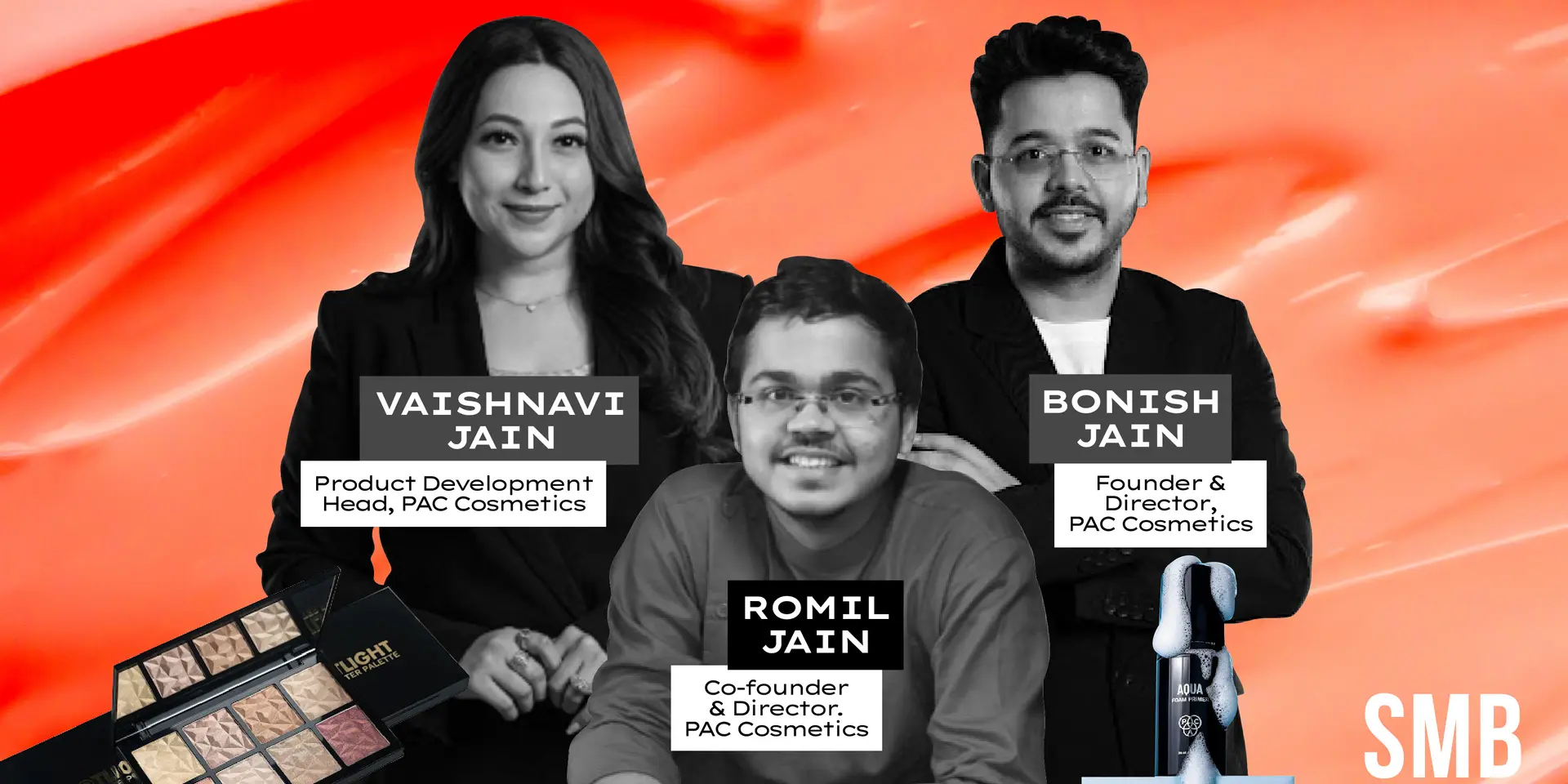

When Bonish Jain joined PAC Cosmetics in 2014, the company was already well regarded within professional makeup circles, but largely invisible to the wider consumer market.
Founded by his father Ramesh Jain in 2006, the Mumbai-based company had earned reputation as a trusted brand of professional, high-quality makeup tools used largely by makeup artists.
Bonish’s entry into the company marked a strategic shift. Choosing entrepreneurship over a conventional academic path, he recognised an opportunity to extend PAC’s professional credibility to a much larger audience.
His objective was clear: to build a beauty brand that combined globally benchmarked product quality with accessibility for Indian consumers, without compromising on professional standards.
What followed was a step-by-step transformation, from a professional supplier to a profitable, omnichannel beauty brand.
From tools to cosmetics
Bonish stepped into the business in 2014 at a time when he was rethinking a conventional academic path. “I realised early on that a traditional education route wasn’t aligned with my interests,” he says.
PAC’s early years under Bonish’s leadership focused on careful expansion rather than rapid scale. While its core strength remained makeup tools, the company began experimenting with colour cosmetics designed for both professionals and regular makeup users.
The brand’s first cosmetic product was a kajal pencil, which served as an entry point into the mass-premium segment. Over time, that experiment grew into a portfolio of more than 1,000 products, with a focused, active catalogue of approximately 350 SKUs today.
A defining moment in PAC’s growth journey came in 2014–15 when the brand launched on Amazon. Until then, sales volumes were small and largely professional-led. Online demand revealed a larger opportunity.
This early exposure to digital demand validated the brand’s potential beyond professional circles and shaped its long-term omnichannel strategy.
“Amazon was where we realised that this could really work,” Bonish recalls.
By 2018–19, makeup accounted for roughly 30 to 40% of the product library, though professionals continued to be the core audience.
Covid and the shift to D2C
The next inflection point for the company came in 2020. As Covid reshaped consumer behaviour and digital adoption accelerated, PAC found itself well-positioned. With accessible price points, consistent quality, and an expanding online presence, the brand saw double-digit growth through the pandemic.
More importantly, the pandemic triggered a strategic rethink. PAC began transitioning from a professional-only brand to one that catered to everyday consumers without diluting its professional standards. “Professionals are still central to how we curate our products,” Jain says, “but access is now for everyone.”
That shift changed the product mix as well. Large-format professional palettes gave way to individual-use products such as liquid blushes, eyeliners, kajal, and foundations, which started seeing higher traction driven largely by word of mouth.
Balancing online and offline distribution
Today, PAC operates a balanced omnichannel strategy, with online and offline sales contributing almost evenly, fluctuating between 50:50 and 60:40 depending on seasonality, says Bonish.
“Festive months tend to skew digital, while retail performs stronger in non-peak periods. Offline, the brand is present across roughly 140 locations through distributor-led retail. These are not company-owned stores, though PAC plans to explore that route in 2026–27,” he says.
The company is headquartered in Mumbai and employs over 200 people across functions.
Global supply chain, designed for Indian consumers
One of PAC’s defining choices has been its approach to manufacturing. While the brand is Indian, its products are contract-manufactured across nearly 60 labs globally, including facilities in China, the US, Canada, the Czech Republic, and South Korea.
Products are selected from these labs and then adapted for Indian consumers across ingredients, shades, packaging, and pricing.
“We try to get the best product fit for the Indian market,” Bonish explains, adding that value creation for the consumer takes precedence over margin expansion.
PAC’s products are priced between Rs 600 and Rs 1,200, placing the brand in the middle of the mass-premium spectrum.
A family-led, bootstrapped operation
PAC continues to operate as a family-led and self-funded business. Bonish’s brother, a chartered accountant, joined the company in 2019 and now oversees finance and operations, helping formalise systems, supply chains, and ERP processes.
Bonish’s wife, a trained makeup artist, works closely with the product development team.
Despite operating in a sector dominated by venture-funded peers, PAC remains entirely bootstrapped. The company expects to close FY25 with a GMV of Rs 140–150 crore and an EBITDA margin of 20–25%, with around 25% growth projected in the next fiscal year.
Looking beyond India
With a strong domestic foundation in place, PAC is preparing to enter international markets, starting with online launches in Dubai, Nepal, and Sri Lanka. Documentation and regulatory approvals are currently underway.
Longer term, Bonish’s ambition is to reverse a familiar narrative in Indian beauty.
“We’ve seen Western brands come into India for years,” he says. “Now we want to build a brand that goes global from India.”