



How Volks Energie carved its space in India’s energy EPC market
Founded in 2011 by Piyush Goyal and Arjun Rathi, Volks Energie provides energy storage solutions, HVAC, and solar energy systems across India.

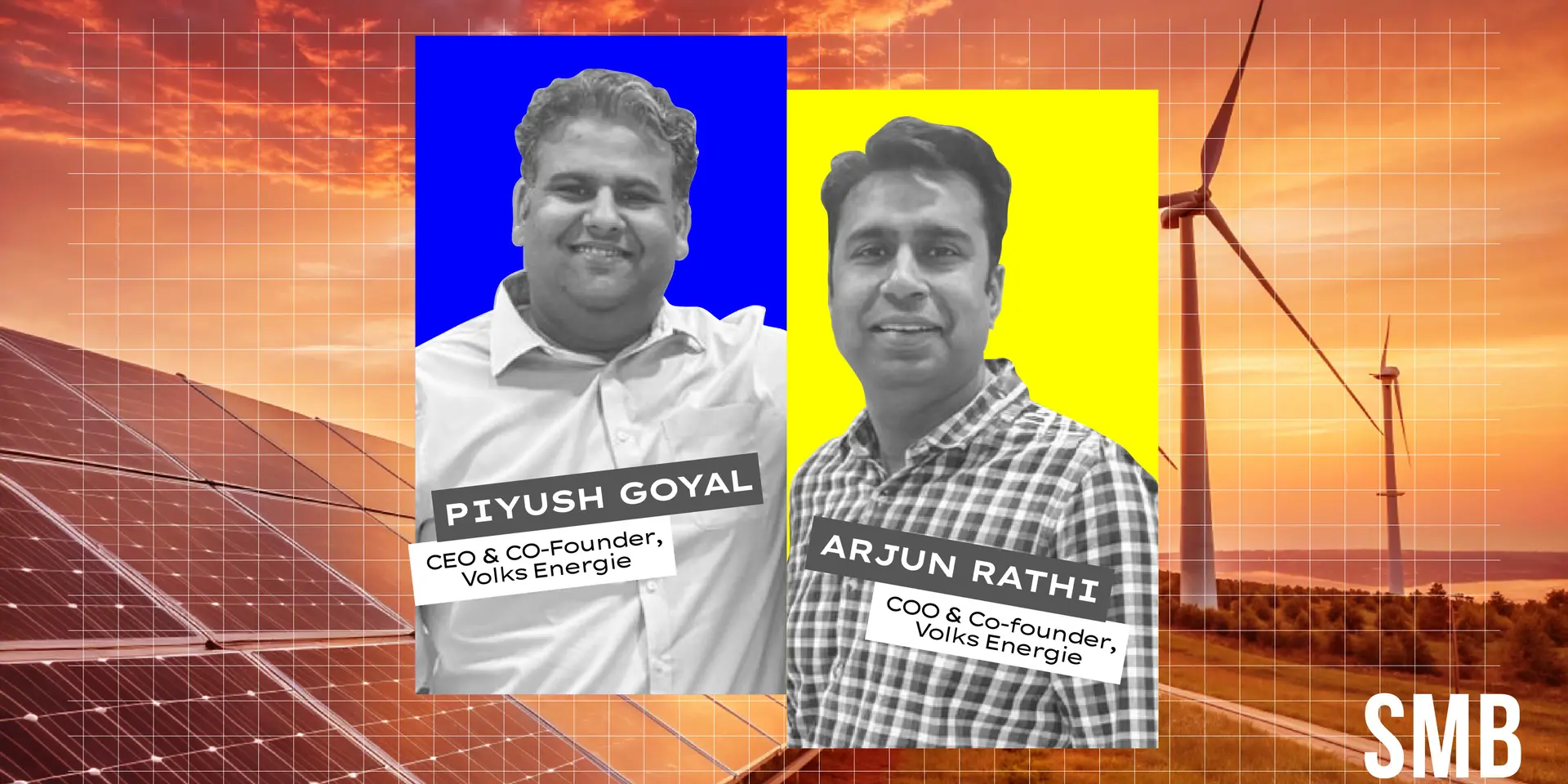

Delhi-based Volks Energie was founded in 2011 by two college friends with a shared vision for clean energy. Today, that vision is driving projects across India—from Baramulla in the north to Kanyakumari in the south, and from Jaisalmer in the west to Imphal in the east.
Founded by chemical engineering graduates Piyush Goyal and Arjun Rathi, the company has now grown into one of India’s most formidable engineering-driven energy companies built without any external funding.
After graduation, Piyush joined Emergent Ventures as a carbon credits consultant, where he witnessed India’s solar sector taking shape. “I realised solar was my calling,” he says. In 2012, he left his job to start the venture that he and Arjun had planned in college. Arjun joined a year later, brining experience from Petron LNG.
What started as a small company 14 years ago is now a key player in the Solar and HVAC Engineering, Procurement, and Construction (EPC) ecosystem, and offers solutions across Battery Energy Storage Systems (BESS) and UPS.
Early pivots
The early days were challenging. Rooftop solar was new, customers were sceptical, and adoption was slow. The founders adapted by selling solar water heaters, a market far more mature than rooftop solar at the time.
By 2013, they added high-efficiency AC systems, recognising early on that air conditioning is the largest energy load in any building. These solutions helped customers cut overall power consumption. This approach also opened the door to government tenders.
But breaking in as first-generation entrepreneurs was far from easy. Calls went unanswered and emails disappeared into the void.
Then came an almost old-school idea: handwritten letters. For nearly three months, Piyush and Arjun wrote and posted 50–60 physical letters a day to various government departments and state guest houses.
One of those letters landed at Gujarat Bhavan in Delhi at exactly the right time. Their AC vendor had backed out before a high-profile visit, and they needed help immediately. Volks Energie stepped in and took on the small Rs 5 lakh project, which was their first government breakthrough.
That validation opened opportunities for the company. Slowly, credibility was built, and they won projects from the Railways, Bank of Baroda, defence MES projects, and state guest houses.
In 2014, the firm won a Rs 2 crore solar water heating project from DG MAP in Uttarakhand. Executing it well gave them legitimacy in the defence ecosystem.
By 2017, Volks Energie was empanelled with the Delhi government for rooftop solar installations, enabling subsidies for consumers. At the same time, its hybrid solar and AC efficiency solutions began scaling with GAIL, IGL, BPCL, NTPC, Power Grid, and airports across the country.
Today, the company works across solar, cooling, and power infrastructure. Its solar EPC business covers the design and execution of rooftop, ground-mounted and off-grid projects for residential and commercial customers. It also provides HVAC services, including system design, installation and retrofitting for industrial and commercial facilities.
In addition, the company offers Battery Energy Storage Systems (BESS) for load management, solar integration and backup power, along with UPS solutions to support critical equipment across offices, factories, healthcare facilities and data centres.
Its Heating, Ventilation, and Air Conditioning (HVAC) systems operate in over 30 airports—from small regional airstrips to major terminals.
“Our strength lies in executing where others hesitate—harsh climates, insurgent areas, remote geography, or rural infrastructure,” claims Arjun.
The COVID Years: No growth, all grit
When the COVID-19 pandemic halted operations, growth paused, but several critical projects, especially in remote Bihar, continued.
“It was one of our toughest execution periods, but our team never said no,” explains Piyush.
Another incident came from BSF border posts in Tripura, where battery banks had to be transported on boats across rivers to reach the border outposts. The team managed the entire journey without disruption.
“These stories define our company’s core DNA: execute anywhere, anytime, under any condition,” adds Piyush.
Solar + Nickel Cadmium battery systems
Realising the rooftop solar market had become overcrowded with small EPC players, Volks Energie made a shift towards complex, high-value engineering work. It focused on large-scale solar plants, nickel-cadmium–backed solar hybrid systems, precision air-conditioning (PAC) for data centres, and projects in difficult terrains.
PAC expertise, in particular, emerged as a strong differentiator. Unlike traditional HVAC, PAC systems require precise humidity control, constant temperature, 99% uptime, and highly secure engineering conditions. This capability has positioned Volks Energie in critical-infrastructure ecosystem, supporting IRCTC’s Delhi data centre, Power Grid Telecom, NTPC’s IT facilities and other critical installations.
Another turning point came when the company won tenders involving nickel-cadmium battery-backed solar hybrid systems, a highly specialised infrastructure used along vast gas pipelines. Volks Energie managed to convince Power Grid—India’s benchmark power transmission utility—to adopt nickel-cadmium, and is now educating other DISCOMs and state utilities.
“These systems are designed to survive nuclear holocausts or long natural calamities,” Piyush explains. “Even if everything shuts down for seven to ten days, these batteries ensure gas supply continues across the country.”
This expertise has made Volks Energie one of the few Indian companies capable of handling such mission-critical projects.
Expanding beyond B2G
From FY25 onward, the company has been deliberately widening its footprint into specialised B2B segments. It has been building a strong presence across industries such as fertilisers, cement, pharma, chemicals, auto and auto ancillaries, data centres, and clean rooms, which are used in Pharma to ensure contaminant-free production.
“We have already executed projects in fertiliser plants and auto ancillary units, and have begun catering to premium residential developments—particularly in Delhi NCR—where large-scale AC and solar installations are increasingly required for luxury homes,” says Piyush.
To support this diversification, Volks Energie is also setting up dedicated business development teams for each vertical.
Despite COVID-related disruptions, Volks Energie reported around Rs 20 crore in revenue during FY20–23. The company grew to Rs 28 crore in FY24 and further to Rs 46 crore in FY25. For FY26, it is projecting revenue in the range of Rs 70–75 crore.
The company currently employs around 50 people, and expects its team size to double over the next 12–18 months.
“We have been entirely bootstrapped to date, supported primarily through debt lines. As demand scales, we are now exploring a mix of equity and additional debt to accelerate growth,” adds Piyush.
Volks Energie competes with OEMs such as Blue Star, Voltas, and battery-maker HBL. However, Arjun believes the firm’s advantage lies in its execution speed and project-specific engineering depth.
Large manufacturers, he notes, are often constrained by internal processes and competing priorities, while Volks Energie’s focused approach allows it to move faster and tailor engineering solutions more precisely.
Edited by Megha Reddy