


This Bengaluru startup’s silk-based sponge is healing soldiers’ wounds
An innovative collaboration between Bengaluru-based startup Fibroheal Woundcare Pvt Ltd and the Indian Institute of Science (IISc) has produced a game-changing medical device — Fibroplug— a haemostatic sponge that controls severe bleeding within seconds.

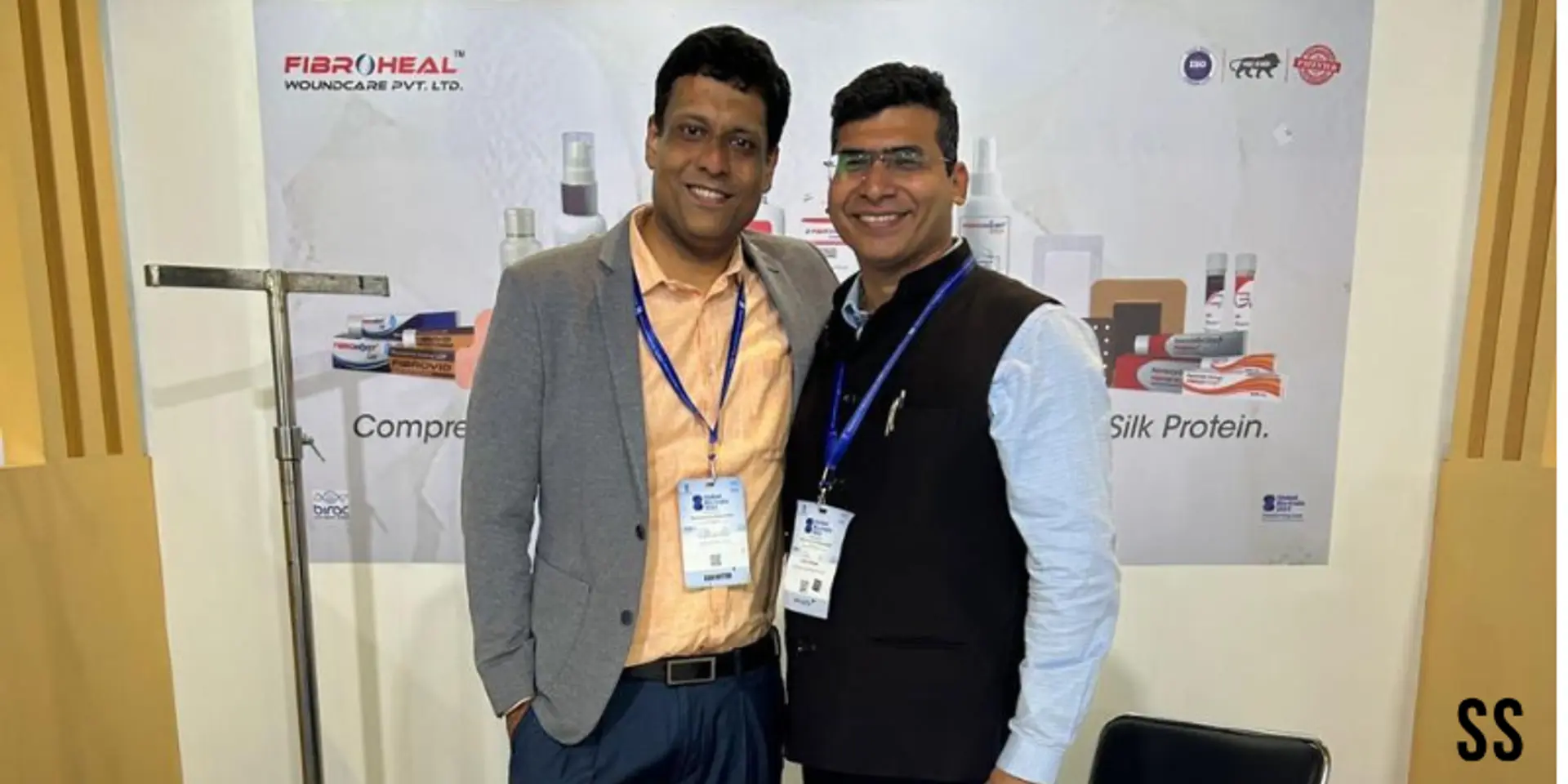

In a significant leap for India's defence healthcare, Bengaluru-based Fibroheal Woundcare Pvt Ltd, in partnership with the Indian Institute of Science (IISc), has developed a patented haemostatic sponge that is now being deployed by the Indian armed forces to control life-threatening bleeding in battlefield scenarios.
A haemostatic sponge is a medical device used to stop bleeding during surgery or after an injury. The sponge absorbs blood and provides a physical barrier that supports clot formation.
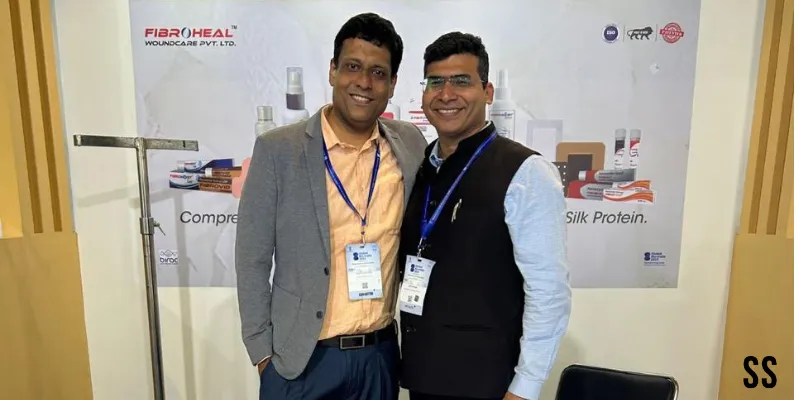
Vivek Mishra (Founder & CEO Fibroheal) and Dr Kaushik Chaterjee (IISc).
Named Fibroplug, this bioengineered product can stop bleeding in under 30 seconds in lab conditions and in less than two minutes in real-world applications—a critical advancement in preventing deaths due to hypovolemic shock, or excessive blood loss.
The product has quickly become an asset to defence operations, especially during recent border tensions, and is currently not available commercially, as production is being directed entirely toward meeting defence needs.
The science behind Fibroplug
Fibroplug is made from a unique bio-composite of silk-derived protein fibroin, chitosan (a biopolymer derived from shellfish), and silica particles. The easy-to-use dressing that prevents rebleeding and supports natural clot formation. The silk layer ensures easy removal without disturbing the wound site—a critical limitation in conventional haemostats.
According to Co-founder Vivek Mishra, “Fibroplug is 25% more effective and costs just one-fourth of the price of existing haemostatic dressings in the market.” The price of Fibroplug ranges from Rs 200 to Rs 800, while the price of other alternatives start from Rs 5000.
A startup with a scientific soul
Founded in 2017 by Vivek Mishra and Bharat Tandon, Fibroheal Woundcare was started with the aim to explore the non-textile application opportunities.
“Fibroheal literally means ‘healing through fibroin,’ and we were fascinated by silk’s properties and its potential in wound care,” said Mishra.
The turning point came in 2018 during a doctors’ conference at Command Hospital in Bengaluru. Mishra recalls, “That’s when I first heard doctors say that many battlefield deaths happen not due to gunshots themselves but because of the inability to stop bleeding.”
Shortly afterward, during a Startup India- CRPF (Central Reserve Police Force) Grand Challenge event, the startup gained critical insights from defence personnel about real-life trauma conditions on the field. This reinforced the team’s resolve to address the urgent need for an effective haemostatic solution.
That same year, Fibroheal began its collaboration with Prof. Kaushik Chatterjee at IISc. Over the next four years, rigorous research and clinical testing followed. By 2020, the first prototype of Fibroplug was ready.
Resilience through the pandemic
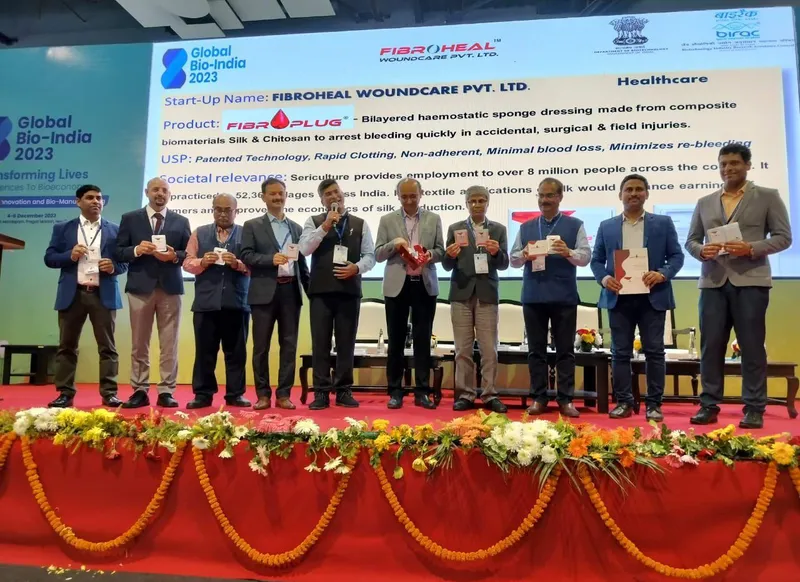
During launch/unveiling Fibroplug at Global Bio India on 8th Dec 2023 at Bharat Mandapam.
While the COVID-19 pandemic posed immense challenges for most startups, Fibroheal remained operational. Since wound care was categorised as essential medical service, the team was allowed to continue lab work and product development during the lockdown.
“We used this time to push our boundaries and advance Fibroplug,” Mishra said.
By 2022, a dedicated production section for Fibroplug was established in their Doddaballapur facility in Bengaluru. “Since Karnataka is the largest producer of silk in India, this location strategically helps,” said Mishra.
The company currently manufactures about 5,000 units a month and plans to scale up as demand increases from defence establishments. It’s priced between Rs 200 to Rs 800.
Road ahead
Fibroheal’s team of 75 aims to grow to 100 in the coming months.
“Production of medical devices is capital intensive,” Mishra noted, “and we’ve been fortunate to receive support from BIRAC (Biotechnology Industry Research Assistance Council), the Government of Karnataka, and private equity investors.”
The startup is determined to support the Government of India’s Aatmanirbhar Bharat initiative by reducing dependence on imported medical technologies.
“We want to cut down on medical imports and make medical technology in India through our science, innovation and people.” Mishra added.
Though Fibroplug is currently dedicated to defence use, its applications extend far beyond. From ambulances and accident sites to school playgrounds and hospital emergency rooms, the technology’s versatility could eventually transform emergency care across India.
(The copy was updated to correct a typo.)
Edited by Affirunisa Kankudti