



From blueprints to blooms: How a Kerala engineer is cultivating saffron indoors
Founded in 2024, LNS AgriTech is Kerala’s first indoor saffron farm. It was started by Seshadri Shivakumar, a 35-year-old civil engineer, who left his decade-long job to grow saffron in Wayanad.

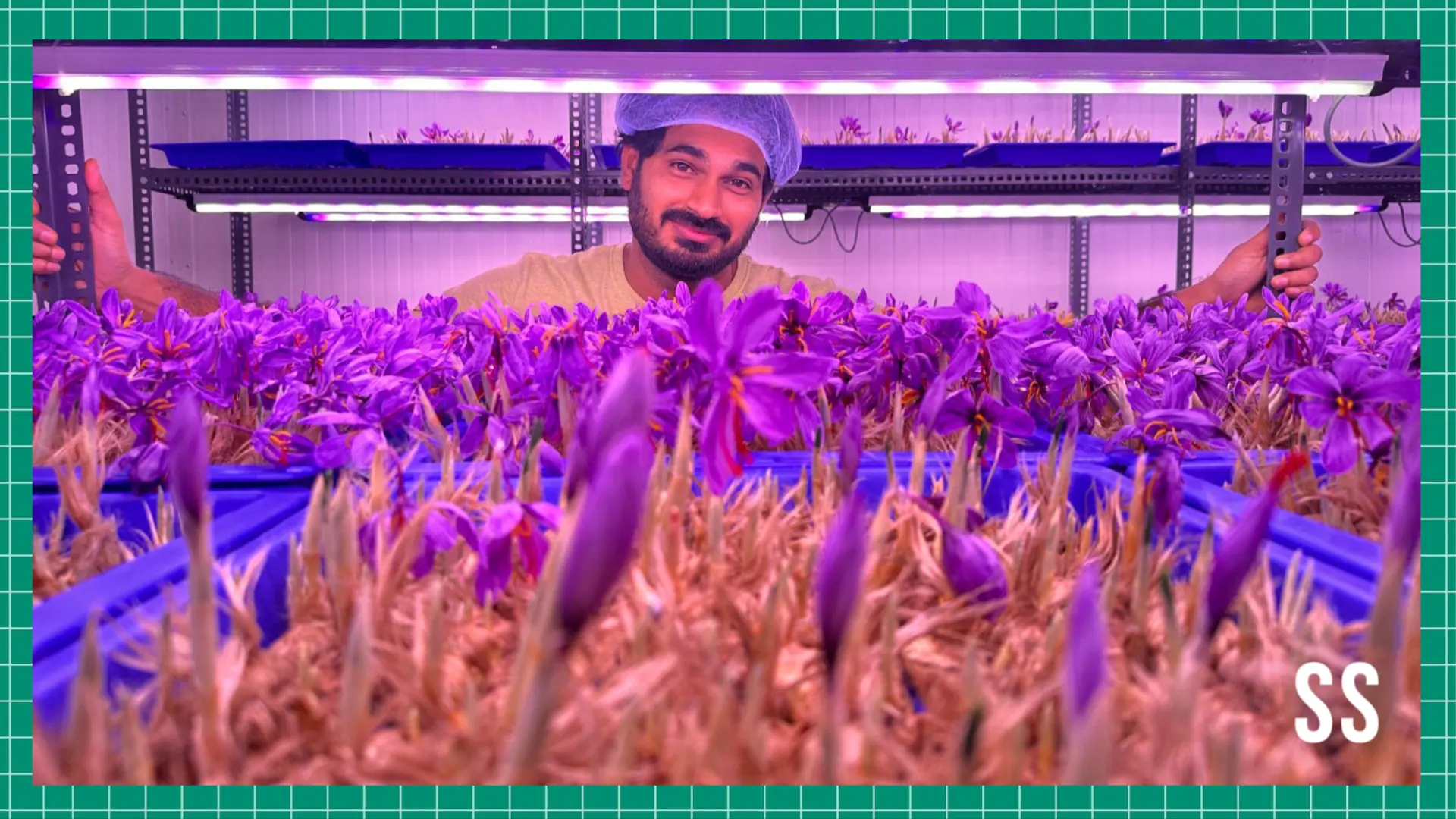

In a world where people increasingly seek stability and routine, Seshadri Shivakumar took a different route—one that led him from construction sites and structural plans to flower beds and cold storage rooms.
A civil engineer by profession, Shivakumar spent ten years working in the field before he decided to take a break and began exploring sustainable business ideas, particularly in agriculture.
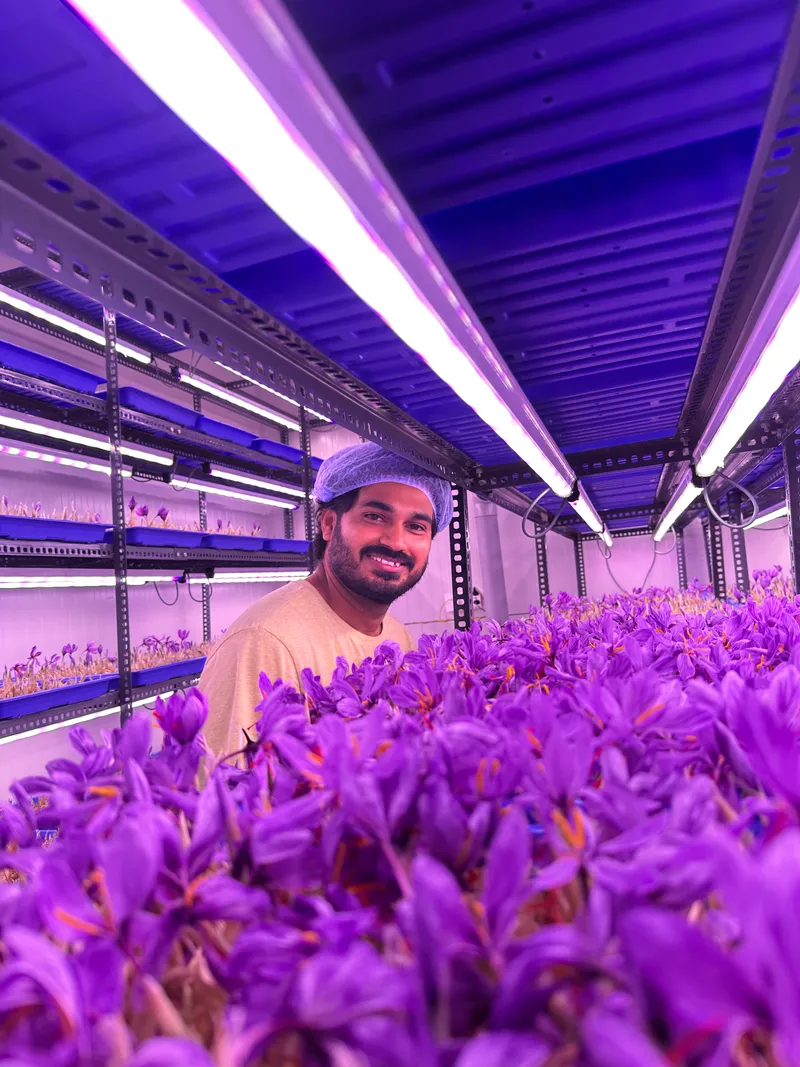
Seshadri Shivakumar in his indoor saffron farm
He was looking for a venture that would combine innovation, sustainability, and usefulness to society. One of the ideas that caught his attention was saffron cultivation—a crop that, until then, he had only seen associated with the frigid lands of Kashmir.
The idea and the first step
Saffron is one of the most expensive spices in the world, and its cultivation has always been geographically restricted to certain cold regions, primarily Kashmir. However, Shivakumar was drawn to the challenge of growing it in Kerala in an entirely different climate.
He spent hours researching on Google and YouTube, learning about controlled environment agriculture. “I visited similar indoor cultivation setups to learn more,” said Shivakumar.
Settled in Wayanad, he started experimenting on the terrace of his sister’s house. That humble terrace would soon host LNS AgriTech—Kerala’s first-ever indoor saffron farm.
Building a climate-controlled farm
The journey from idea to execution wasn’t easy. Saffron cultivation demands the precise control of four key environmental factors—temperature, humidity, light, and carbon dioxide.
Shivakumar built a cold storage room typically used for food preservation and transformed it into a high-tech cultivation chamber. He then installed refrigeration units to mimic Kashmir’s fluctuating temperatures, which range from 1°C to 27°C depending on the saffron growth stage.
To maintain optimal humidity, he added a combination of humidifiers and dehumidifiers. He also installed grow lights emitting specific wavelengths between 400 and 700 nanometres to replace natural sunlight, and regulated carbon dioxide levels to ensure the best growth conditions.
This attention to detail helped recreate the natural environment saffron needs to bloom in the heart of tropical Kerala.
Finances, failures, and the first flower
Financially, the venture demanded more than Shivakumar had initially anticipated. His first foray into entrepreneurship saw costs exceed his projections by 20–30%.
Procuring saffron corms—bulbs from which the flowers grow from Kashmir—was another major hurdle. Not only are they expensive, but they’re also difficult to source on time and in good condition. “Procuring Kashmiri saffron is easy, but procuring saffron bulbs is very tricky.”
With minimal external support and his own doubts clouding the early days, Shivakumar kept the project mostly to himself. His first real sense of relief came when the first flower bloomed in mid-October 2024.
Shivakumar harvested and sold the first batch in November, primarily to wholesalers, but he soon realised that selling directly to consumers was a more sustainable and profitable route.
Going direct: Selling through social media
Currently, Shivakumar manages the business operations and finances by himself. His sister assists with the cultivation process, and a friend helps him handle social media, which has become a critical tool for his marketing strategy.
Most of his saffron is now sold at Rs 700 a gram via Instagram where he is building a brand and expanding his consumer base. “This direct-to-consumer model helps bypass middlemen, lowering transport costs and giving me more control over pricing.”
While entering the market was initially tough, social media has allowed him to tap into an audience that values locally grown, high-quality produce.
Understanding the crop cycle
Saffron cultivation is structured in two major phases—flowering and multiplication. The flowering period lasts from September to December. Post that, the corms multiply; one mother corm produces multiple daughter corms, which means that from the second year onwards, there's no need to repurchase corms.
In his first year, Shivakumar started with 500 kg of corms. Thanks to the multiplication process, he now expects a surplus that can either be used for further cultivation or sold.
The initial year, he admits, brings minimal income and high investment, but it becomes more profitable in the following years without requiring additional capital.
What the future holds
Shivakumar’s aspirations do not stop at saffron. He is already researching the cultivation of medicinal mushrooms as his next vertical. He’s also exploring a revolutionary idea: finding a way to harvest saffron flowers multiple times a year.
Traditionally, saffron flowers bloom only once annually, which limits production. “If I succeed in breaking that cycle and inducing multiple harvests through controlled environment tweaks, it could transform the economics of saffron farming in India.”
India presently produces only 7 metric tonnes of saffron annually, while the national demand is around 100–120 metric tons.
Advice for aspiring saffron growers
Shivakumar offers a word of caution to those considering entering the field. The industry may seem lucrative with stories of saffron selling at over Rs 5 lakh per kg, but the reality is much more complex.
He explains, “It takes around 175 flowers just to make one gram of saffron. And you need nearly 1.5–2 lakh flowers for a single kg.”
He urges aspiring farmers to learn about every aspect—from operations and ROI to environmental requirements—before diving in. To this end, he also conducts workshops online and offline to teach saffron cultivation, through his Instagram platform @lns_agritech.
Edited by Suman Singh