



Not a case study: These orgs are redefining mental health therapy with lived experiences
This World Mental Health Day, we look at how trauma, queer, and caste-informed approaches are challenging the foundations of Indian mental healthcare, shifting the focus from treatment to transformation, from pathology to power.

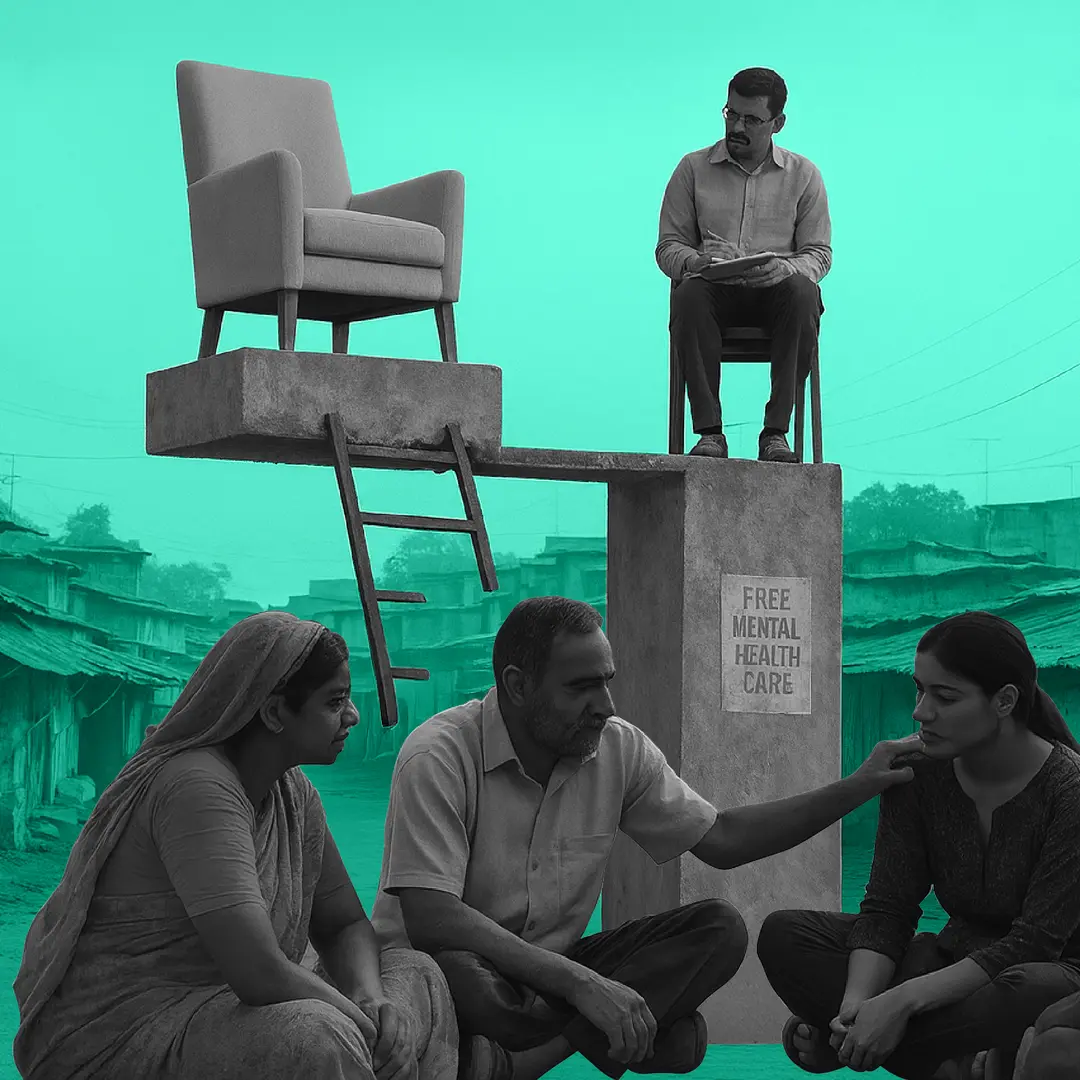

A few years ago, while covering a mental health camp in rural Tamil Nadu, I watched a woman suddenly rise in the middle of a group session and announce, almost defiantly, that she spoke to dead people.
She had been living with untreated schizophrenia, which was only recently diagnosed through an NGO-led intervention. For years, villagers mocked or feared her—some called her payithiyam (mad), others believed she was possessed—but never spoke to her as an equal.
The NGO, which does not wish to be named, had trained local ASHA workers to reach out to people like her struggling with chronic, untreated mental health, building contact slowly and respectfully. At first, the woman was violent and mistrustful. But the team persisted with weeks of steady, unprejudiced interactions that calmed her down. She softened, started to speak more clearly, recalled parts of her childhood, and began recognising those around her. Her body shifted from survival to safety.
“She is now an individual, not a case study,” her ASHA worker had said. For the first time in years, people began to call her by her name—Sundari.
Sundari started to share her story in fragments: her marriage, neighbours, the small rituals she still remembered. She laughed sometimes, talked and rested on her own terms. Most importantly, she would decide when to take medicines.
Her diagnosis hadn’t changed, but people changed the way they interacted with her, and that, her case workers believed, led to some unprecedented results.
Sundari's story is aligned with research that shows when it comes to healing chronic trauma, especially in low-resourced, marginalised contexts, care that combines social connection and cultural understanding is more effective than a purely biomedical model can ever be. Simply put, while Cognitive Behavioural Therapy (CBT)—one of the most widely used forms of psychotherapy—and medication can stabilise symptoms, real, restorative recovery depends on safety, belonging, and being seen within one’s social and cultural world.
These findings are consistent across multiple studies. A 2023 study on culturally responsive cognitive behavioural therapy for ethnically diverse populations found that when therapy is adapted to reflect people’s language, beliefs, and lived experiences, outcomes improve significantly. In India, the Community Care for People with Schizophrenia in India (COPSI) trial, published over a decade ago, had already established that people who received community-based psychosocial interventions alongside medical care reported better functioning and lower caregiver burden.
Deepa Pawar has been doing just that—grounding mental health in the words, stories, and rhythms of people’s lives. The founder of Anubhuti Trust, a Thane-based organisation working on gender and social justice, Pawar embeds mental health in the lived experiences and cultural languages of communities whose grief, silence, and exclusion are rarely recognised in psychology manuals.
Working with nomadic and denotified tribes (NT-DNT), Adivasi and Dalit communities, and youth, Pawar hosts interactive workshops where distress is discussed through folk games and metaphors. She repurposes the game of Housie, for instance, by replacing numbers with words like “fear”, “silence”, “hunger,” so participants can reveal their inner states without feeling pathologised.
At their Mann Mela, or ‘mental justice fair’, Anubhuti Trust facilitates young people from NT-DNT and Dalit communities to talk about loneliness, stigma, or violence in a setting that feels safe and collective, not clinical. The fair reframes mental health as a question of justice—not an individual failure.
In a similar approach, Dr Nilesh Mohite, a Dalit psychiatrist from Mumbai, has harnessed his own experiences of caste-based exclusion in medical school. Through Project Ashoka, he helps marginalised students in universities and medical colleges with caste trauma, access to therapy, and leadership grounded in social awareness. His team runs support circles, mental health workshops, and advocacy campaigns across campuses, where students discuss not just symptoms but the systemic conditions that create their distress. They also train peers to identify signs of burnout or discrimination and connect students to community-based support.
“Therapy and medication helped me survive,” says Mohite, “but what truly healed me was knowledge—understanding how caste, hierarchy, and history work.” That understanding now anchors our work.”
These practices are far from fringe. Somatic therapy, for instance, is one of the most popular alternative modalities finding root in India today. It works with the understanding that the body stores trauma long after the threat has passed, and this can result in perpetuated symptoms later in life.
“Adults who live in dissociation were children who couldn’t complete the fight-flight-freeze responses and have been stuck in these states for years,” says Rajini Divya Kumar, a Bengaluru-based somatic therapist and psychotherapist.
This understanding lies at the core of Mumbai-based Mariwala Health Initiative (MHI), which supports grassroots, rights-based mental health programmes across the country. As an organisation that supports decolonial, trauma, queer, and caste-informed mental health work, it works with the belief that care is inseparable from justice and dignity. It considers community-based organisations—especially those led by people who’ve faced marginalisation—are essential to bridging this gap.
“Basic counselling and medication are not enough, because mental health is an intersectoral issue,” says Raj Mariwala (they/them), Director of MHI.
“Organisations led by and for those who have faced caste violence, for instance, don’t just offer counselling; they provide legal recourse, mental health care for the whole family, and linkages to employment.”
Raj adds that the same oppressive structures that govern public policy and sociocultural norms—be it health, social, or economic—perpetuate inequalities in mental health. They believe that when professionals work alongside organisations informed by these realities, “they learn to build their competency from the knowledge of the margins—something mainstream mental health rarely engages with affirmatively.”
Organisations like The Banyan have been doing this for decades. Known for its pioneering work with homeless women with mental illness, The Banyan has built programmes that centre lived experience—bringing survivors into leadership and research roles, and designing care models that respond to the intersections of gender, poverty, and caste. Its NALAM project trains community health workers from marginalised groups to co-create mental health solutions, and its ongoing work on “decolonising care” has been documented in collaboration with TISS and the Centre for Mental Health Law and Policy.
Raj calls this approach to mental health a “redistribution of knowledge.”
“This is very critical,” they say, “because psy-disciplines, by defining what is ‘normal’ and ‘abnormal’, often reinforce structural oppression around ability and neurotypicality.”
Those who fall outside it—people with mental illness or neurodivergence—are systematically marginalised.
A recent NIMHANS study estimates that nearly two million people in India could be neurodivergent and undiagnosed.
Considering millions fall outside the frame of what’s considered “normal,” it is perhaps a good time to ask who gets to define that word in the first place, and who gets erased by it.
Edited by Kanishk Singh