


10 years after RPWD: Is India’s digital revolution truly inclusive?
2026 marks ten years of the Rights of Persons with Disabilities (RPWD) Act, legislation that promised equality, accessibility, dignity, and full participation for persons with disabilities (PWDs) across all areas of life.

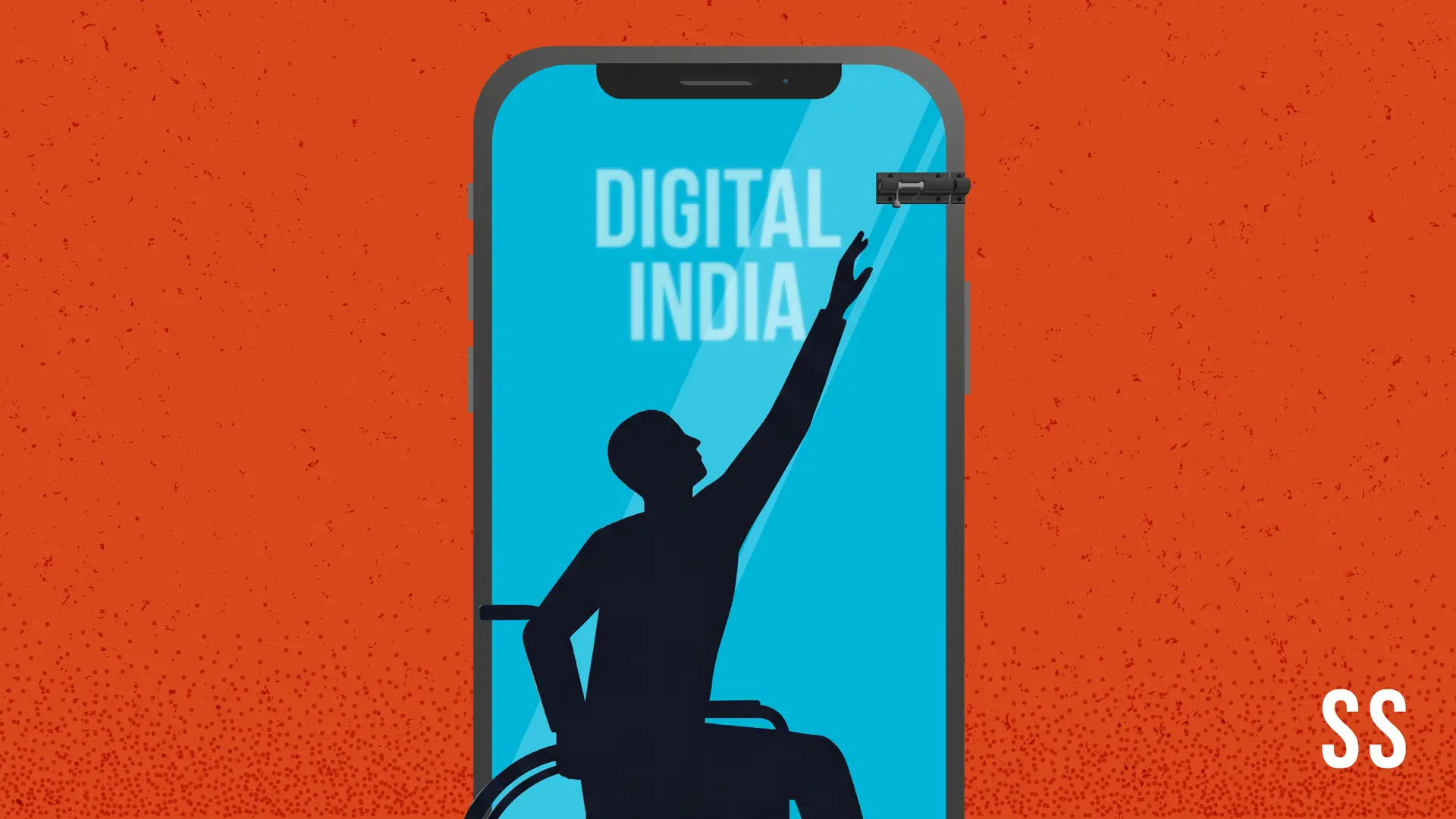

Can a digital revolution truly earn its title if millions of people are unable to participate?
When Karthik, a young professional with a visual impairment, tried to complete a mandatory bank KYC update, he encountered a barrier most of us would never think twice about. The banking app required him to align his face perfectly within an on-screen frame and click a live selfie for verification. The app repeatedly flashed instructions like “move left,” “adjust lighting,” and “face not detected.” But Karthik could not see the visual prompts guiding him.
What should have been a two-minute verification process turned into a frustrating experience that forced him to depend on someone else to access a basic financial service.
Karthik is only one of 3.5 crore Indians with disabilities for whom this is everyday life in ‘Digital India’.
As India’s digital economy hurtles toward the trillion-dollar mark, we are witnessing a paradox of progress. A critical question remains missing from the centre of the digitalisation conversation: How do we ensure this frontier is built for everyone?
As we mark Global Accessibility Awareness Day (GAAD) on May 21, the question becomes even more urgent for another reason. 2026 marks ten years of the Rights of Persons with Disabilities (RPWD) Act, legislation that promised equality, accessibility, dignity, and full participation for persons with disabilities (PWDs) across all areas of life.
The RPWD Act was a boon for PwDs, but its digital implementation has been uneven. According to the BB100 State of Digital Accessibility in India 2025 report, 64% of Indian websites fail basic accessibility standards, and a staggering 97% of home pages have detectable accessibility barriers.
Most have treated digital accessibility as a "good-to-have" feature, an afterthought, rather than a core requirement of democratic participation.
This oversight has real-world consequences for people like Ritika, a woman living with cerebral palsy, who struggles with apps that require rapid gestures, tiny buttons, or time-sensitive interactions.
To address accessibility, we must first understand that "disability" is not a monolith to be cracked. It is a spectrum of diverse human interactions that our current interfaces simply aren't coded to recognise.
Is AI a great equaliser or a great divider?
The exponential rise of Artificial Intelligence has added an urgent layer to this conversation. AI-driven real-time captioning and voice-to-text tools are already life-changing. For many, AI is the bridge that closes the gap between intention and action.
However, we face a critical risk: Algorithmic Ableism. We see this lack of Algorithmic Able-ism in the life of Naveen, a wheelchair user with a spinal cord injury. Naveen relies on eye-tracking assistive technology to navigate his digital world. Yet, he often finds that the very telemedicine and public service platforms designed to make life easier are incompatible with his software. Because the underlying code wasn't built with assistive-tech protocols in mind, Naveen is denied the digital "front door" to healthcare.
To prevent this, our AI models must be trained on representative data that includes diverse physical interactions and atypical speech. We don't just need "smart" bots; we need inclusive intelligence that recognises human value in all its forms.
This year’s GAAD theme, ‘Design, Develop, Deliver’, is a call to move accessibility from the end of the product cycle to the very beginning. When we treat inclusion as foundational architecture rather than a "patch," everyone wins.
As we look toward the next decade of the RPWD Act, our strategy is evolving. We are moving from a focus on "better code" to "better representation." The most impactful AI tools of tomorrow will be the ones built by PWDs.
We must build with intentionality so that more people like the Karthiks, Ritikas, and Naveens of this world, who are fully capable of studying, working, banking, and leading, are never again sidelined by an interface they cannot navigate. The trillion-dollar dream belongs to them, too.
(Sukanto Aich is CEO of The Association of People with Disability (APD)).