



Can no-code automation cut enterprise costs? Inside Expressonic’s bet on RPA
By letting domain experts automate without coding, Bengaluru startup Expressonic wants to make automation simple, affordable, and accessible.


Automation in large organisations is often slow and expensive, needing complex coding along with coordination between IT teams and software vendors.
Bengaluru-based Expressonic Global Solutions, with its platform Kraft-a-Bot, aims to solve this problem by letting domain experts automate processes themselves, without writing any code.
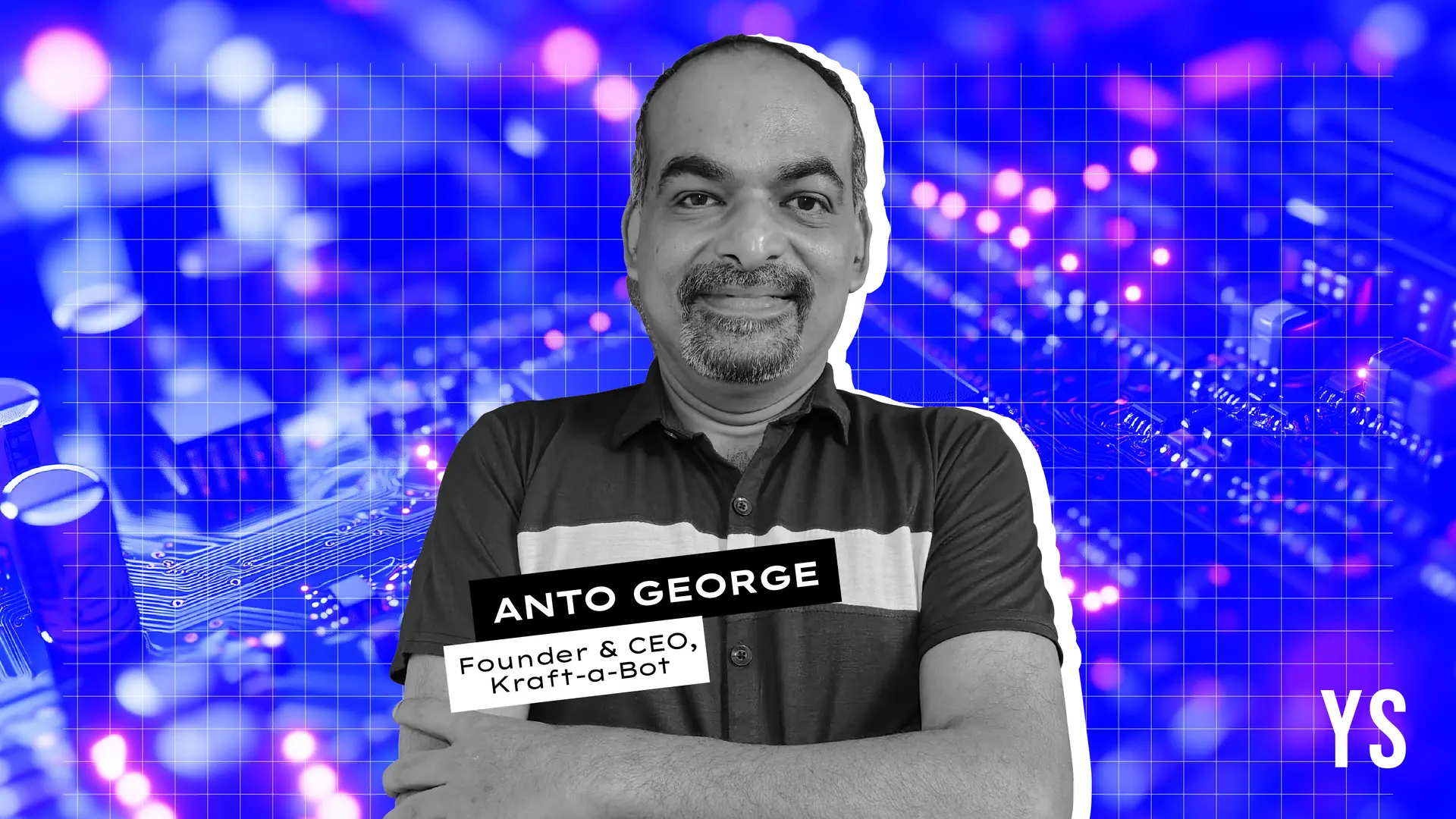
“We wanted a solution where a finance professional or an operations manager could design automation themselves after a few weeks of training, without depending on a big IT team,” says Anto George, Founder and CEO of Expressonic.
George co-founded Expressonic with Sam Thomas, Felix Francis, Sanjay Thomas, and Emi Anto. The bootstrapped startup began its journey in 2019 with an initial investment of just Rs 1 lakh. In FY25, it reported a revenue of Rs 12 lakh. “We’re seriously considering raising funds for product development and customer acquisition,” George says.
George has spent over 30 years in the IT industry, largely working in infrastructure and applications. His last corporate stint was with Computer Sciences Corporation (CSC), where he managed IT and the Global Service Desk for India.
During that time, he encountered robotic process automation (RPA) tools from companies like UiPath and Blue Prism that promised to be easy, but still needed many experts, including developers and process specialists, to work on every project.
“That gap in this sector was clear to me. Even so-called drag-and-drop tools needed heavy coding and big teams, which smaller firms couldn’t afford,” George says.
Building Kraft-a-Bot
The idea for Expressonic, born in 2019, was to build Kraft-a-Bot as a true no-code RPA Office Suite, much like Microsoft Office in its simplicity. The aim was to help people who know the processes best to record, configure, and automate them without writing any code.
The software has three parts: Design Studio for creating jobs, Real Bot for running them on schedule, and Enterprise Manager for monitoring and managing bots across locations.
After spending the first few years in R&D, the startup began commercialising its product in 2023. That same year, it onboarded its first client, Journey Pediatrics, a hospital in the US. The project involved moving medical records between systems where direct transfer wasn’t possible.
“The bot worked like a human employee, logging in, reading medical history, and re-entering it into the new system,” George tells YourStory.
Since then, Expressonic has added two more US clients in healthcare and digital forensics. George says the startup has already received a US patent for its framework, while the Indian application is still pending.
The startup has a core team of 10 employees, with five consultants in the US.
Pricing, revenue, and business model
Expressonic operates on a recurring annual license model, priced at $4,500 for the Professional Edition and $6,500 for the Enterprise Edition, with additional costs for training/professional services. For large organisations that deploy hundreds or even thousands of bots, the total contract value can be much higher.
Along with its Bengaluru headquarters, the startup also operates from a partner office in Kochi run by Co-founder Sam Thomas of Urban Telecom.

Competition and challenges
In the global RPA market, Expressonic faces giants like UiPath, Automation Anywhere, and Blue Prism. “Our solution is unique because it’s truly no-code; domain experts can automate tasks themselves without large RPA teams,” George says.
One of Expressonic’s biggest challenges has been the Indian market. George believes that small firms find the license cost of Rs 3-4 lakh unaffordable, while large corporates demand a proven large-scale track record -- something that’s hard for a young startup.
“That’s the reason we’re focusing on the US, where even smaller businesses see automation as a cost-saving tool,” George says. “Meanwhile, we’re also working to build traction in India.”

Tech in the pipeline
While Kraft-a-Bot is not yet fully AI-driven, it already uses computer vision and object detection for certain automation tasks, such as identifying windows or images on a screen.
The startup is now planning to integrate AI into its platform, particularly for tasks such as data classification and processing, which are currently handled through third-party tools.
“RPA still has a big role. AI can’t replace repetitive tasks, but together they make processes smarter,” George says.
It is also planning to move to a SaaS model, so customers can simply subscribe to the service instead of installing it on-premises. While this shift will require significant investment. George says, “Launching SaaS will be our priority once we get funds, likely within the next two years.”
According to the Precedence Research report, the RPA market size is about $28.31 billion in 2025. It is expected to grow rapidly and reach around $211.06 billion by 2034.
“If we can achieve even 2–3% of the global RPA market in the next five to six years, that itself will be significant,” George says.
Edited by Affirunisa Kankudti