



Court cases to AI insights: Why a veteran lawyer and a technologist joined forces to simplify legal disputes
Chennai-based legaltech startup Adidem has developed an intelligence platform powered by AI/ML, which resolves disputes faster than traditional methodologies.

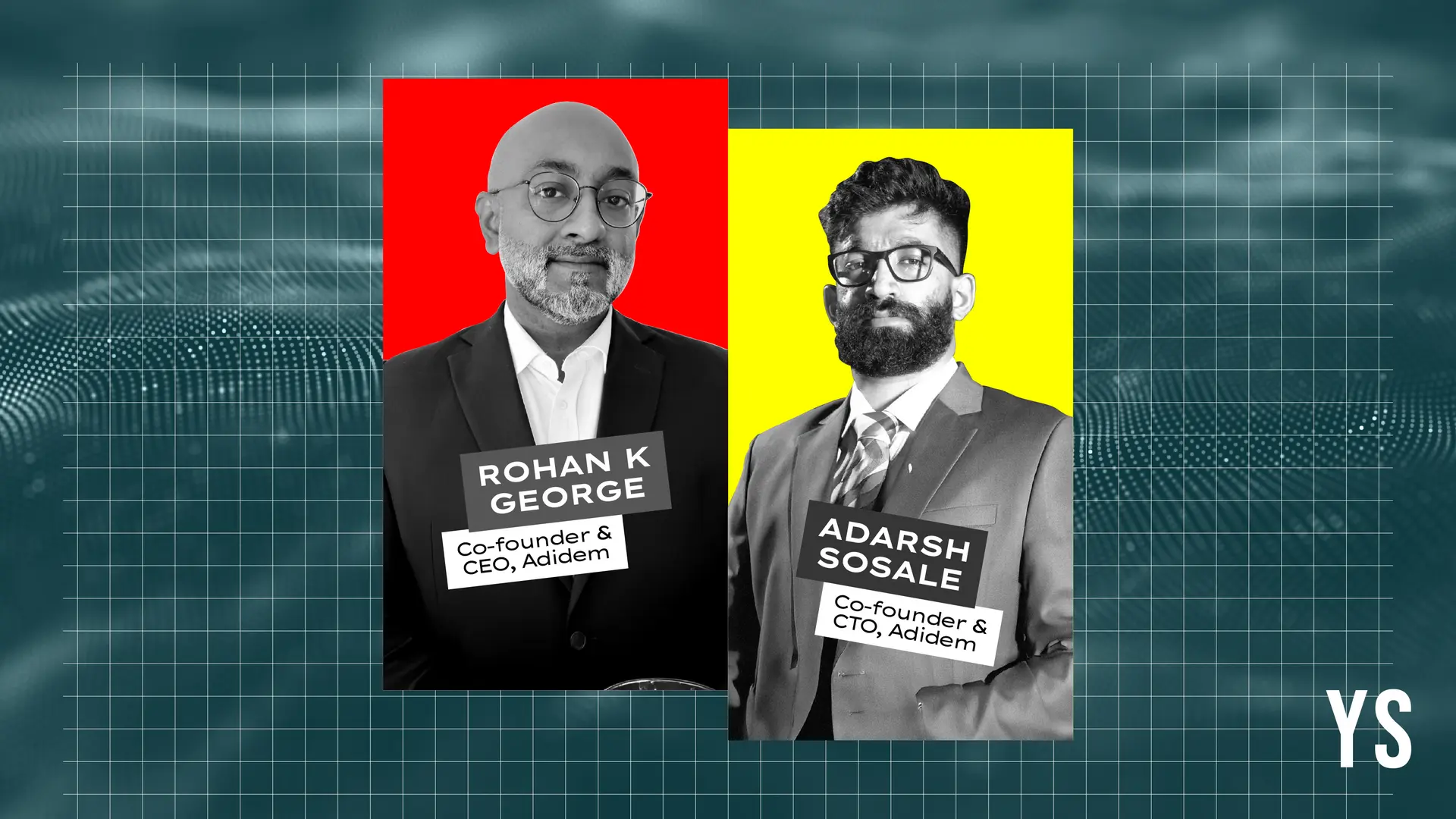

Veteran lawyer Rohan K George had grown used to the inefficiencies of the Indian legal system—manual reviews, multiple layers of documentation, and endless mail chains even in routine dispute cases.
But when OpenAI unveiled ChatGPT 4.0 in 2023, he saw the potential in leveraging AI to bring about real change in the sector.
George, who was a partner at a law firm at the time, suggested ChatGPT4.0 to his colleagues, who connected him to Adarsh Sosale, a technologist who had previously built an algorithmic contract generator for other partners at his firm.
When the two met, they quickly discovered a shared conviction: the power of creating a tool that could automate legal proceedings. As a result, the duo co-founded legal tech startup Adidem in 2024, Latin for ‘of the same mind’ or mutual agreement, to build an AI/ML-powered platform to resolve arbitration and litigation disputes faster.
Bootstrapped with Rs 50 lakh, the two-member startup operates remotely primarily between Chennai and Bengaluru.
A clear problem
The founders began with a ‘proof of concept’ for a word plug-in contract generator, but eventually decided to pivot into the legal dispute space as the latter had more robust data available to the public.
“The data on contracts is locked up behind organisation doors. However, we have data on all judgments passed by high courts and the Supreme Court all the way from 1960. That gave us the confidence to build something in disputes,” CTO Sosale tells YourStory.
The legal tech startup is specifically focusing on companies with large volume disputes. According to George, companies across multiple categories all have a dispute portfolio that can vary between 150 to a few thousand disputes.

The CEO explains with an example, “If you’re a home loan company issuing out loans, a certain percentage of them are going to become Non-Performing Assets (NPAs). And a certain number of those NPAs are going to be litigated. Either you or the borrower will file a suit.”
While such cases are common across sectors, companies don’t often see these as a big problem, as the amounts are relatively small. However, this is the bulk of the workload for the average disputes team.
“It is all done manually, going through 300 pages of case files, reading 200 emails across 30 contacts…it’s a huge amount of work, and the only way to scale is by hiring more people. That’s where we come in with an AI-led solution,” he says.
AI-powered in-house counsel
Presently, the startup only offers in-house legal counselling.
Its flagship product, Adidem Dispute Intelligence (ADI), first collects information from the official online court system about new and existing case filings involving the client, assuming the role of a company’s in-house counsel.
“Usually, the in-house legal counsel then has a conversation with the company lawyer. In our case, that communication is automated. The case files are then put into Adidem, which starts creating a theory of the dispute, summarising the dispute and analysing key issues, conflict points and inconsistencies,” George explains.
Once the theory is ready, the platform shares it with the client’s internal and external counsel teams and establishes a line of communication between the two parties.
ADI’s impact is tangible—and visible.
“Four hours of email validation takes about one and a half hours now. Reading the entire case file takes a similar amount of time as opposed to eight hours before. And drafting takes about an hour as compared to five,” shares George.
However, the legal draft was created by George and Sosale themselves.
“If you use traditional AI tools to create a legal draft, it’s going to have disaggregated context pulled from different places with no precision. We have built a patent-pending system of drafting, which allows us to identify specific locations and specific documents and tie those together with a common united thread,” George says.
ADI is also able to reduce human effort by going through companies’ large dispute portfolios, identifying plausible risk triggers—key events that signal the onset of legal action.
The tech stack
Sosale says Adidem uses a combination of large language models (LLMs) like Gemini, Claude, and a refined version of Llama.
“Apart from these, we don’t just stick to 21st-century innovation. We use NLP algorithms, which were developed in the ’90s. We have used TF-IDF and BM25 (a text search algorithm that Perplexity and Google partly use today), Random Forests (an ML model that generalises well), and have fine-tuned BERT models from 2018,” he explains.
He adds that these decisions are to keep the startup’s output traceable and reliable, and its compute cost efficient. “Long story short, we have a pretty complex pipeline with many smaller models that are doing specific tasks well, and LLMs are used in the final step to put the information together.”
The legal industry at large
Adidem’s first client was Cadre ODR—a dispute resolution company that specialises in arbitration, in what George refers to as a ‘partnership’.
Presently, the startup is piloting ADI with two companies, charging Rs 75,000 to Rs 1.5 lakh, depending on the volume of work, and has received exemplary feedback.

The legal sector, however, has been slow to adopt technology, says Sosale. “Very well-paid lawyers were finding it difficult to navigate certain tools that people in tech and tech-adjacent fields take for granted,” he adds.
While the gap frustrated him, it also showed potential for legal tech companies like Adidem. “I realised that if we can make our product stick, it’s going to create a generational impact on the industry—a transformation that no other tool can provide in India,” he shares.
Funding and future
Adidem is looking to raise a seed round of $500,000 to $1.5 million by the end of 2025. “We want to invest significantly in product growth and development. One feature we are very excited about is to connect all the analyses with the body of Indian case law, which would make it easy to discover cases,” says George.
Competing with international companies like the London-based Crimson and the New York-based Syllo, he believes Adidem’s robust technology separates itself from the rest.
“Most other companies are creating products to resolve private practitioner problems. Their tech is focused on one dispute. We are very clear that our tech should encourage collaboration. While we want to continue specialising in disputes, we don’t want to get trapped in an echo chamber,” he signs off.