


10 Lessons from Meditations for Mortals by Oliver Burkeman
Discover 10 powerful lessons from Oliver Burkeman’s Meditations for Mortals, offering practical reflections on life and what truly matters.

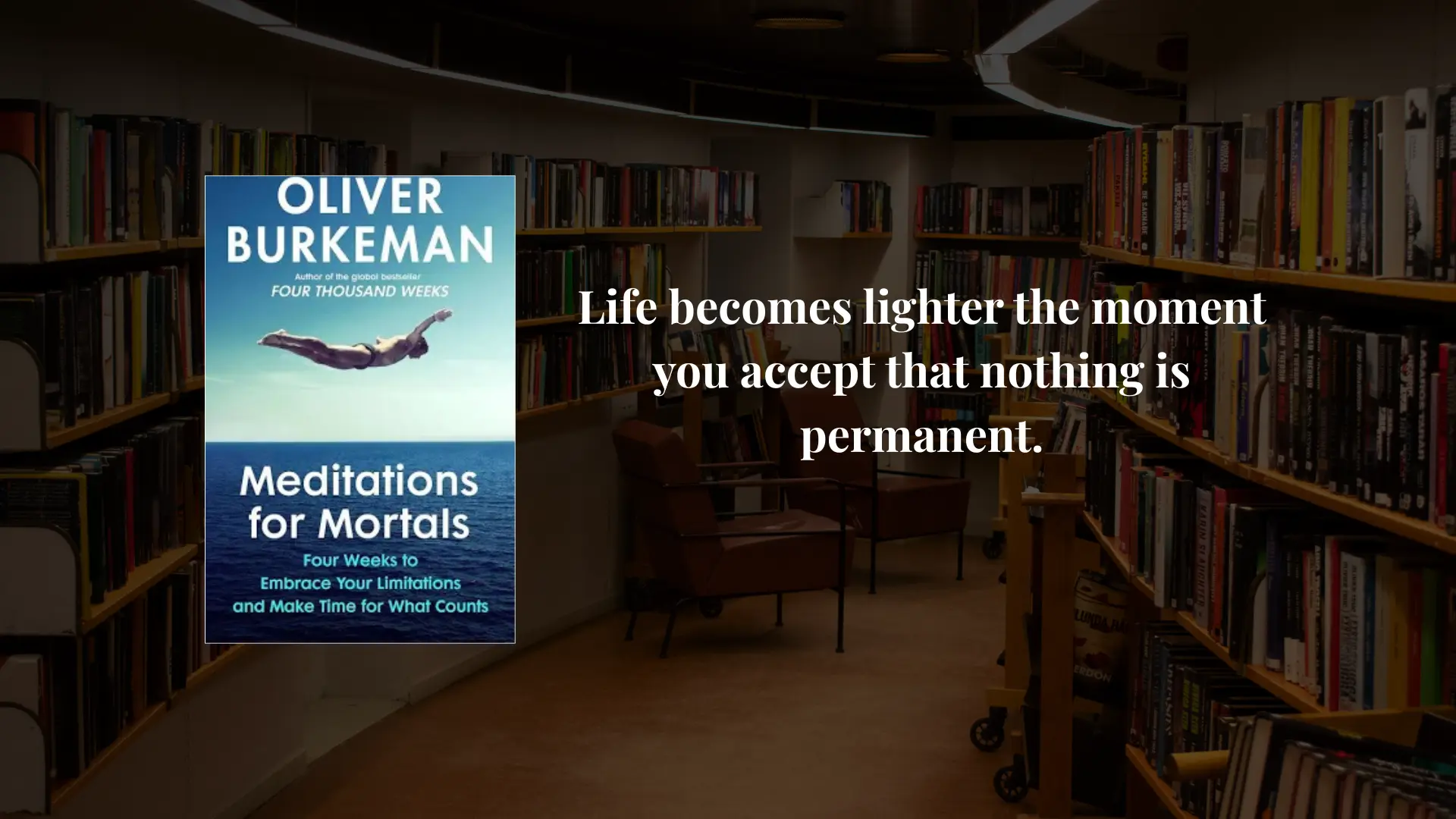

Most of us move through life as if we will live forever: rushing, postponing, worrying, planning endlessly, and chasing goals that feel endlessly distant. We delay joy until tomorrow, delay rest until burnout, delay dreams until “the right time,” and delay living until life forces us to face its end.
Oliver Burkeman’s Meditations for Mortals shakes us awake from this illusion.
After the global success of Four Thousand Weeks, Burkeman returns with a raw, honest, and deeply reflective exploration of mortality, meaning, and time. Instead of treating death as fear, he invites us to see it as clarity, the lens that helps us decide what truly matters and what deserves to be gently let go.
This book isn’t dark or heavy. It is liberating. It reminds us that life becomes meaningful not because it is long and perfect, but because it is short and imperfect. When we accept our mortality, we stop pretending we have infinite time. We stop being controlled by fear, perfectionism, and unrealistic expectations. We live with intention, presence, and gratitude.
10 Lessons from Meditations for Mortals
1. Life is short, so don’t waste it
Burkeman explains that the root of anxiety is the belief that we have endless time to do everything. When we accept that our time is limited, everything becomes sharper and more meaningful.
Key insights:
- You cannot do everything in one lifetime, so choose intentionally.
- The value of life increases when we acknowledge its finiteness.
- Time becomes precious when you treat it as non-renewable.
2. Stop waiting for the perfect moment
Most people pause life until some imaginary ideal condition arrives. But perfection is an illusion, waiting only leads to regret and stagnation.
Key insights:
- Life happens in the middle of chaos, not after it.
- Action creates clarity, not the other way around.
- Progress begins with imperfect steps.
3. Doing less can lead to living more
Our culture glorifies productivity and busyness as proof of worth. Burkeman suggests embracing slowness and focus instead of multitasking and overload.
Key insights:
- The more tasks you juggle, the less depth you give each one.
- Meaningful work requires space, quiet, and attention.
- Simplifying your life strengthens purpose.
4. Let go of the illusion of control
We chase control to feel safe, but life remains unpredictable no matter how hard we try. Accepting this truth brings peace instead of panic.
Key insights:
- You cannot control outcomes, only intentions and effort.
- Uncertainty is not the enemy—it is the natural state of life.
- Resilience grows when you surrender the need to control everything.
5. Relationships matter more than achievements
At the end of life, what people cherish most are not trophies or status—they cherish love, time spent together, and meaningful connection.
Key insights:
- Success means little without people to share it with.
- Relationships require presence, patience, and vulnerability.
- Time invested in people multiplies in emotional value.
6. Make peace with imperfection
Perfectionism leads to procrastination and fear. When people wait to be flawless, they waste years hiding instead of living.
Key insights:
- Imperfection is proof of growth, not failure.
- Mistakes are stepping stones to wisdom.
- Done is better than perfect because done exists—perfect doesn’t.
7. Presence is the only real wealth
Life happens in the now—not the memory of yesterday or the dreams of tomorrow. If you don’t learn presence today, you won’t magically learn later.
Key insights:
- Being distracted is a form of self-loss.
- The moment you are living now is the only moment guaranteed.
- Awareness deepens experience.
8. Accepting mortality helps you live more fearlessly
The fear of death often keeps us from fully living. When we face mortality honestly, we stop shrinking ourselves and start expanding our courage.
Key insights:
- Acknowledging the end helps us prioritise what matters.
- Death gives life structure and urgency.
- Fear loses power when it is confronted.
9. Let go of the need to do it all
We are taught to chase every opportunity, but saying yes to everything weakens our ability to commit deeply.
Key insights:
- Every “yes” comes with a hidden “no” to something else.
- Depth beats variety.
- Freedom is choosing what to release.
10. Meaning is created, not found
Life doesn’t hand us purpose—we build it through our actions, relationships, and presence.
Key insights:
- Meaning grows from consistency, not intensity.
- Small daily choices shape who we become.
- Life’s purpose is formed through contribution, creativity, and care.
Final thoughts
Meditations for Mortals is an invitation to stop sleepwalking through life.
The awareness of death is not a threat—it is a teacher.
The more we accept the limits of time, the more fully we inhabit the time we have.
So instead of waiting, worrying, rushing, comparing or postponing joy, choose presence, connection, and courage.
You don’t need more time in your life. You need more life in the time you already have.