


Commitment to code: Fortheye wants to redefine product development for brands
Gurugram-based Fortheye goes beyond traditional app development, staying with clients long after delivery. It has helped brands including Tanishq, Chai Tost, and Asian Paints build products that scale and sustain.


When startups and enterprises build a new digital product, the real challenge often begins after launch. Bugs surface, user behaviour differs from expectations, and the team that built the product is no longer around to fix it.
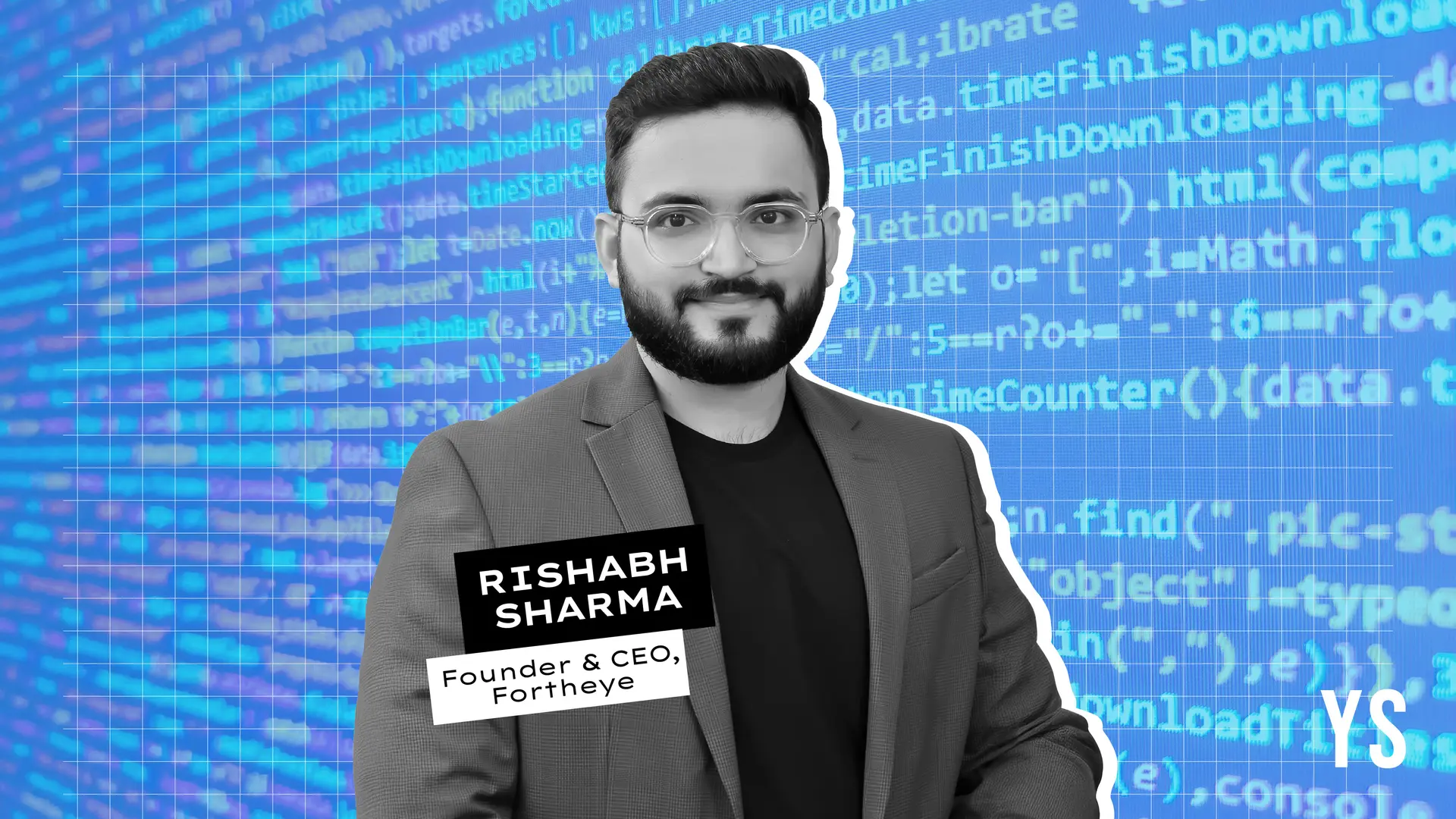
This gap between product creation and product sustainability is what led Rishabh Sharma to start Fortheye Solution Private Limited. This Delhi-based digital product development company aims to become a long-term product partner rather than a one-time service provider.
“Unlike most tech agencies that leave after delivery, we stay,” says Sharma, Founder and CEO of Fortheye, in a conversation with YourStory. “We offer three months of unconditional support after launch, when real challenges begin.”
Sharma’s entrepreneurial journey began far from tech. In 2017, while preparing for medical exams, he realised his real interest was in computers and switched to pursuing B.Tech in Computer Science. During college, he freelanced and completed over 10 projects across India and Saudi Arabia. In 2020, he started The Dev Brain, a WordPress website venture, which later inspired the idea for Fortheye after he saw that clients wanted long-term product partners, not just websites.
Sharma registered Fortheye Private Limited in April 2021, after beginning operations in late 2020 with an initial investment of Rs 20 lakh from himself and his father, who also serves as the director. From the outset, his vision was to build more than a conventional IT service firm—one that truly understands clients’ business goals, develops scalable products, and supports their growth.
The business
Fortheye builds end-to-end digital products, including web platforms, mobile applications, and micro SaaS systems, for startups, SMEs, and large enterprises. Its core business is B2B, and the company currently serves approximately 15 active clients; it has worked with more than 50 clients to date.
The startup operates on two fronts.
The first focuses on product validation and R&D prototypes, such as 3D virtual experiences. For instance, Fortheye developed a virtual showroom for Tanishq and another for the Royal Museum Event (GOA), both built in collaboration with its partner Metadome.ai, a Gurugram-based 3D configurator company.
The second front involves full-scale digital product development, where Fortheye builds production-ready apps, dashboards, and SaaS solutions.
So far, the startup has developed over 300 projects and 100 applications, with more than 35 currently live on app stores. “Around 15 of these apps generate between $10,000 and $15,000 per month in revenue for our clients,” Sharma says.
Fortheye’s client portfolio includes Tanishq, Asian Paints, Chaitos, Metadome, and Sonata Software Limited, among others. It has also worked with universities, including Galgotias University, and has clients in the US, Dubai, and Saudi Arabia.

How it works and earns
Fortheye’s revenue comes from project-based billing as well as subscription-style maintenance contracts.
For minimum viable product (MVP) development, pricing starts at around Rs 4 lakh, while advanced or enterprise-level builds can range from Rs 15 lakh to Rs 30 lakh, depending on complexity. The company is entirely bootstrapped and profitable.
“We might raise funds for a specific product, but not for the company itself,” Sharma says.
The startup reported a revenue of approximately Rs 50 lakh in FY25. “Our team has already crossed that benchmark this year as it moves into larger engagements and a stronger international push,” the founder says. It currently employs 16 full-time staff and five consultants, forming a 20-member core team that handles design, development, and operations.
On the technology side, Fortheye relies on modern frameworks and cloud infrastructure to ensure scalability and performance. For backend systems, the team primarily works with Node.js; mobile apps are developed natively in Kotlin and Swift. The startup also integrates DevOps tools like Jenkins, GitHub, and JMeter for deployment and testing, and uses AWS for hosting.
Automation and AI play a supporting role. “We use pre-trained AI models from AWS and tune them as per the client’s needs,” Sharma added. “We don’t train models in-house yet, but some of our applications already use AI-based automation.”

Navigating competition and growth
The digital product development space is crowded, but Fortheye has positioned itself as a product partner, not just a vendor. Sharma draws inspiration from Appinventiv and Zoho. “Appinventiv’s work quality is something I really admire,” he says. “And Zoho is a company I would love to collaborate with someday.”
According to the Mordor Intelligence report, the global market for building digital products is pegged at around $265 billion in 2025 and is forecasted to grow rapidly, potentially doubling by 2030. “We’re still a small player, but even 0.5% of this market is a big number. We don’t chase rapid expansion; we focus on value creation,” Sharma asserts.
Challenges and learnings
Building a sustainable tech company wasn’t without hurdles. For Sharma, hiring the right talent was the hardest part. “People trained for large IT companies often don’t fit our structure,” he says. “We had to bring in fresh talent and train them ourselves. It took time, but it’s worth it now.”
Fortheye plans to stay committed to its B2B focus for at least the next five years while expanding into new geographies. The company currently operates in three countries and aims to reach 10 within the next two years. “We’re already doing business in the US and the Gulf. Next, I want to expand into Germany,” Sharma says.
Beyond service growth, Fortheye is also developing its own products. One of them is Chalkboard, an administration solution for schools currently in beta testing and expected to be launched by January 2026.
Edited by Kanishk Singh