



Money beyond F&O: Groww’s hunt for a new cash cow
With revenue from F&O trading thinning fast, Groww is focusing more on wealth management, commodities, and other products.



Around this time last year, Groww and other brokerages found themselves in a tricky spot after the Securities and Exchange Board of India (SEBI) reduced the number of weekly derivative contracts that traders could access, aiming to curb the surge in high-frequency F&O trading.
Derivatives brokerage fees have long been the bread and butter for platforms that don't charge commissions on regular equity trades. In fact, Zerodha—which pioneered the zero-commission model—is considering bringing back brokerage fees as regulatory restrictions on derivatives trading slashed its brokerage revenue by 40% in Q2.
For Groww, nearly two-thirds of its revenue came from derivatives brokerage, and this was a clear signal to diversify its offerings. The impact has been stark: in FY26, Groww saw nearly Rs 203 crore in revenue evaporate.
So, how is Groww diversifying its business? Recent quarterly results and investor presentations released by the fintech's parent, Billionbrains Garage Ventures, offer a rare glimpse into how Groww's revenue mix is evolving.
Derivatives dependent
Under the hood, derivatives still carry most of the load, although Groww's reliance on it is gradually easing, but at the cost of declining overall revenue.
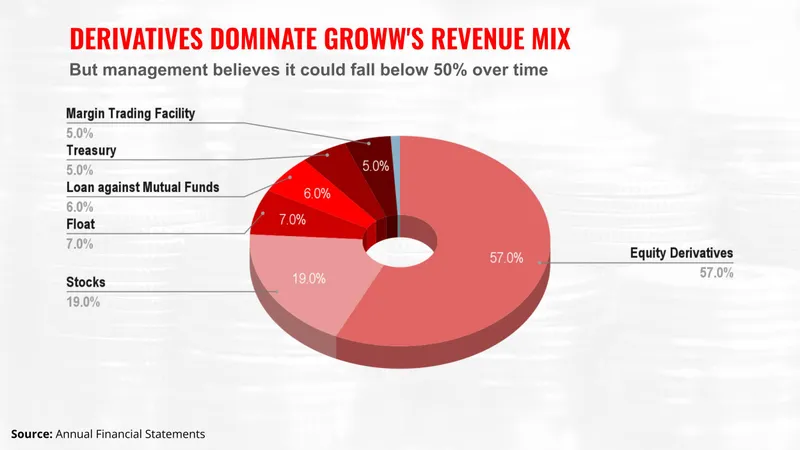
Equity derivatives accounted for 57% of its total income in Q2 FY26, down from 68% a year earlier. The share briefly dropped to 56% in Q1 FY26.
The number of active F&O users has been broadly stable in recent quarters, but the platform is seeing higher engagement from serious traders. The company's F&O user base has stabilised at around 1.4 million over the recent quarters.
“The average orders per user have grown in the range of 10–20%. High-quality users are still there on the platform and are actually growing, while low-quality customers who were earlier placing significantly fewer orders are moving away,” Co-founder Ishan Bansal said during the company’s earnings call, adding that it sees this as a healthy move for both Groww and the industry.
Further, management expects derivatives to slip below 50% of the revenue mix over time, as other segments scale up. "It is beyond 50, definitely it can come below 50," Bansal said.
He emphasised this would largely be driven by faster growth in wealth management, commodities, and other products rather than an absolute decline in F&O revenue.
Meanwhile, revenue from stocks has expanded its share by 4 percentage points annually, now accounting for 19% of the total pie, driven by better monetisation.
Revenue per order in the stocks segment has also risen, aided by a 66% jump in average order value and increased brokerage fees implemented earlier in May.
On the other hand, Groww has managed to lower its cost to serve per order even as volumes rise. Technology costs have reduced after backend optimisation, while transaction-related expenses have risen with activity. “We were running at significantly higher capacity to maintain uptime. There is still an opportunity to optimise some of these costs in the future,” Bansal added.

The MTF surge
Perhaps the most aggressive diversification play for Groww is in credit and margin trading.
The Margin Trading Facility (MTF), launched in April 2024, has already grown to account for 5% of revenue, up from just 1% in the prior year.
MTF lets investors borrow from the broker to trade bigger positions and pay interest on the borrowed amount. According to the fintech, the MTF loan book now stands at Rs 1,668 crore, capturing a 1.7% market share after volumes surged 60% in Q2 FY26.
Now, Groww wants a much larger slice of the MTF market over the medium term, as it targets a double-digit market share in MTF over the next three years. Management argued that the product can expand the market rather than redistribute the share among existing players.
Credit grows slowly
Simultaneously, Groww is deepening its foray into credit through its NBFC subsidiary, Groww Creditserv. Disbursements surged 58% quarter-on-quarter, driven largely by the introduction of Loan Against Securities (LAS), which accounted for nearly a third of all new disbursements in Q2.
Around 9,800 customers tapped LAS in the quarter, while personal loans continued to grow organically.
“LAS is [at a] very early stage today. It is actually not even fully LAS. It is a loan against mutual funds as of now. Loan against securities is yet to be launched,” Bansal said, adding the company needs to build more features and optimisation before the product can scale meaningfully.
The company said credit costs are stabilising for its three-year-old unsecured lending business. The NBFC loan book is roughly Rs 1,250 crore, with the company looking to maintain a “healthy mix” of secured and unsecured loans over time.
Wealth management
The other big bet is wealth management. In October this year, Groww paid nearly Rs 961 crore and completed its acquisition of Fisdom, and it will consolidate its business starting Q3. Fisdom generated Rs 166.3 crore in revenue last year, which management said would add 3-4% to Groww’s operating revenue at its current run rate.
For now, Fisdom is close to breakeven but still loss-making, so the near-term impact is more strategic than earnings accretive, the company said. The revenue model is largely distributed across four product lines: regular mutual funds, PMS and AIF distribution, insurance, and unlisted securities.
Fisdom has also launched a “PMS of mutual funds” product that charges advisory fees directly to customers, which the fintech expects to grow faster and eventually offer it more broadly on its platform.
This acquisition, according to the company, will help a fast-growing affluent user segment, whose numbers have risen 52% annually. For context, Groww classifies users with over Rs 25 lakh in assets as affluent.
These users now account for 34% of all the assets Groww's customers hold on the platform, up 31% from the previous year. The company expects these users to drive demand for high-ticket products such as PMS, AIFs, and advisory.
Further, it added about 500 employees to Groww's workforce, of which 180 are in sales roles.
Groww also has a pipeline of smaller experiments. It rolled out a desktop trading terminal called 915—still in beta phase—for high-frequency traders, with features like option chains, open interest analysis, and AI-powered widgets. It also launched Bond IPOs in June and has already captured 5-6% market share in retail allocations.
Commodities is another new area for the company. Groww has already scaled to 20,000–30,000 daily commodity orders, with a significant chunk coming from first-time commodity traders on the platform.
The company believes its market share in commodities will catch up with its broader equity share relatively quickly, since it is a pure transaction business and does not require building a separate book.
Edited by Suman Singh