



Beyond the skip button: Flam is rewriting the rules of digital attention
From app-less mixed-reality content to 10X engagement, Flam is turning QR codes into fully interactive brand experiences and redefining how users discover and buy online.


Most digital advertisements today follow a predictable pattern: a video pops up on your screen, you skip it in five seconds, and move on. In a world where people scroll faster than brands can talk to them, attention has quietly become the most expensive commodity online.
Bengaluru- and San Francisco–based Flam wants to change this. Instead of flat, one-way ads, the startup is building interactive, mixed-reality content that users can touch, move, or even talk to—all without downloading an app.
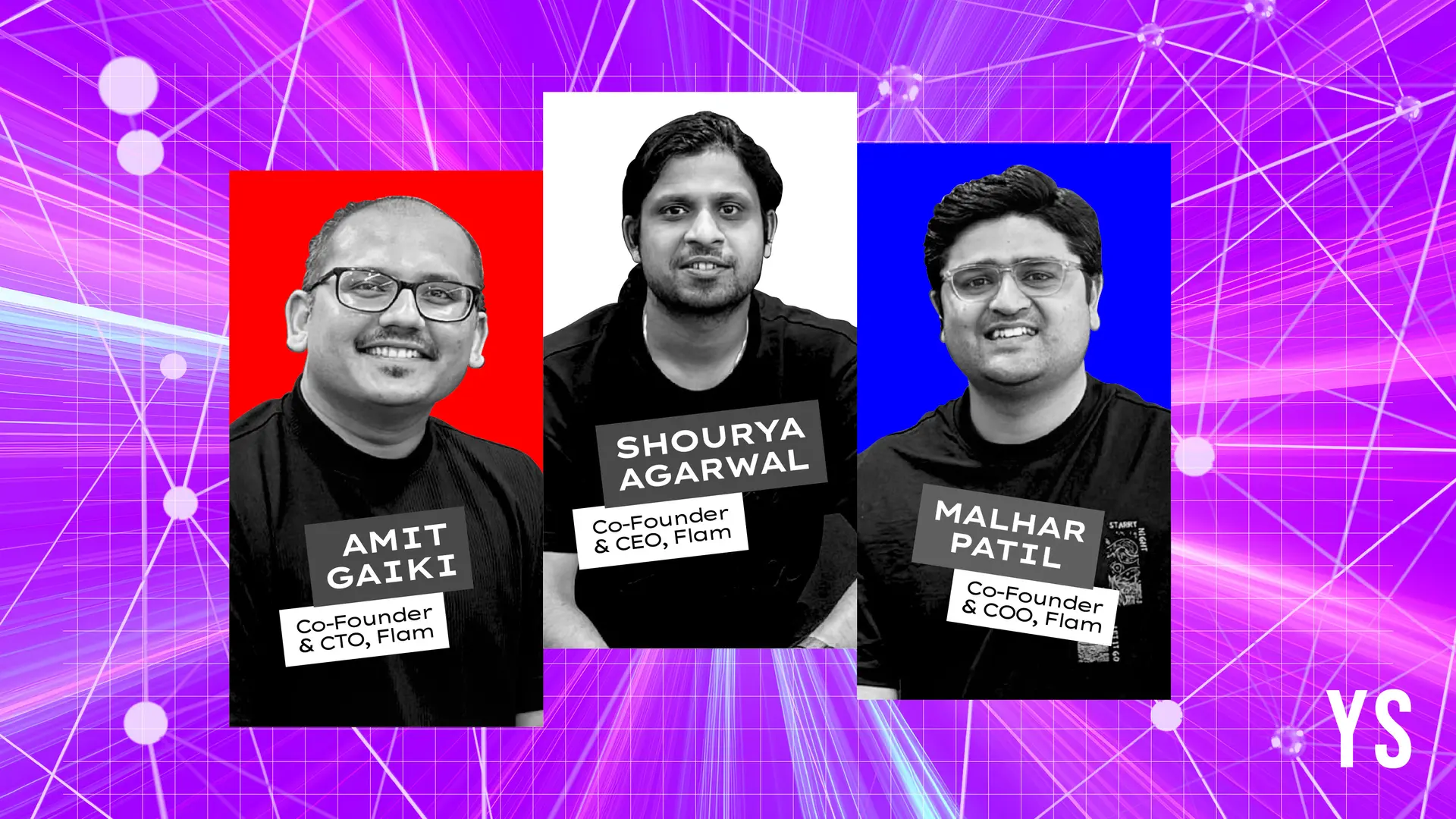
Flam was founded in 2021 by three college friends from Birla Institute of Technology and Science (BITS) Pilani: Shourya Agarwal (Co-founder and CEO), Malhar Patil (Co-founder and COO), and Amit Gaiki (Co-founder and CTO).
What began as an exploration in consumer internet products gradually evolved into a full-stack mixed-reality publishing infrastructure used by more than 100 global brands. But the idea did not appear overnight.
“When we started this, it was more into the consumer internet space. However, we observed a shift towards increasingly interactive content. Text became images, images became videos, and we thought of building something even more engaging,” Gaiki says.
The trio studied together and wanted to build a high-growth consumer product. But while testing their early prototype during college, they realised the real gap wasn’t in social media; it was in the tools for creating and distributing content. Traditional formats like photos and videos had decades of mature tech behind them; mixed reality didn’t.
“We had to build all that ground up,” Gaiki says. “Most of this learning doesn’t come from colleges. You learn it on the job.”
Building the core tech
From 2021 to early 2024, the team at Flam focused entirely on R&D, building its graphics library, testing formats, and trying different user experiences. The startup wasn’t thinking about advertising then; it was trying to make mixed-reality content load instantly on any phone without an app, which became its biggest breakthrough.
“When you scan our QR code, the bundles get installed on your phone without any app. It opens the interface instantly,” Gaiki says.
This ability to launch a high-fidelity 3D experience through a simple link or QR code removes the usual adoption hurdles: app downloads, drop-offs, and glitchy web rendering.
By March 2024, Flam released its first commercial campaign with Britannia, featuring Ranveer Singh in a mixed-reality newspaper ad. It was the moment the team realised that its long R&D cycle had finally paid off.

The product and how it works
Flam’s platform has three parts. The first is the consumption layer, where end users access content through QR codes or web links. The second is a publishing platform, where brands upload and manage their mixed-reality campaigns. The third is the creation layer, where brands can either use Flam’s tools or plug into existing software like Adobe After Effects to create content.
Gaiki puts Flam’s experience as “an AI interface” rather than a typical ad format. Users can place content in their environment, tap objects, or even talk to them.
“People can talk to the content. If a brand sends a link for phones, people can tell the specifications they need, and those phones are rendered in real time. Also, they can click and buy from there itself,” he says.
This real-time interactivity uses a mix of foundational AI models, custom LoRAs, and Flam’s own optimisations for 3D generation, image tracking, and rendering. The startup supports 100% of Android and iOS devices, which Gaiki claims is one of Flam’s biggest differentiators.
Business model, pricing, and customers
Flam operates on a B2B2C model. The brands pay, while their consumers interact with the content. The startup does not use a subscription model but offers both campaign-wise billing and long-term enterprise deals.
A basic campaign costs between $5,000 and $10,000, while highly interactive one-off campaigns can cross $100,000. Long-term year-long licences let brands publish unlimited content and integrate Flam into all their marketing channels, including stores, billboards, online campaigns, and print ads.
In its first year of going commercial, Flam has worked with 100+ global brands, including Google, Samsung, Hyundai, Emirates, and Britannia.
Google first advertised with the startup in 2024 and continues to run multiple campaigns, with even its in-store experiences now moving to Flam’s interface.
The startup’s revenue has grown rapidly since monetisation began in 2024. “Since the fundraising, the revenue has gone up 5X,” Gaiki says.
So far, Flam has raised $22.5 million, including a $14 million Series A round led by RTP Global, with participation from Inventus, TurboStart, and others.

Team, offices, and market
Flam has around 140 employees, including a 60-member tech team. The startup operates out of Bengaluru and San Francisco, with Bengaluru housing tech, design, and marketing, while the US office focuses on sales and some product functions.
According to the Market Research Future, the mixed reality market is valued in the mid–single–digit to mid–teens billion-dollar range in 2024, depending on whether you look at “pure MR” or combined AR+MR estimates, and is projected to grow at 30–50% CAGR over the next decade.
Gaiki says the startup’s interactive content can significantly increase a user’s attention time. A typical video ad sees 5-10 seconds of attention; interactive Flam ads can cross 30 seconds. “We are seeing attention CPMs (Cost Per Mille) 10X lower than any other platform,” he says, adding, “That has been unheard of in advertising.”
Because of this, Gaiki believes Flam is not competing with existing mixed-reality companies but expanding the market itself.
Challenges and the road ahead
Flam saw its biggest challenges in the early stages of development. Creating the core 3D rendering stack, making it load instantly on low-end devices, and ensuring compatibility across phones took years of experimentation.
However, the reception has been good since the product hit the market, Gaiki says. Customer feedback now drives features, and Flam continues to evolve the product to make interactivity more seamless.
The next big step for Flam is moment shopping—a feature it is currently building. Instead of opening an ecommerce app and scrolling for products, users will get smart, contextual links through WhatsApp or other channels. The content will help them understand what they are looking for and show the products in real time.
“Imagine talking to your email, and the email creates the content instantly for you to shop,” Gaiki says. Flam is already testing this with a few brands and plans to launch it next quarter.