



India risks losing crypto users without swift regulation, says Binance APAC Chief
Delays in crypto policy are pushing Indians offshore, warns Binance’s SB Seker. In an interaction with YourStory, he spoke about what decisive regulation could mean for the country’s digital future.

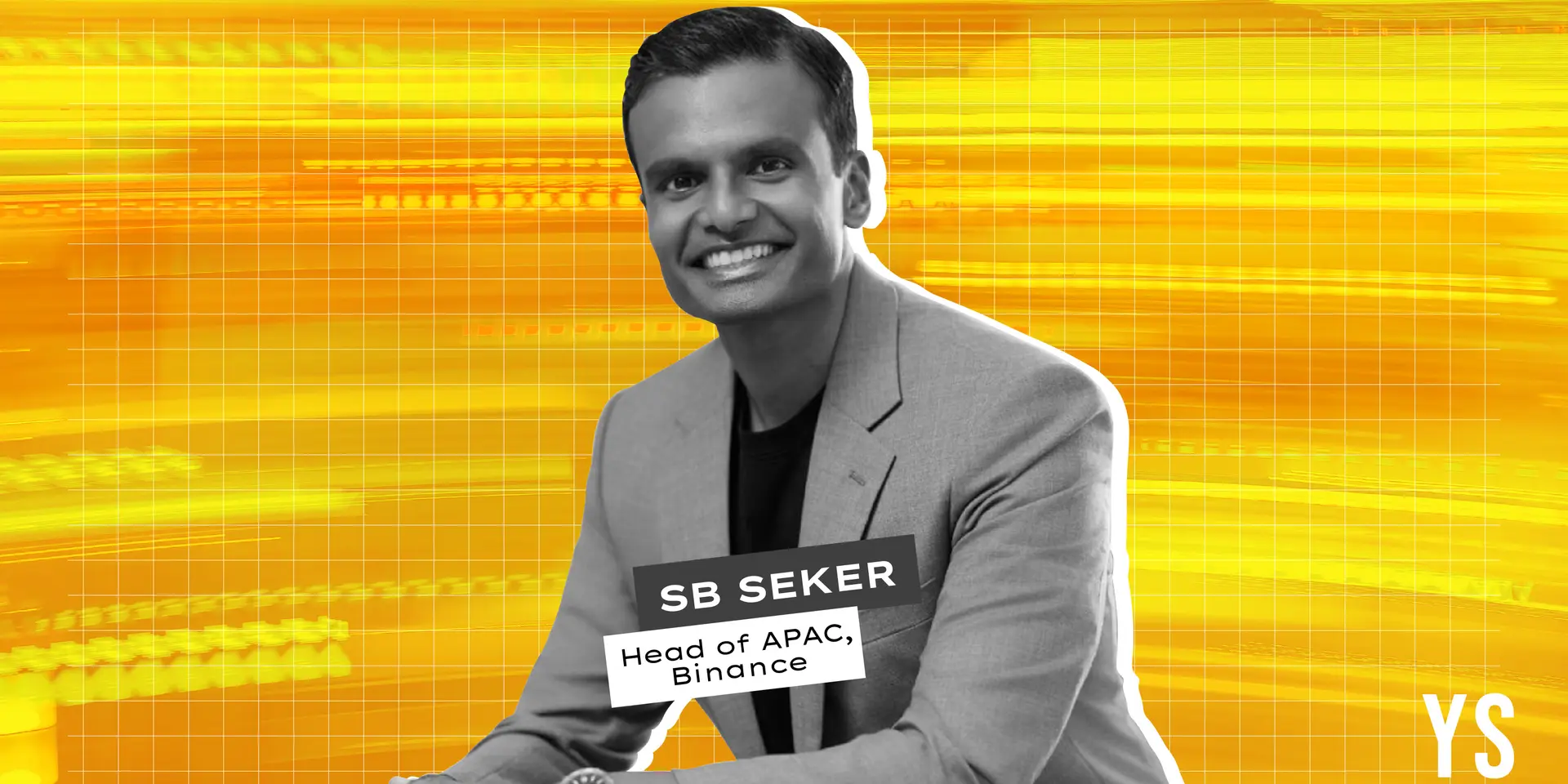

India's crypto industry is at a turning point. While millions of Indians are using digital assets, the country's regulatory framework is still unclear. For SB Seker, Head of APAC at Binance, the window for proactive regulation is narrowing.
“Too much delay is also not a good idea,” he says, noting that prolonged uncertainty risks are pushing users toward unregulated offshore platforms and decentralised protocols that offer easier onboarding.
Once they do, he notes, “Pulling them back to a regulated centralised model is going to be harder.”
Before joining Binance, Seker worked as a litigator in Australia and spent years as a central banking lawyer at the Monetary Authority of Singapore, giving him first-hand experience in financial regulation.
Speaking to YourStory on the sidelines of Binance Blockchain Week in Dubai, Seker spoke about why India's policymakers should treat crypto as a systemically important component of financial services, and outlines the opportunities that clear regulations could unlock for Indian entrepreneurs and developers. He also addressed how the industry can rebuild trust after recent security incidents, where two major exchanges, WazirX and CoinDCX, lost millions of dollars in digital heists.
Edited excerpts from the interview:
YourStory [YS]: Why should Indian lawmakers take crypto regulations seriously right now?
SB Seker: In terms of volume, revenue, or users, crypto is still in early stages and doesn’t yet move the economic needle for India. But if you look at the trendline, the growth rate far exceeds any other sub-sector within financial services. Even with only passive AML registration and no licensing framework, the trajectory is clear.
Crypto is on course to become a systemically important part of financial services, whether India acts or not. That’s why long-term, scalable regulation matters. India also needs responsible market participants with strong compliance, security, and consumer-protection standards. With such a massive, financially diverse population, you can’t achieve meaningful consumer protection without licensing. It doesn’t need to be the government’s top priority, but it can’t be ignored while shaping the future of financial-services regulation.
YS: What is the biggest concern for regulators or central banks that haven’t warmed up to crypto?
Seker: Indian regulators are highly sophisticated. They’ve lived through the UPI build and broader digitisation. The hesitation is more a policy lag.
Because of India’s size, whatever regulatory stance is chosen will have long-term consequences.
India now has the luxury of second-mover advantage: it can observe what worked, what failed, and what can be adapted. India can pick the model that aligns with its aspirations.
My only caution would be: avoid too much delay. If Indian users get used to offshore exchanges or DeFi platforms that let them trade instantly, then that behaviour becomes their default. Once that happens, bringing them back into a regulated system where proper checks exist becomes an uphill task.
YS: If India codified crypto regulations tomorrow, what opportunities would open up?
Seker: Once regulations define the roles of exchanges, brokers, and dealers, and also clarify which products are allowed, adoption will be quicker.
India’s adoption is already unusually cross-sectional across Tier I, II, and III cities, with surprisingly uniform distribution across regions. The metros naturally lead in absolute numbers, but the interest from smaller cities is remarkably strong.
India already has 20 to 30% of the global Web3 developer pool. A lot of them are Indian or of Indian origin, but they’re working for companies offshore because of lack of clarity. With clear rules, the demand will naturally come onshore. That means, companies like ours, and many others, will start anchoring themselves in India.
YS: Do you agree that not enough is being built for India right now?
Seker: Yes, but with some humility. It’s not for us to tell India what should be built for Indians. But there is definitely upside if more companies build in this space inside India.
Every time we do a Binance Yatra in Visakhapatnam, Ahmedabad, Chennai, Mumbai, Bengaluru, and I speak to founders, I’m blown away. These projects are extremely high-quality. Layer-2s, DePIN, DeFi, AI-integrated solutions, compliance tools—the innovation level is extraordinary.
The piece missing is clarity. If the market understood the regulatory stance, the accelerator and incubator ecosystem would grow much faster.
Look at the UAE. When we entered five years ago, it was extremely nascent. Then they created their licensing framework, built it into their financial-services ecosystem and now they have over 1,300 licensees and $30 billion projected revenue by 2030. If the UAE can do that, India definitely can.
YS: After the WazirX hack and redistribution of assets, many Indian investors say they no longer trust exchanges. How do you rebuild trust?
Seker: First, users should educate themselves. Understand the technology, products, and always maintain a margin of safety based on your own knowledge, experience, and financial position.
From an industry perspective, trust comes from how well a company protects its systems and its customers. We go through strict audits, and we hold global certifications that show our security and data-protection standards are solid.
Secondly, you look at what measures a company has put in place as a good-faith policy to account for losses when these things happen. If something like that ever were to happen—touch wood—how would we deal with it?
We have a $1 billion fund set-aside to specifically compensate users if they lose money through no fault of their own.
Thirdly, you look at a company’s track record. During the October 10 liquidations, the stock market lost about $150 billion and digital assets lost around $20 billion. Half of that came from unregulated, decentralised platforms. Still, we paid out nearly $300 million within 48 to 72 hours to users who were trying to close their positions but couldn’t because liquidity disappeared in certain tokens.
We also paid another $100 million through our Together Forward initiative to support hedge funds, market makers, and liquidity providers who took losses. Normally, this doesn’t happen.
In traditional finance, when there are haircuts or bailouts, it’s the state that steps in—JP Morgan doesn’t pay this out. But we did, because we genuinely believe the industry has to move forward together.

YS: Do you expect to see an Indian stablecoin soon?
Seker: That’s for the RBI to decide. Stablecoins pegged to a local currency only make sense for a large country. For smaller countries, it doesn’t make sense because you run into liquidity issues.
But India is massive. And I personally hope that, in my lifetime, the INR becomes part of the IMF’s global reserve basket. It’s already becoming more common in cross-border trade settlement. So, in that context, I do hope we eventually see some form of Indian stablecoin take shape.
One of the real pain points today is that there are no INR on-ramps or off-ramps. It’s not hard law, but there’s market guidance that these rails shouldn’t be offered to crypto or digital-asset players. That creates a bottleneck.
From our point of view, we’re agnostic. It can be an Asset Reserve Certificate (ARC) model, an RBI reserve-backed token, a private stablecoin, or a CBDC, all of these have pros and cons. A CBDC is good for monetary-policy distribution, but it also squeezes banking liquidity because wholesale banks aren’t involved—the wallet sits at the government level.
So, whatever RBI chooses, we just hope there will be an INR-linked stablecoin that circulates freely within India so users can participate legitimately in the digital-asset space.
YS: What’s your view on gold tokenisation, especially for Indian users who love gold?
Seker: Gold tokenisation has been tried in quite a few places—Australia has done it, the UAE has been working on it for some time, and there are private projects I’ve interacted with in previous roles that have been trying to make gold tokenisation work for years.
But the challenge with tokenised product is redemption. For gold, the big question is: how granular can redemption really be, and who is actually holding the physical gold? Gold comes in fixed denominations—coins, bars, and so on.
If you fractionalise it massively, and someone wants to redeem one gram or two grams, what do you do? That’s the core problem. Below those standard sizes, how do you execute redemption? Anyone who solves that will do very well.
There are gold certificates, but the certificate is not gold. Many Indian users will want actual physical redemption, and they’ll want it in very small quantities. So, projects need to solve that. That’s the main constraint around gold tokens.
Edited by Megha Reddy