



This startup is building AI agents that think like finance teams
Founded by Rajeev Pathak, Niyati Chhaya, and Ram Jayaraman, Hyperbots offers agentic AI-native co-pilots that automate core finance workflows such as procure-to-pay, order-to-cash, expense management, analytics, and other processes.


Finance and accounting have long been among the hardest enterprise functions to automate in a meaningful way. While software has digitised workflows, much of the actual judgement — deciding whether an invoice is valid, whether a cost should be accrued, or whether a vendor is billing correctly—has remained firmly human.
Hyperbots, a New York and Bengaluru-headquartered startup, is attempting to close that gap by building AI agents designed to reason the way finance professionals do.
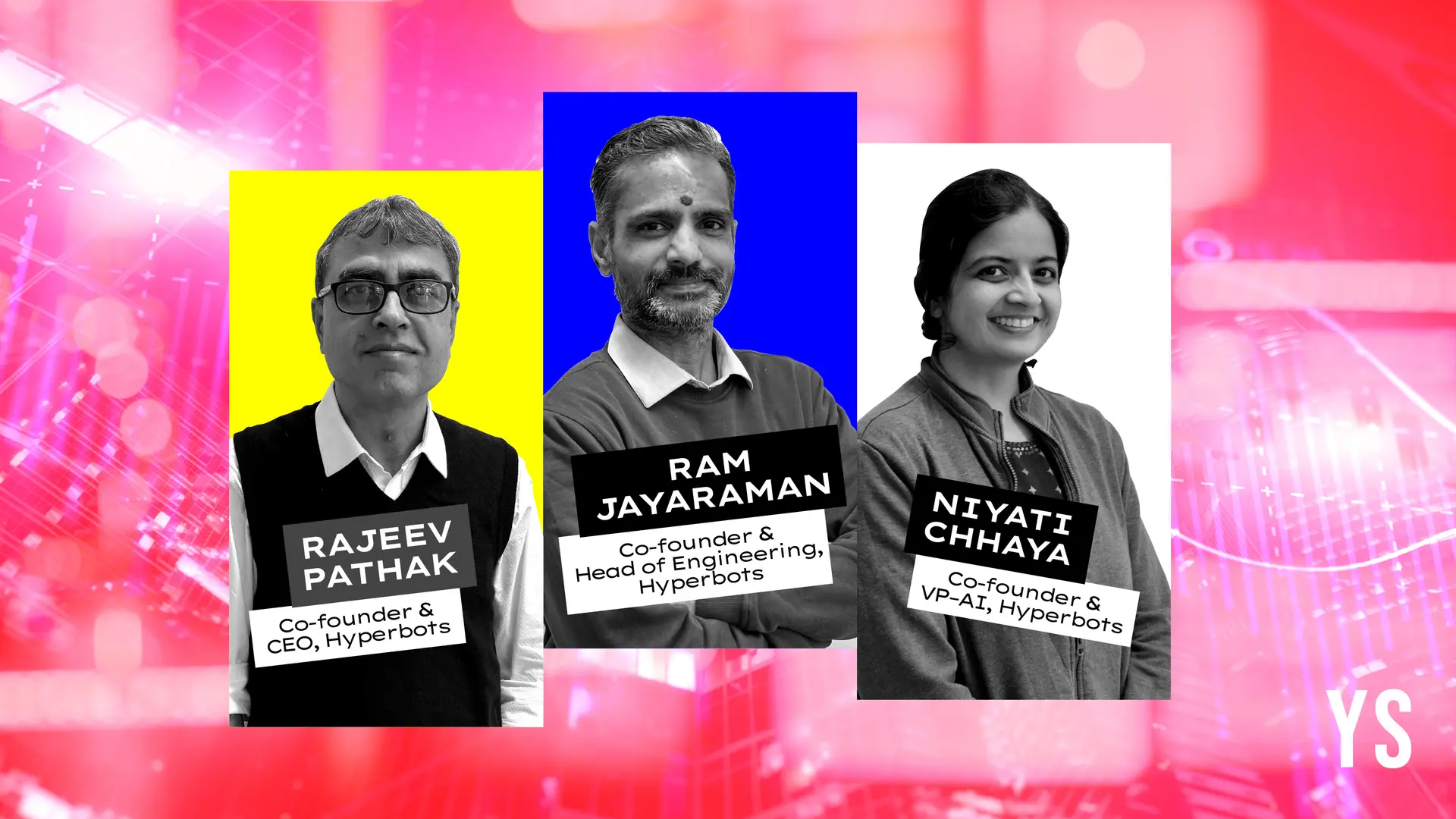
Founded in 2023 by Rajeev Pathak (Co-founder and CEO), Niyati Chhaya (Co-founder and VP–AI), and Ram Jayaraman (Co-founder and Head of Engineering), Hyperbots offers agentic AI-native co-pilots that automate core finance workflows such as procure-to-pay (PTP), order-to-cash (OTC), expense management, analytics, and other processes.
In 2025, the company was selected as one of only three Indian startups to be part of the AWS Generative AI Accelerator, a recognition it attributes to both its technical depth and enterprise adoption.
“Our focus has always been on building highly efficient, accurate, in-house AI agents,” says Niyati Chhaya, Co-founder and VP–AI, Hyperbots. “We are laser-focused on solving problems inside the CFO’s office, rather than building generic AI tools and trying to retrofit them later.”
Why finance remains difficult to automate
Unlike text-heavy enterprise workflows, finance teams deal with invoices, contracts, purchase orders and P&L statements that are often semi-structured, vary widely by vendor and geography, and combine tables, numbers, handwritten notes and accounting logic.
“Extracting accurate information from finance documents isn’t just an OCR problem,” Chhaya explains. “You’re dealing with math, tables, handwritten data and implicit accounting rules all at once. That combination is still largely unsolved with single-model approaches.”
Hyperbots’ response is a Mixture-of-Experts architecture, where different AI models specialise in different types of intelligence instead of relying on a single large model to handle everything.
How Hyperbots’ AI agents work
In a typical invoice workflow, a vision-language model reads low-quality scans, handwritten notes and tables. A domain reasoning model validates tax rules, discounts, PO matching and contract terms. A forecasting model estimates cash-flow impact and payment timing, while a domain-specific LLM recommends the appropriate general ledger treatment based on historical postings and accounting policies. A secure redaction layer removes sensitive information before storage or retraining.
“All of this is coordinated by an agentic layer that behaves like a finance analyst,” says Chhaya. “It decides the sequence of tasks, handles exceptions, triggers approvals and safely writes back into the ERP with full audit trails.”
Rather than stopping at document extraction, the system is designed to complete finance workflows end to end—reading, validating, reconciling and posting data autonomously.

Accuracy over scale
Hyperbots says its platform has been pre-trained on more than 30 million finance documents, achieving 99.8% accuracy in production environments. According to the team, the hardest part was not model size, but data quality and training discipline.
“Creating the right dataset and refining the training strategy were the toughest challenges,” Chhaya says. “Ensuring we could maintain that level of accuracy consistently, even with limited resources, has been the most demanding part of the journey.”
A judgment-first approach
While AI-led finance automation is becoming crowded, Hyperbots argues that most products still treat finance as a workflow optimisation problem rather than a judgment problem.
“Our agents don’t just move documents through a pipeline,” Chhaya says. “They understand why a tax rate is wrong, why a vendor might be billing twice, or why an unbilled receipt needs to be accrued.”
This focus on judgment, she says, comes from training foundation models on over 35 million structured and unstructured finance fields and co-designing product decisions with CFOs. “What stays defensible is whether the system behaves like a finance professional, not whether it claims end-to-end automation.”
Where customers see value first
Among Hyperbots’ AI copilots, invoice processing and accruals are seeing the fastest adoption. Invoice automation removes immediate manual workload, while accruals address month-end accuracy—two persistent pressure points for finance teams.
The platform is already used by global enterprises, including NASDAQ-listed healthcare companies and firms across semiconductors, EV infrastructure and marketing services. Across sectors, the pain points are similar: mismatched invoices, inconsistent vendor formats, misapplied taxes and operational knowledge locked inside inboxes.
“These aren’t problems you solve by adding more people or more software,” Chhaya notes. “They require systems that can understand context, apply judgement and react continuously as new information arrives.”
What’s next
Hyperbots integrates with major ERP systems and maintains ISO 27001, SOC 1 Type 2 and SOC 2 Type 2 certifications, reflecting the security and compliance requirements of enterprise finance teams. The company has raised $9 million in venture funding during 2024–25, with backing from Arkam Ventures, Athera Venture Partners, JSW Ventures, and Kalaari Capital.
Over the next 12–18 months, Hyperbots plans to expand beyond Procure-to-Pay workflows into Order-to-Cash copilots, and launch HyperLM, a specialised language model and intelligent workspace built specifically for CFO use cases.
As enterprises move from basic automation toward systems that can assist with financial judgment, Hyperbots is betting that finance—long considered too complex for AI-led reasoning—may become one of the clearest proving grounds for agentic AI.
Edited by Jyoti Narayan