



Pine Labs’ first profit after market debut; India’s most affordable bionic hand
Lastly, a quantum-driven crypto meltdown, more AI chaos, and China creating a new global money system are among the outrageous predictions made by Danish investment bank Saxo Bank.



Hello,
On Wednesday, Pine Labs reported its first earnings after its recent market debut.
The fintech firm posted a profit for the second consecutive quarter, as the newly listed payments company cut depreciation and ESOP charges while higher-margin businesses lifted earnings. In Q2 FY26, its net profit rose to Rs 5.97 crore, compared with a loss of Rs 32.01 crore a year earlier.
Meanwhile, Meesho saw its IPO fully subscribed by afternoon on day 1 of opening, as heavy demand from retail investors drove up bids, according to the Bombay Stock Exchange. The 277.9 million share offering attracted bids for 322.2 million shares, achieving a subscription ratio of 1.16 times.
Elsewhere, aeroplane parts maker Aequs' nearly $103 million IPO was fully subscribed within hours of opening yesterday, as investors were drawn to the company's long-term prospects and expansion plans amid a growing backlog of jet orders, Reuters reported.
Lastly, a quantum-driven crypto meltdown, more AI chaos, and China creating a new global money system are among the outrageous predictions made by Danish investment bank Saxo Bank.
PSA: The crystal-ball gazing is only intended to open debates and does not actually predict the future, the bank said.
What is your prediction for 2026?
In today’s newsletter, we will talk about
- India’s most affordable bionic hand
- Inside India’s new-age defence tech sector
- The fight against child marriage
Here’s your trivia for today: Which company took over the production of Rolls-Royce cars in 2003?
Innovation
India’s most affordable bionic hand
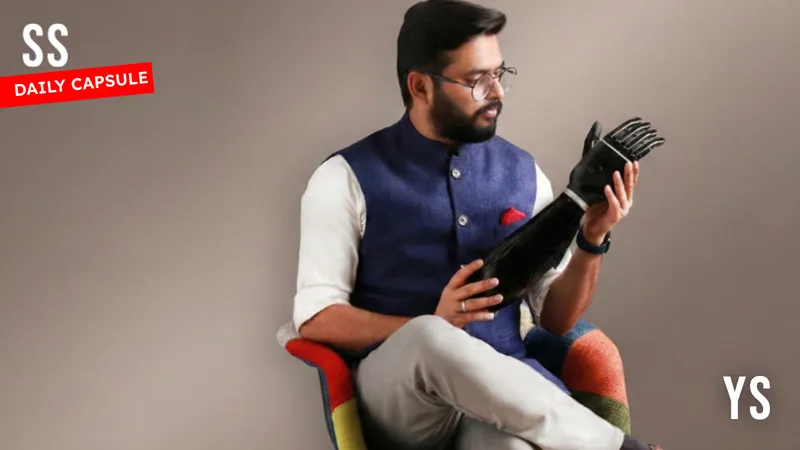
Makers Hive’s KalArm—the world’s most affordable fully functional bionic arm—uses AI, robotics, and 3D printing to give upper-limb amputees natural movement at one-tenth the global cost, restoring independence with dignity.
From EMG sensors to linear actuators, wrist mechanisms, finger mechanisms, thumb mechanisms, and the bionic controller, everything had to be built from scratch, and in India. Founder Pranav Vempati named the bionic KalArm as a tribute to Indian scientist and former president, APJ Abdul Kalam.
Ensuring dignity:
- KalArm costs somewhere between Rs 4.5 lakh and Rs 6 lakh. The variation happens because the forearm is customised from person to person, depending upon the degree of amputation, while the arm is manufactured at scale.
- It is 3-D printed, embedded with EMG sensors and lightweight. When a person thinks about moving their fingers, their muscles produce tiny electrical impulses. EMG sensors placed on the residual limb detect these signals and send data to motors via a bionic controller, which then moves the fingers accordingly.
- Makers Hive is also launching the KalArm Lite in three months, a version that will be available for Rs 2.5 lakh.
Insights
Inside India’s new-age defence tech sector
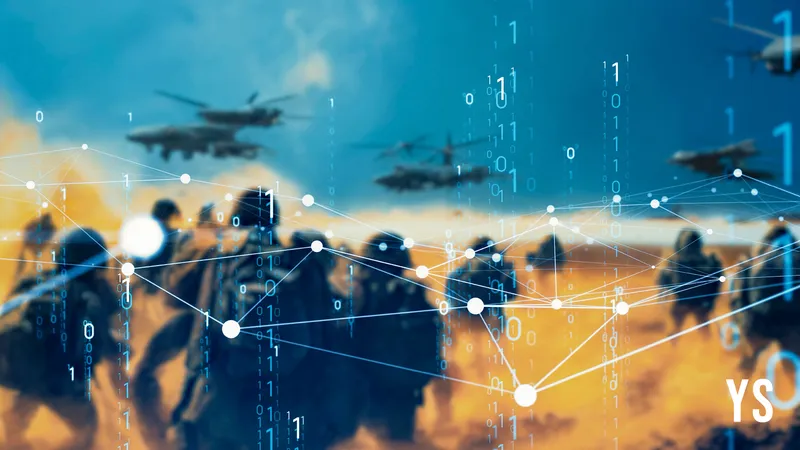
India’s new-age defence technology sector, spanning sophisticated drones, autonomous robots, and quantum computer-enabled communication channels, is projected to grow to nearly a $19 billion market by 2030. However, this growth hinges on overcoming a major challenge: building a sizable talent pool.
Quess Corp, in a report, India’s defence tech evolution: skills shaping the next decade, highlighted that India’s real race isn’t just “growing the pie of defence talent” but tilting this pie towards hard-tech + IP retention. “If that happens, India leapfrogs from being a service base to a sovereign defence innovator by 2030,” it noted.
Key takeaways:
- According to the report, of India’s 800,000 AI professionals, less than 5% are defence-ready. It warns that unless there is a transformation on a war footing, India risks becoming a subcontractor rather than a leader in defence systems.
- It also noted that 89% of the defence tech startups have already integrated AI modules into their products or R&D efforts, with AI expected to underpin almost all defence applications by 2030.
- The demand for defence-focused cybersecurity is growing 20% annually, but India has fewer than 5,000 experts in this domain. The talent shortage is similarly acute in UAVs (unmanned aerial vehicles), radio frequency specialists, optical engineers, and several other critical specialities.
Insights
The fight against child marriage

Representational image | Credit: CRY
The National Family Health Survey - 5 data shows a steady decline in child marriages—from 47.4% in 2005-06 to around 23.3% in 2019-21. Yet, a 2023 UNICEF report highlights a stark reality: India still accounts for one-third of the world’s child brides.
Despite the progress India has made in reducing incidents of child marriage, the burden remains the highest in the world due to the country’s large population. A coordinated ecosystem of ministries, local governance, community leaders, and civil society can help the country’s fight against child marriage.
News & updates
- Social media: Google's YouTube shared a "disappointing update" to millions of Australian users and content creators, saying it will comply with a world-first teen social media ban by locking out users aged under 16 from their accounts within days.
- Missing: The search for the missing Malaysia Airlines flight MH370 will resume later this month, more than a decade after the jet disappeared in one of the world’s greatest aviation mysteries.
- AI push: LSEG will integrate its financial data and analytics into ChatGPT and make OpenAI's enterprise tool available to its employees, deepening its push to embed AI across financial markets.
Which company took over the production of Rolls-Royce cars in 2003?
Answer: BMW
We would love to hear from you! To let us know what you liked and disliked about our newsletter, please mail [email protected].
If you don’t already get this newsletter in your inbox, sign up here. For past editions of the YourStory Buzz, you can check our Daily Capsule page here.