



How Makers Hive built KalArm, India’s most affordable bionic hand
Makers Hive’s KalArm, the world’s most affordable fully functional bionic arm, uses AI, robotics, and 3D printing to give upper-limb amputees natural movement at one-tenth the global cost, restoring independence with dignity.

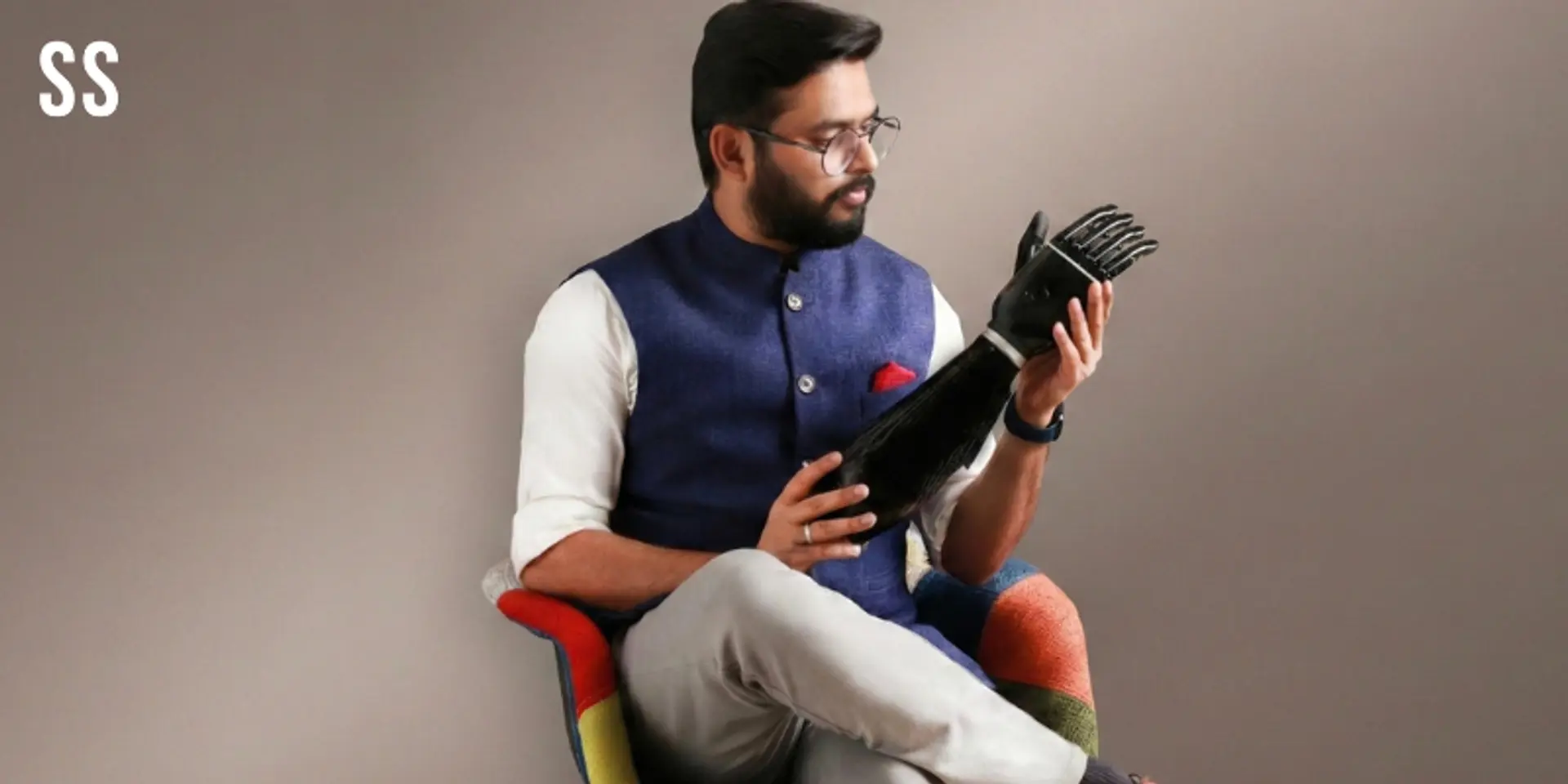

While working in the R&D team of TCS Ignite in Chennai, Pranav Vempati would often spend his weekends with his mentor, MS Swaminathan, who pioneered the Green Revolution in India.
Just like any other young person interested in technology, Vempati too dreamed of going abroad, starting up a new venture and making money.
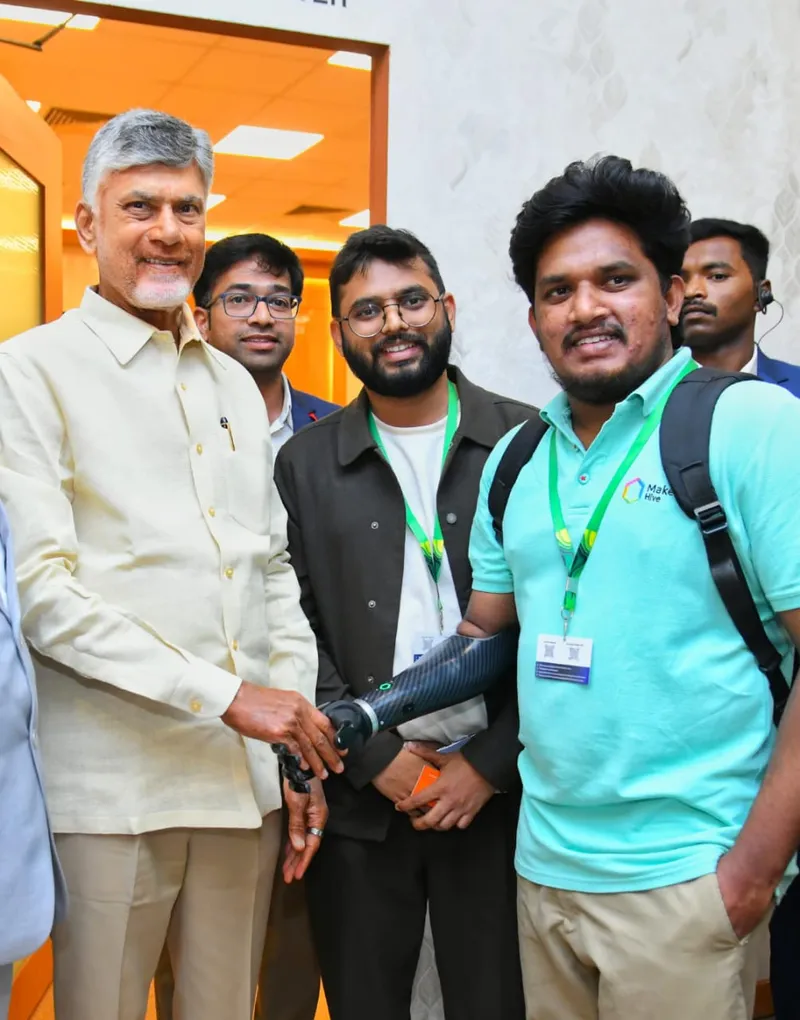
A KalArm beneficiary shaking hands with the chief minister of Andhra Pradesh, N Chandrababu Naidu
But his time with Dr Swaminathan brought in a shift in the way he would approach life.
"I always used to debate with Dr Swaminathan, saying, how would it matter wherever technology grows? Ultimately, technology is progressing. He made me realise that once you go to a developed nation and develop technology there, it’s creating a wider gap between the developed and the developing nations,” he recalls.
His mentor’s words struck a chord: India stands on four pillars—agriculture, education, health, and nutrition. But India was exporting its brightest minds. What the country needed, Vempati realised, were homegrown innovations that could make advanced technology accessible to its own people.
Inspired by this thought, he decided to build his own company, Makers Hive, an innovation factory building solutions with technology, based in Hyderabad. But his decision to work in the field of assistive technology came from a chance encounter with an amputee.
He asked him a simple question, "What is your dream?" The answer affected him deeply. "Pranav, today, if I have to go to the washroom, my mum has to come and clean me up. I can't even do basic things. You are talking about big words like dreams. I don't even have basic dignity in life,” he shares.
The conversation would change everything, prompting Vempati to address the most difficult problem statement in assistive technology—hands. Advanced bionic hands available globally cost anywhere between Rs 30 and 60 lakh, and are out of reach for most Indians needing them.
Vempati set himself a challenge: could he build a world-class product at one-tenth of the price? He took inspiration from ISRO and “how they were doing everything that NASA was doing at a fraction of the price.”
The journey from concept to product took nearly seven years of intensive research and development. The team faced several challenges. A pair of EMG sensors, which detect the minute electrical impulses from muscle movements, costs upwards of Rs 1.5 lakh alone. To build an affordable product, they had to develop their own sensors at just Rs 15,000 to 20,000. Reducing the manufacturing cost by almost eight times, and lowering the final price accordingly, was a significant breakthrough.
From EMG sensors to linear actuators, wrist mechanisms, finger mechanisms, thumb mechanisms, and the bionic controller, everything had to be built from scratch, and in India. Vempati named the bionic KalArm as a tribute to Indian scientist and former president, APJ Abdul Kalam.
“Kal in Hindi also stands for ‘tomorrow'. So KalArm is also the hand of the future,” Vempati adds.
KalArm costs somewhere between Rs 4.5 lakh to Rs 6 lakh. The variation happens because the forearm is customised from person to person, depending upon the degree of amputation, while the arm is manufactured at scale. KalArm is 3-D printed, embedded with EMG sensors and lightweight.
How does KalArm work?
When a person thinks about moving their fingers, their muscles produce tiny electrical impulses. EMG sensors placed on the residual limb detect these signals and send data to motors via a bionic controller, which then moves the fingers accordingly.
The hand features adaptive grasping mechanisms that allow it to hold an egg without breaking it or lift a heavy bag, all without touch or visual feedback. The fingers adjust their grip based on the object being held, with 24 different grip patterns available.
Makers Hive provides five days of intensive ADL (Activities of Daily Living) training after fitment. Trainers work with users on practical tasks: putting on clothes, cooking, writing, typing, personal hygiene, and countless other activities.
On the fifth day, users face a test. They have to perform 15 to 20 tasks within a five-minute time limit. It’s about demonstrating functional independence to manage daily life on their own.
Makers Hive follows up after one week, two weeks, one month, three months, and six months, gathering feedback and addressing issues.
"We set the expectations right. A bionic hand is not a complete replacement for a normal human hand. But with proper training and realistic expectations, it can restore dignity, enable economic independence, and transform lives,” Vempati emphasises.
KalArm is sold through four channels—direct customers, hospitals and prosthetic clinics, government agencies, and CSR projects. It has conducted paid pilot validations across these channels, working with major hospital chains including Apollo, Yashoda, Manipal, Fortis, and Amrita. Government pilots were completed with the Ministry of Defence, Ministry of Home Affairs, Ministry of Railways, BARC, and ISRO.
The company holds ISO 13485 certification for medical device manufacturing and a CDSCO manufacturing licence. It has eight patents.It has Prosthetic & Orthodontic (P&O) clinics in Hyderabad and is setting up two more, in Delhi and Mumbai. So far, it has completed 86 fitments and will reach 100 by the end of this month.
Stories of transformation
Vamshi lost his hand in an accident when he was 16 years old. He depended on his mother for every small task and lived on Rs 2,000 in his village. Two years after receiving a KalArm bionic hand through a CSR project, Vamshi lives independently in Hyderabad, cooks his own food, cycles to work and earns around Rs 30,000 a month.
He demonstrates how he writes and picks up a bottle of drinking water, all of which seemed impossible a few years ago. One of KalArm’s first users is Gayathri, who was able to pick up her baby with her own hands.
Makers Hive is also launching the KalArm Lite in three months, a version that will be available for Rs 2.5 lakh.
The company is working with several corporates to pitch in with a partial payment method where they provide what individuals cannot afford. Under fully-funded CSR projects, it works with defence-based PSUs to provide arms to people who lost their hands fighting for the country or corporate funding for para-athletes representing India.
Looking forward
Despite the presence of global giants like Össur and Ottobock, and competitors like Ather Biomedical, Makers Hive differentiates itself on the “Made in India” and cost factor.
The company launched commercial sales just nine months ago. It has a manufacturing facility in Hyderabad capable of producing 1,200 units annually on a single shift, expandable to 3,500-3,600 units across three shifts.
As a 24-year-old building a deeptech startup seven years ago, Vempati found it difficult to find investors in the beginning. Over the years, Makers Hive has raised Rs 32 crore in total funding. Recently, it raised 10 crore from Silver Needle Ventures as a combination of primary and secondary in a bridge round.
Vempati and his co-founder and CTO, Chanakya Gone don’t just want to stop at prosthetics.
Makers Hive has begun developing Kalam X, a variant designed for industrial robotics and humanoid robots. The company is also developing Sthira, a device for people with Parkinson's disease.
Edited by Jyoti Narayan