



Priya Agarwal Hebbar on why women are key to India’s mining and manufacturing future
On International Women’s Day, Vedanta's Priya Agarwal Hebbar speaks about breaking barriers in the traditionally male-dominated mining sector, why women’s participation is critical to India’s industrial future, and the need to redesign workplaces for a truly inclusive workforce.

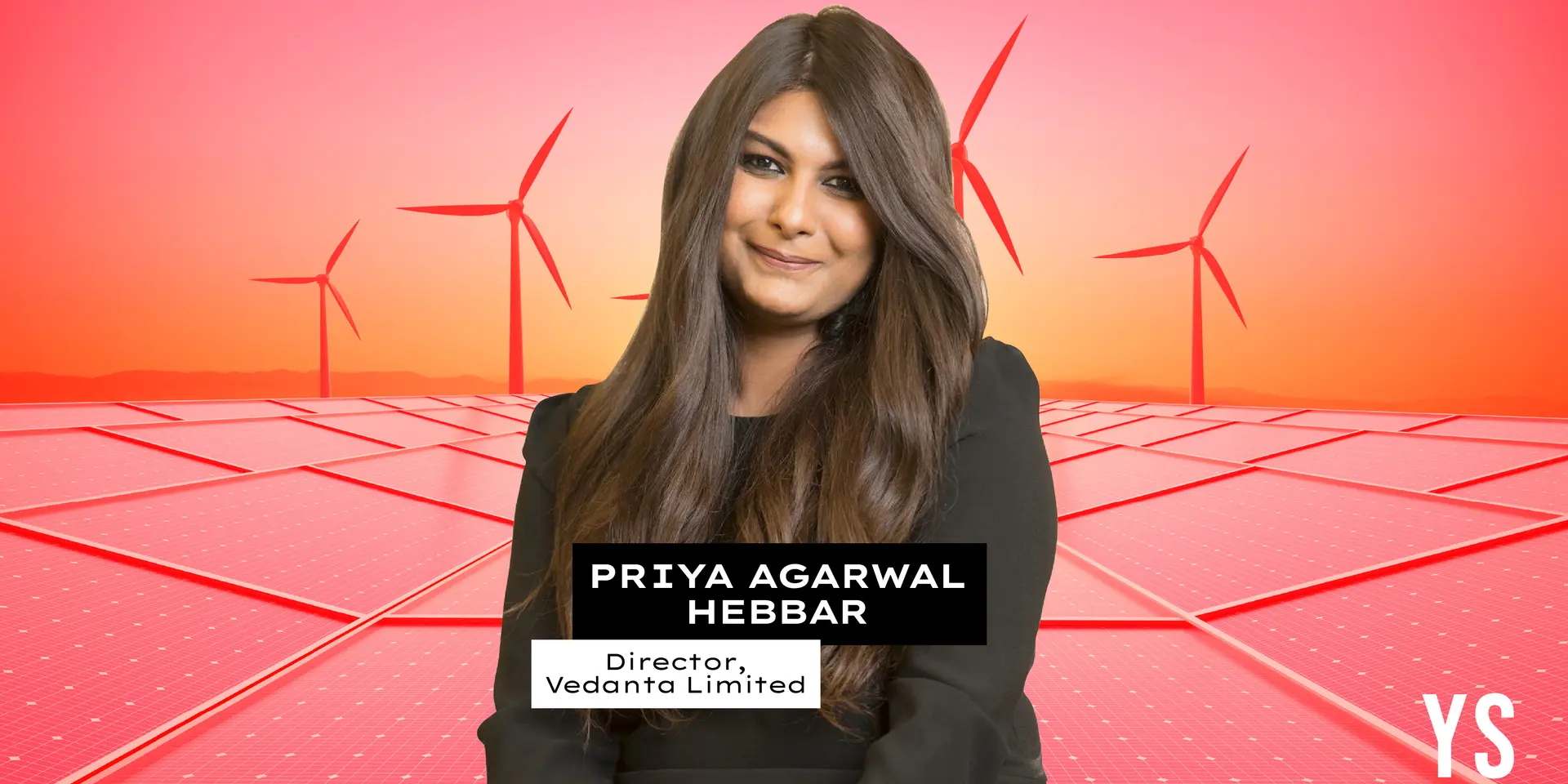

The conversation around women in the metals and mining sector is shifting from a diversity initiative to an imperative for national competitiveness, believes Priya Agarwal Hebbar, Director of Vedanta Limited and Chairperson of Hindustan Zinc.
In a candid dialogue in the spirit of Women's Day, Hebbar speaks about the need for institutional evolution that prioritises women-first employment rather than surface-level representation.
With minerals forming the backbone of electric vehicles, solar plants, and future infrastructure, integrating the full intellectual capacity of the workforce will be critical for India’s transition into a ten-trillion-dollar manufacturing powerhouse. Vedanta has already invested over Rs 12,500 crore to boost the production of critical materials like aluminium, zinc, and nickel to meet the surging demands of India’s electric vehicle ecosystem.
Historically, industrial workplaces were not built for a gender-diverse workforce, reinforcing the perception of mining as a rugged, masculine domain. Today, however, the industry is increasingly driven by automation, predictive analytics, satellite mapping, and sustainability science.
This technological shift and the changing perception of the sector are echoed by Vedanta Resources Chairman Anil Agarwal. In an interview with Shradha Sharma, Founder and CEO, YourStory, last year, Agarwal emphasised that the convergence of advanced technology and natural resources will take the country ahead, noting that modern techniques can now extract minerals without traditional digging. He also strongly advocated for female empowerment, stating that “today is the era of girls” and asserting that their financial independence is what will ultimately change the country and society.
For Hebbar, this transformation is also personal. Growing up around mines gave her early exposure to the sector, but stepping into leadership within a male-dominated industry required redefining her sense of belonging.
She emphasises that the focus must shift from asking whether women “fit” into mining to ensuring systems are redesigned for the future—through upgraded infrastructure, safe night-shift policies, stronger leadership pipelines, and frameworks that support long-term career continuity.
In the following interview, Hebbar shares her insights on driving these systemic changes and why building a resilient, sustainable future requires engaging the full potential of India’s workforce.
Edited excerpts:
YourStory [YS]: When you look back at your journey, what moments shaped you the most as a leader?
Priya Agarwal Hebbar [PAH]: My journey has not been linear. Growing up around mines gave me early exposure to the industry, but stepping into leadership within a traditionally male-dominated sector required redefining what belonging meant for me. There came a point when I realised that leadership is not about fitting into an existing mould. It is about shaping your own presence with clarity and conviction. I stopped introducing myself, even internally, as a “woman leader.” I chose to simply be a leader. That mental shift was transformative. It allowed me to focus on purpose rather than perception. At Vedanta, we believe that good work sees no gender—and that belief begins with leadership.
[YS]: The metals and mining sector is considered to be a male-dominated sector. Why do you believe increasing women's representation here is critical for India’s future?
[PAH]: Metals sit at the foundation of India’s future. Every electric vehicle, every solar plant, every piece of infrastructure begins with minerals. If India is serious about becoming a manufacturing powerhouse and leading the energy transition, we cannot build that future with only a fraction of our talent engaged. For me, this is not just a diversity conversation. It is a national competitiveness conversation. If we want a ten-trillion-dollar India, we must become a 100% India—one that engages the full intellectual and leadership capacity of its people.
[YS]: What systemic barriers still hold women back from entering core industrial roles, and how can businesses like Vedanta address them meaningfully?
[PAH]: Many of the barriers are inherited from perception rather than present-day reality. For decades, mining was imagined as purely physical, rugged and masculine. That image became self-reinforcing. But the nature of work has changed. Today, operations are driven by automation, predictive analytics, satellite mapping and sustainability science. Earlier, industrial workplaces were not designed for a gender-diverse workforce. So the question is not whether women “fit” into mining—it is whether systems are designed for the future. At Vedanta, we chose to redesign rather than accept the status quo. We upgraded infrastructure, enabled women to work night shifts safely, strengthened leadership pipelines and created policies that support long-term career continuity. The work is two-fold: redesign systems and expand the imagination. When both evolve, participation follows.
[YS]: What change would you most like to see for women in Indian industry over the next decade?
[PAH]: I would like inclusion to become ordinary. The real milestone will be when we stop counting how many women are in the room and start focusing on the quality of ideas in the room. I would like to see more women running large businesses, leading operations, heading technical functions and shaping strategy at the board level. In sectors like ours, it should become entirely unremarkable to see women managing mining shifts or leading smelters. Equally important is strengthening the STEM pipeline—encouraging more young women to choose engineering, geology, data science and manufacturing, and ensuring the ecosystem supports them through different life stages. Most of all, I would like young girls across India to grow up believing that no industry is off-limits to them. When ambition is not constrained by gender, India’s growth story becomes stronger and more inclusive.
[YS]: How can workplaces become environments where women feel confident to speak up and lead?
[PAH]: Confidence is cultural. It grows when merit is recognised without bias and when leaders actively create space for diverse voices. When a young engineer sees someone like her leading a mine shift or heading a plant, ambition becomes tangible. Inclusion is not about adding women into existing systems. It is about evolving systems so that everyone can perform at their best. An inclusive workplace is not one that “makes space” for women. It is one that recognises that they were always meant to be there.
[YS]: How would you define the power of women in shaping India’s future
[PAH]: The power of women lies in participation. India is at an inflection point—industrially, digitally and environmentally. The decisions we make in this decade will shape the next fifty years. When women are equal participants in building infrastructure, shaping climate strategy, driving digital innovation and leading enterprises, the quality of growth improves. It becomes more resilient, more sustainable and more thoughtful. A 100% India is not symbolic. It is strategic.
[YS]: How can we see more women entrepreneurs and leaders in India? What do we need to do as a country, as a society?
[PAH]: We need alignment at three levels. First, early exposure. Girls must see possibility before they encounter limitation. Second, ecosystem support—capital, mentorship and professional networks must be accessible, not exclusive. Third, societal belief. Ambition in women must be treated as normal, not exceptional. If we want a developed India, we must normalise ambition everywhere—in boardrooms, laboratories, factories and small towns. When a girl in Rajasthan or Odisha sees a woman operating heavy machinery or leading a plant, something shifts. We are not just changing who works in industry. We are changing who imagines they can. That is where real transformation begins.
[YS]: One lesson you have learnt along the way in your journey as a woman leader that you would like to share with other women.
[PAH]: Do not wait for permission to belong. Very often, we internalise limits before the world imposes them. There will always be rooms that were not originally designed with you in mind. Enter them anyway. Leadership is not about certainty. It is about courage and consistency. If you see a space where you don’t yet see someone like you, do not assume you are out of place. You may be the beginning of change in that space.