



Why developers need to stop coding in silence and start building in public
At DevSparks Bengaluru 2026, AI and engineering creator Arsh Goyal argued that in an AI-first world, coding skills alone are no longer enough. Developers need visibility, communication, and a creator mindset to stand out.

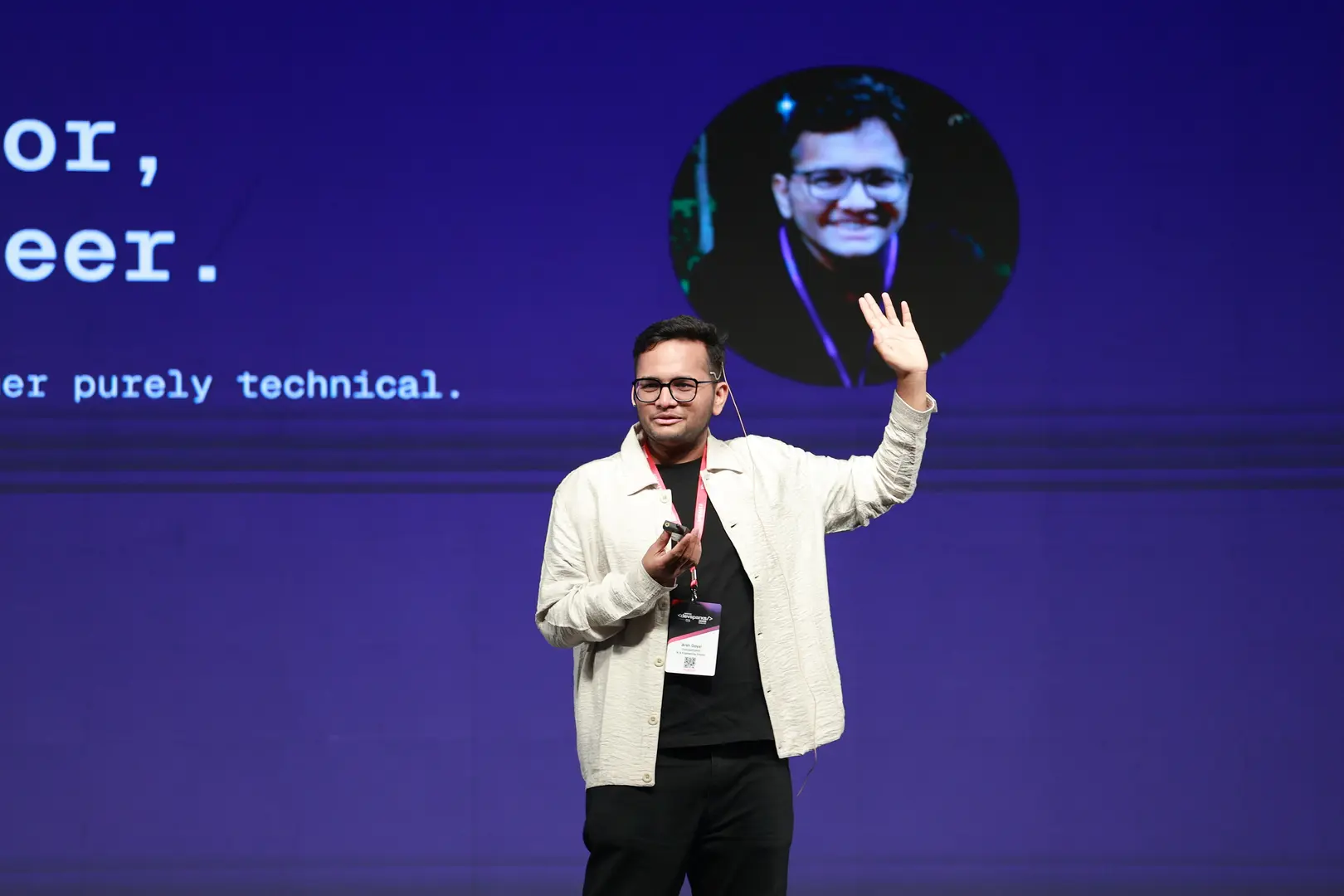

The era of engineers quietly working behind the scenes is fading fast. In today’s competitive technology landscape, visibility is as important as technical skill.
At DevSparks Bengaluru 2026, YourStory’s flagship tech summit, AI and engineering creator Arsh Goyal urged developers to rethink how they approach their careers. Opening the event, the ThoughtSpot creator spoke about why engineers need to adopt a creator mindset to stand out in an increasingly crowded market.
His message was straightforward: developers need to make themselves visible as AI makes coding more accessible and implementation becomes increasingly commoditized. Great work alone is no longer enough if nobody knows it exists.
The modern engineer doesn’t just code. They communicate, share ideas, and build in public, he suggested.
Becoming a creator: A personal journey
To explain his point, Goyal shared his own journey from being “just another engineer” to becoming a creator.
An electronics and communication engineering graduate from NIT Jalandhar, he followed a fairly conventional path early on, completing multiple internships before joining Samsung’s Memory Solutions team as a software engineer.
At the time, he wasn’t creating content or building an audience. That changed when he started sharing what he was learning and working on through LinkedIn posts.
“In the beginning, I got a few likes and not much else. But eventually, people started relating to what I was doing and opportunities opened up. One of the first was when a large company approached me and asked if I’d be interested in teaching their students. I taught competitive programming there for about a year, and suddenly an entirely new world opened up,” he said.
That visibility led to more opportunities. Goyal went on to deliver more than 100 sessions across IITs, NITs, and other leading engineering colleges, while also consulting companies on software engineering and AI.
“A creator is often the first person to spot and understand what’s happening in the market. Once you see that shift, you can build something of your own and start selling,” he said.
Goyal added that one of the biggest advantages of becoming a creator is gaining access to people, conversations, and experiences that would otherwise remain out of reach.
“I’ve had conversations with Nvidia CEO Jensen Huang, met the team behind Gemini at Google, and visited Microsoft’s Cambridge Research Lab to see the future of AI and infrastructure up close. My journey is proof that consistently building in public can quietly turn a standard developer career into one filled with opportunities,” he said.
Developing a creator mindset
In an AI-first world, where much of the implementation work is being automated or accelerated, Goyal believes developers need a creator mindset to remain differentiated.
Writing excellent code inside a repository is no longer enough, he argued. The real advantage comes from combining engineering expertise with communication and distribution.
“Communication becomes more important as your career progresses. Early on, most of your role is writing code with some communication. But as you grow, that balance flips,” he said. “Think about people with 10 or 15 years of experience. Very few spend their day just writing code. The job becomes more about explaining, aligning, and making decisions. And with AI, it’s increasingly about clearly directing what needs to be built rather than manually writing every line yourself.”
To encourage the audience, Goyal pointed out that most developers are already doing creator work without realising it. They write design documents, draft pull request descriptions, explain ideas on Slack, and conduct internal demos.
The problem, he said, is that much of this valuable work remains hidden within company walls.
Turning insight into action
Closing his session, Goyal focused on practical next steps.
He encouraged developers not to let their work stay invisible. Whether they build a project, solve a difficult problem, or learn a new technique, they should think of it as something worth sharing.
“I’m not asking everyone to become an influencer. That’s not the goal,” he said. “The goal is to become better at your job by communicating and sharing what you’re already building. Even if a small group of the right people sees your work, it can create opportunities you never expected.”
Edited by Teja Lele